

XML Sitemap SEO: What It Is, Why It Matters, and How to Use It Correctly
XML sitemap SEO is often treated as a minor technical detail, but it plays a more strategic role than many site owners assume. A sitemap will not make weak pages rank, and it will not replace strong internal linking or content quality. What it can do is help search engines discover, prioritize, and revisit the right URLs more efficiently.
That matters most on sites with a lot of pages, frequent updates, or structural complexity. If search engines spend too much time on low-value URLs or fail to find important pages quickly, visibility suffers. In those cases, a well-managed XML sitemap becomes part of the site’s technical clarity.
This article explains XML sitemap SEO in practical terms. It covers what an XML sitemap is, why it matters, how it works, what commonly goes wrong, and how to approach it in a way that supports broader technical SEO goals.
What Is XML Sitemap SEO?
XML sitemap SEO is the practice of using XML sitemaps to help search engines discover and understand the most important indexable URLs on your website.
An XML sitemap is a machine-readable file that lists URLs you want search engines to know about. In practical terms, it acts as a structured signal that says, “These are the pages that matter on this site.”
That does not mean search engines will index every page in the sitemap. It also does not mean a sitemap replaces crawling through normal internal links. Instead, the sitemap supports discovery and prioritization.
A good XML sitemap usually contains pages that are:
- live and accessible
- indexable
- canonical
- valuable enough to appear in search
That last point is where XML sitemap SEO becomes strategic. A sitemap should not be a dump of every URL your CMS can generate. It should reflect your preferred SEO inventory.
Why XML Sitemap SEO Matters
XML sitemap SEO matters because search engines do not discover every important page equally well. The larger or more complex a website becomes, the more useful clear discovery signals become.
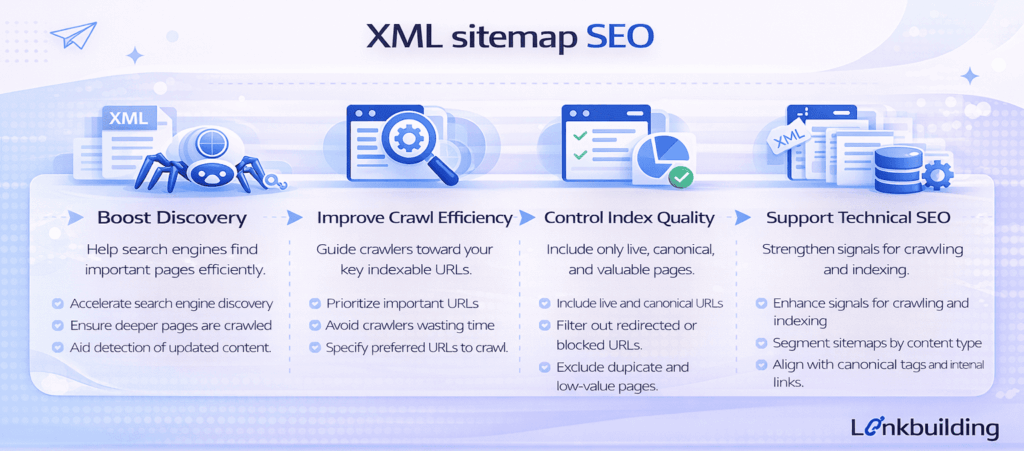
It supports faster discovery
When new pages are published or existing pages are updated, search engines may find them through internal links eventually. But an XML sitemap gives an additional path for discovery, especially on larger sites or websites with deep architecture.
It improves crawl efficiency
A sitemap helps guide search engines toward the URLs that matter most. This is particularly useful when a site also contains faceted navigation, filtered URLs, archives, tag pages, or other low-value sections that can consume crawl attention.
It reinforces index quality
A sitemap works best when it contains only pages that deserve to be indexed. That helps align your technical signals with your SEO strategy. If low-value, redirected, blocked, or duplicate pages appear in the sitemap, the signal becomes weaker.
It supports broader technical SEO
XML sitemap SEO connects naturally to other technical topics such as crawling and indexing, canonical tags, index bloat, internal linking, and crawl budget. It works best as part of a clean technical system, not as a fix for structural problems elsewhere.
How XML Sitemaps Work
Search engines use XML sitemaps as discovery and prioritization hints. They do not treat them as instructions that must be followed exactly.
Once a sitemap is submitted or detected, search engines can use it to:
- find URLs they may not have discovered yet
- revisit URLs that have changed
- compare listed URLs to their own crawl data
- assess whether the site is sending clear technical signals
A sitemap can include metadata such as last modification dates, but the core value lies in the URL list itself. The most important question is not whether the sitemap exists. It is whether the right URLs are in it.
That is the real substance of XML sitemap SEO.
Important Elements of XML Sitemap SEO
Indexable URLs only
A sitemap should contain pages that are eligible for indexing. If a URL is marked noindex, blocked, redirected, or canonicals to another page, it generally should not be included.
A common technical mistake is allowing the sitemap to list URLs that conflict with the site’s actual indexation logic.
Canonical pages only
If a page has duplicate or near-duplicate versions, the sitemap should include the canonical version rather than every variation. This helps reinforce URL preference and reduces ambiguity.
This is why XML sitemap SEO overlaps closely with canonicalization.
Valuable pages only
Not every page on a website deserves a place in the sitemap. Thin tag pages, internal search results, duplicate filters, and low-value utility pages usually weaken the signal rather than improve it.
A sitemap is strongest when it reflects the pages you would actually want search engines to rank.
Accurate updates
Some sitemap systems update automatically. Others rely on plugins or manual generation. Either way, the sitemap should remain current. Outdated URLs, broken URLs, and stale redirect targets reduce trust in the file.
Logical sitemap segmentation
Large websites often benefit from splitting sitemaps by type, such as product pages, category pages, blog posts, or location pages. This makes sitemap management easier and helps diagnose technical SEO problems more efficiently.
Common XML Sitemap SEO Mistakes
Including non-indexable pages
One of the most common issues is listing URLs that should not be indexed at all. This includes redirected URLs, canonicalized duplicates, noindex pages, or pages blocked from search.
That creates a mismatch between what the sitemap says and what the site actually wants search engines to do.
Treating the sitemap as a substitute for internal linking
A sitemap helps with discovery, but it does not replace site architecture. Important pages still need strong internal links and clear contextual pathways.
If a page is only reachable through a sitemap, the site structure may be too weak.
Dumping every URL into the sitemap
Some CMS setups generate bloated sitemaps that include pagination, media attachments, tags, author archives, and other low-priority URLs. That is not good XML sitemap SEO. It is just technical clutter.
Failing to keep the sitemap clean
Broken pages, outdated URLs, and redirected entries often remain in sitemaps long after a site changes. Over time, that reduces the usefulness of the sitemap as a technical signal.
Ignoring canonical conflicts
If the sitemap lists one version of a page but on-page canonicals point elsewhere, search engines receive mixed signals. Those inconsistencies should be resolved.
Practical Guidance for Using XML Sitemaps Correctly
The most effective approach to XML sitemap SEO is selective rather than exhaustive.
Start by identifying which page types truly matter for organic search. These may include:
- core service pages
- product pages
- category pages
- strategic blog content
- priority location pages
Then make sure your sitemap includes only those URLs that are live, canonical, and indexable.
It is also useful to review sitemap quality against other technical SEO systems. Ask practical questions such as:
- Are these pages internally linked well?
- Are any sitemap URLs redirected or non-canonical?
- Are low-value pages being included by mistake?
- Do sitemap entries match the actual SEO priorities of the site?
For websites building topical authority, sitemap quality should support content clusters rather than dilute them. If you publish strategic supporting content around technical SEO, crawling and indexing, canonical tags, or internal linking, those pages should be included cleanly and consistently when they are intended to rank.
When XML Sitemap SEO Matters Most
Not every site depends on sitemaps equally.
A small site with strong architecture and limited page count may see only modest benefits from sitemap refinement. The sitemap still matters, but it is less likely to be a major performance lever.
XML sitemap SEO becomes more important when a site has:
- many pages
- regular content publishing
- ecommerce or faceted navigation
- large archives
- multiple page templates
- weak discovery paths
- recent migrations or structural changes
In those situations, sitemap quality often plays a more visible role in how efficiently search engines process the site.
Timing and Expectations
XML sitemap improvements can help search engines discover and reassess URLs faster, but they do not create ranking gains on their own.
If a sitemap is cleaned up and aligned with indexable, valuable pages, the benefits may appear through better discovery, cleaner crawling patterns, and stronger technical consistency. That can support better SEO performance over time, especially when paired with improvements in internal linking, canonicalization, and content quality.
But it is important to stay realistic. A sitemap is a supporting mechanism. It helps search engines find and understand the right inventory. It does not compensate for weak pages or poor site architecture.
Conclusion
XML sitemap SEO matters because it helps search engines focus on the URLs that actually deserve attention.
A good XML sitemap does not try to include everything. It reflects your preferred, indexable, canonical pages and supports the broader technical structure of the site. When handled well, it improves discovery, reduces mixed signals, and strengthens the clarity of your technical SEO setup.
For websites serious about sustainable organic growth, XML sitemaps should be treated as a strategic housekeeping tool rather than a box to tick. They work best when they align with how the site is structured, which pages are meant to rank, and how search engines are expected to crawl and index the website.