

Why Technical SEO Matters for Sustainable Organic Growth
Technical SEO rarely gets the same attention as content strategy, keyword research, or link building. That is understandable. It sits behind the scenes, and when it works well, it often goes unnoticed. But from an SEO perspective, that foundation matters more than many businesses realize.
The reason is simple: search engines cannot rank pages effectively if they struggle to access, interpret, or trust the site those pages live on. A website may publish strong content and target the right search terms, yet still underperform because technical issues create friction at key points in crawling, indexing, and site structure.
That is why technical SEO matters. It helps search engines discover the right pages, understand how those pages relate to each other, and process the site more efficiently. For websites trying to build long-term topical authority, technical SEO is not a secondary task. It is part of the infrastructure that allows the rest of SEO to work properly.
This article explains why technical SEO is important, where its impact comes from, what often goes wrong, and how to approach it realistically.
What Is Technical SEO?
Technical SEO is the process of improving the technical foundation of a website so search engines can crawl it, understand it, and index the right pages efficiently.
It includes areas such as site architecture, internal linking, crawlability, indexability, page speed, mobile usability, structured data, canonicalization, redirects, and XML sitemaps.
In practical terms, content tells search engines what a page is about. Technical SEO helps search engines reach that page, process it correctly, and understand its role within the wider site.
That distinction matters. A page can be relevant and well written, but if the site sends mixed technical signals, rankings become harder to earn and harder to sustain.
Why Technical SEO Matters
The core reason technical SEO matters is that it reduces friction between your website and search engines. The fewer unnecessary obstacles a site creates, the easier it becomes for strong content to perform.
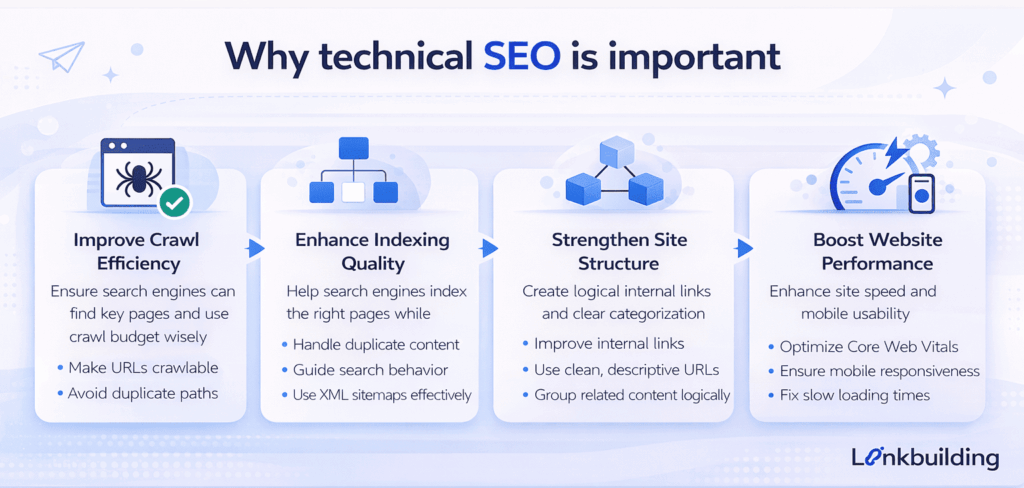
It helps search engines crawl efficiently
Search engines do not interact with websites in a casual way. They crawl URLs, follow links, interpret directives, and allocate resources across the site. If too much of that effort is wasted on low-value pages, broken URLs, duplicate paths, or weak internal structure, important pages may be discovered more slowly or revisited less often.
Technical SEO improves crawl efficiency by making the site easier to navigate programmatically. That becomes more important as a website grows.
It improves indexing quality
Indexing is not just about getting pages into search engines. It is about helping search engines index the right pages.
Many websites allow thin, duplicate, or low-priority pages into the index while stronger pages remain under-supported. That creates noise. Technical SEO helps clarify which URLs deserve attention and which should stay out of the index.
This is one of the clearest answers to the question of why technical SEO matters. Better indexing quality usually creates a stronger foundation for rankings than simply increasing the number of indexed pages.
It strengthens site architecture
Search engines evaluate pages individually, but they also interpret how pages relate to one another. Technical SEO supports clear hierarchies, logical URL structures, and internal linking patterns that show which pages are most important.
For websites using a topical cluster model, this becomes especially valuable. A broader page on technical SEO should be supported by focused articles on areas such as XML sitemaps, canonical tags, crawl budget, structured data, or Core Web Vitals. Technical SEO helps make that structure clear and usable.
It supports better user experience
Technical SEO is not only about bots. It overlaps with real user experience in areas such as site speed, mobile usability, stability, and clean navigation.
A technically sound site tends to be easier to use. That does not guarantee better rankings on its own, but it removes avoidable friction that can weaken both search performance and conversions.
It protects growth over time
Small websites can sometimes perform reasonably well despite messy technical setups. Larger sites usually cannot. As content expands, templates multiply, and CMS rules become more complex, technical issues scale with them.
That is why technical SEO matters even more on growing sites. It prevents small technical weaknesses from turning into structural SEO problems later.
How Technical SEO Supports SEO Performance
Technical SEO supports organic performance by improving the conditions under which search engines assess a site.
Discovery and crawling
Before a page can rank, it has to be found and crawled. Technical SEO helps ensure important URLs are reachable through internal links, supported by XML sitemaps where appropriate, and not hidden behind broken architecture or unnecessary crawl traps.
Understanding and interpretation
Search engines need to understand what a page is, how it fits into the site, and whether it is the preferred version of that content. Canonical tags, structured data, internal linking, and clean HTML all contribute to that understanding.
Index control
Not every page deserves to rank. Technical SEO supports better control over indexation by reducing duplication, managing low-value pages, and reinforcing preferred URLs.
Performance and reliability
A site that loads slowly, shifts visually, or breaks on mobile sends weak quality signals. Technical SEO helps reduce those issues by improving how the site is built and delivered.
Important Areas Within Technical SEO
Technical SEO is broad, but a few subtopics usually have the biggest strategic impact.
Crawlability and indexability
These are often mentioned together, but they are not the same. A page can be crawlable without being indexable, and it can be technically indexable while still being difficult to discover.
Strong technical SEO asks clear questions:
- Can search engines access this page?
- Should this page be indexed?
- Is this the version we want them to rank?
That discipline prevents a lot of wasted effort.
Internal linking and site structure
Internal links help search engines discover pages, understand context, and interpret site hierarchy. Poor internal linking weakens important pages, especially on content-heavy sites.
This is where a related article on internal linking or site architecture can support the broader cluster naturally.
Canonicalization and duplicate control
Duplicate or near-duplicate URLs are common, especially on larger websites. Canonical tags help reinforce preferred versions, but they work best when the overall URL structure is already clean.
A separate cluster article on canonical tags or duplicate content can go deeper here.
XML sitemaps
Sitemaps help search engines identify priority URLs, particularly on larger or frequently updated sites. They are helpful, but only when they reflect the right pages.
A bloated sitemap that includes redirects, blocked pages, or non-canonical URLs weakens the signal.
Page speed and mobile usability
Technical SEO also includes performance. Site speed, responsive design, and mobile stability all affect how usable a website feels and how efficiently it can be processed.
This naturally connects to supporting topics such as Core Web Vitals and mobile SEO.
Common Mistakes That Undermine Technical SEO
Many technical SEO problems are not dramatic. They are often quiet, cumulative issues that weaken the site over time.
Letting low-value pages enter the index
Filter pages, search result URLs, tag archives, and thin utility pages often end up indexed without a clear purpose. That dilutes site quality and creates unnecessary crawl waste.
Treating canonicals as a complete fix
Canonical tags help, but they do not solve deeper problems caused by messy architecture or uncontrolled URL generation.
Weak internal linking
Important pages often underperform because they are too deep in the site or receive too few contextual internal links from related content.
Ignoring technical SEO until traffic drops
Technical SEO is often treated reactively. By the time major issues become obvious in traffic, indexation, or crawling, the underlying problems may already be widespread.
Focusing on minor issues instead of meaningful ones
Not every warning in an audit deserves equal attention. Strategic technical SEO is about prioritizing what affects crawl efficiency, index quality, and site structure most.
Practical Guidance for a Better Technical SEO Approach
The best way to approach technical SEO is to connect it directly to business priorities and site structure.
Start with the pages that matter most. That usually means core commercial pages, high-value informational assets, and major category or service pages. Then assess whether those pages are easy to crawl, clearly linked, and technically aligned with how you want them to rank.
It also helps to work at the template level rather than page by page. If a category template creates duplicate title tags or poor canonicals, fixing one URL does not solve the problem. The pattern matters more than the single page.
For content-driven sites, technical SEO should also support topical depth. A page focused on why technical SEO matters should be able to link naturally to related articles on crawlability, XML sitemaps, structured data, and technical SEO audits without forcing those links awkwardly.
Timing and Expectations
Technical SEO improvements can affect results at different speeds.
Some fixes, such as correcting blocked pages, bad redirects, or broken canonical signals, may influence crawling and indexing relatively quickly after search engines revisit the site. Other improvements, such as architecture refinement or better internal linking, usually take longer to shape ranking performance.
It is also important to keep expectations grounded. Technical SEO does not replace content quality, authority, or search intent alignment. What it does is remove barriers. It helps the site perform closer to its real potential.
That is often the right way to frame why technical SEO matters. It does not create value out of nothing. It helps search engines access and evaluate the value that is already there.
Conclusion
Why technical SEO matters comes down to one principle: it makes a website easier for search engines to crawl, understand, and trust.
Without that foundation, even strong content can underperform. Important pages may be missed, indexation may become messy, internal relevance may weaken, and growth may become harder to sustain. With a strong technical setup, the site becomes clearer, more efficient, and better prepared to support broader SEO goals.
For any website serious about organic growth, technical SEO is not a side task. It is part of the structure that allows rankings, visibility, and topical authority to scale in a stable way.