
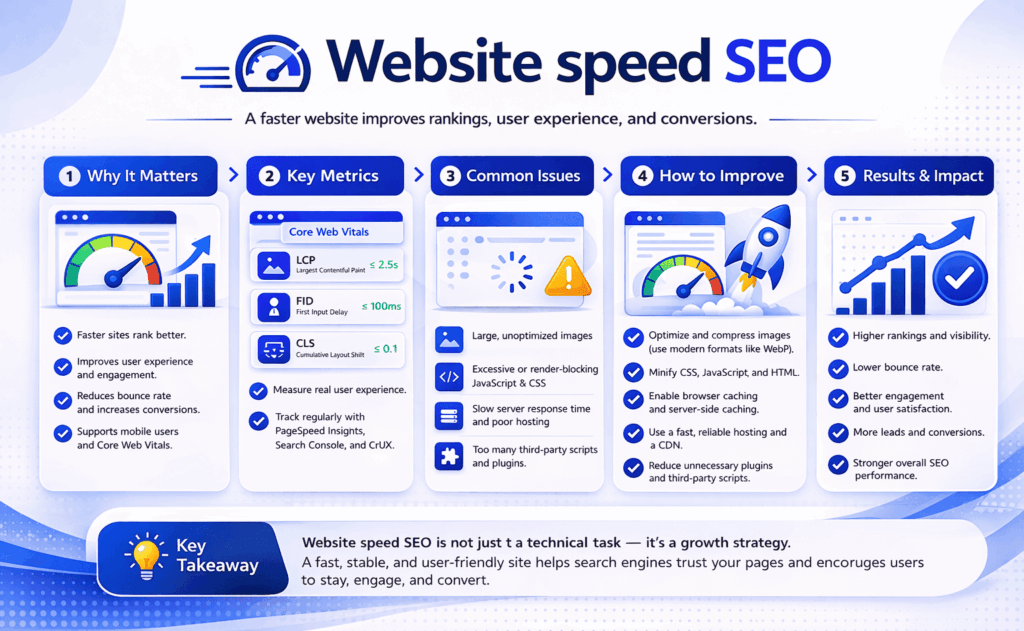

Website Speed SEO: Why Performance Still Matters for Search and User Experience
Website speed has been part of SEO conversations for years, but it is still often misunderstood. Some site owners treat it as a minor technical issue. Others treat it as a direct shortcut to better rankings. Neither view is especially useful.
The reality is more practical. Website speed SEO matters because performance affects how users experience a site and how efficiently search engines can assess it. A faster website is easier to use, often easier to crawl, and more likely to support the rest of your SEO work without unnecessary friction. At the same time, speed alone will not rescue weak content or poor search intent targeting.
That balance is important. If you are building topical authority through a cluster model, performance is not the headline strategy, but it is part of the infrastructure that helps strong pages compete. This article explains what website speed SEO means, why it matters, how it works, what commonly goes wrong, and how to improve it without turning the topic into a checklist of vanity metrics.
What Is Website Speed SEO?
Website speed SEO is the practice of improving site performance in ways that support organic visibility, usability, and technical efficiency.
In practical terms, it focuses on how quickly a page loads, how stable it feels while loading, and how responsive it is when users interact with it. These performance signals influence user satisfaction first, but they also shape how search engines evaluate the quality of the page experience.
Website speed SEO is closely connected to areas such as:
- Core Web Vitals
- page load performance
- mobile usability
- server response time
- image optimization
- script management
- caching
- rendering efficiency
It helps to frame the topic correctly. Website speed SEO is not about chasing a perfect score in every testing tool. It is about reducing avoidable delays and performance problems that damage usability and weaken the technical quality of the site.
Why Website Speed SEO Matters
Website speed SEO matters because performance influences both user behavior and the technical environment in which SEO operates.
It supports a better user experience
A slow site creates friction immediately. Users may leave before the page finishes loading, abandon navigation flows, or lose trust when layouts shift and interactions lag. Even when content is strong, poor performance can make the page feel lower quality than it really is.
From an SEO perspective, that matters because search engines increasingly evaluate whether a page delivers a usable experience, not just whether it targets the right topic.
It strengthens page experience signals
Website speed is not the only page experience factor, but it is a meaningful one. Search engines want pages that load reliably, remain visually stable, and respond quickly enough to be usable on real devices and networks.
That is why website speed SEO overlaps with Core Web Vitals. It is part of a broader performance picture rather than a stand-alone metric.
It helps mobile SEO
Performance problems are often more severe on mobile devices. Pages that feel acceptable on desktop can be frustrating on slower mobile connections or lower-powered devices.
If your site performs poorly on mobile, that can weaken both usability and how search engines interpret the page experience.
It protects the value of strong content
A page can be well written, well structured, and aligned with search intent, but still underperform if the experience around that content is too slow or unstable. Performance does not replace content quality, but it helps prevent technical friction from undermining it.
How Website Speed SEO Works
Website speed SEO works by reducing the technical issues that slow down delivery, rendering, and interaction.
At a high level, performance is shaped by a few core systems: the server, the page assets, the browser rendering process, and the device the user is on. SEO benefits when those systems work together efficiently.
Server response and delivery
Every page request starts with the server. If the initial response is slow, the rest of the experience is delayed before the browser even begins rendering the page.
This is why hosting quality, caching setup, and backend efficiency matter more than many site owners expect.
Asset loading
Once the page begins loading, the browser has to request and process resources such as images, CSS, JavaScript, fonts, and third-party scripts. Heavy assets and too many requests often create unnecessary delay.
Website speed SEO improves when pages use lighter resources and load only what is needed.
Rendering and layout stability
A page may technically load while still feeling slow because the visible content appears late, shifts unexpectedly, or becomes interactive too slowly. Performance is not just about total load time. It is also about how the experience feels during the loading sequence.
Mobile performance
Mobile devices often highlight weaknesses that are less visible on desktop. Large scripts, oversized images, and poor rendering decisions can become much more damaging on mobile.
Important Subtopics Within Website Speed SEO
Core Web Vitals
Core Web Vitals are one of the clearest ways to understand website speed SEO. They focus on three areas:
- loading performance
- interactivity
- visual stability
They matter because they reflect how a page behaves in real use, not just how it performs in lab conditions. A related article on Core Web Vitals can go deeper into each metric, but within this topic, the key point is that they help translate performance into user experience.
Image optimization
Images are one of the most common causes of slow pages. Files are often too large, poorly compressed, or loaded in ways that delay rendering.
Practical improvements include using appropriate dimensions, modern formats, compression, and lazy loading where suitable.
JavaScript and script bloat
Heavy JavaScript can slow down rendering and interactivity. This is especially common on sites that rely on too many plugins, trackers, or front-end effects.
Script control is often one of the highest-impact areas in website speed SEO because it affects both load time and responsiveness.
Caching and delivery optimization
Caching reduces repeated work by helping browsers and servers serve resources more efficiently. Content delivery networks can also improve speed by reducing the distance between the user and the assets being delivered.
Mobile-first performance
Because search engines primarily evaluate the mobile experience, mobile performance deserves special attention. A site should be tested on realistic mobile conditions, not only on powerful desktop connections.
Common Mistakes
Chasing scores instead of solving user problems
A common mistake is treating page speed tools as the goal. A score can be useful, but it is only a proxy. The real question is whether users experience delay, instability, or sluggish interaction.
Overloading pages with third-party scripts
Many websites become slow not because of their core content, but because of tracking tools, chat widgets, testing platforms, ad scripts, and other add-ons that accumulate over time.
Uploading oversized images
This remains one of the simplest and most common performance issues. Large image files often create avoidable delay across templates and content types.
Ignoring template-level problems
Website speed SEO is rarely solved page by page. If the site has bloated templates, inefficient theme code, or heavy reusable components, the issue usually affects entire page groups.
Focusing only on desktop
A site that looks fast on a strong desktop connection may still perform poorly where it matters most. Mobile conditions usually provide a more realistic view of the experience.
Practical Guidance for Improving Website Speed SEO
The best approach to website speed SEO is strategic rather than obsessive.
Start with your most important pages. Focus on the templates and page types that drive organic traffic, leads, or revenue. That might include service pages, category pages, product pages, and high-value informational content.
Then look for the biggest sources of friction:
- slow server response
- oversized images
- excessive JavaScript
- render-blocking resources
- layout shifts
- unnecessary third-party tools
In most cases, the highest-impact work comes from simplifying what the page loads and improving how quickly the main content becomes usable.
It also helps to align website speed work with the rest of your technical SEO. This topic connects naturally to related cluster pages on Core Web Vitals, technical SEO, mobile usability, crawling and indexing, and JavaScript SEO. A fast page is valuable on its own, but it becomes more valuable when the whole technical system is working cleanly.
Timing and Expectations
Website speed SEO improvements can affect results on different timelines.
Some changes, such as image compression or caching improvements, may produce immediate performance gains. Others, such as template refactoring or script cleanup, may take more time to implement but create stronger long-term benefits.
It is also important to set realistic expectations. Speed improvements can support rankings, engagement, and conversions, but they rarely act as a single dramatic ranking lever on their own. Their value often comes from removing friction and making the site more competitive overall.
That is a more useful way to think about website speed SEO. It helps strong pages perform closer to their potential.
Conclusion
Website speed SEO matters because performance shapes how users experience your content and how technically strong your site appears to search engines.
It is not a substitute for relevance, authority, or content quality. But it does support all three by reducing avoidable delays, improving usability, and strengthening the page experience. On sites that rely on structured content clusters and long-term organic growth, that support becomes especially important.
The goal is not to chase perfect tool scores or treat speed as an isolated project. The goal is to build a faster, more stable website that helps users reach the content they need without friction. When that happens, your SEO foundation becomes stronger, and the rest of your content strategy has a better chance to work.