
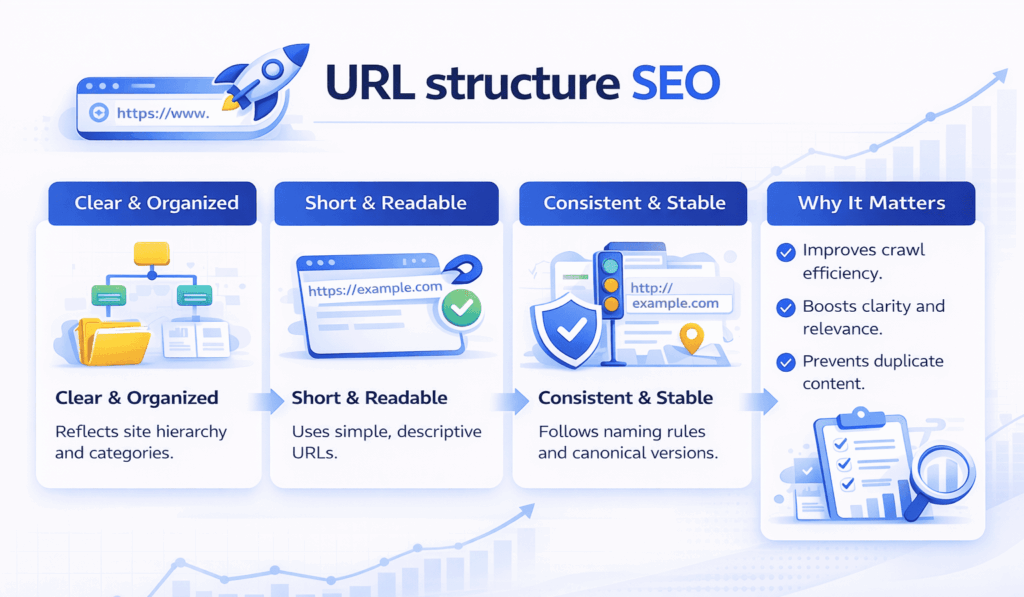

URL Structure SEO: How Clean, Logical URLs Support Search Visibility
URL structure is rarely the first thing people think about when improving SEO. Most teams focus on content, links, or keyword targeting before they look at how their URLs are built. That is understandable, but it also means many sites carry avoidable structural problems for years.
A weak URL setup usually does not destroy rankings on its own. Search engines are far more capable than they used to be. But URL structure still matters because it supports crawl efficiency, site architecture, user clarity, and long-term technical consistency. On larger sites especially, messy URLs often become a symptom of broader SEO issues: duplication, poor hierarchy, weak canonicalization, and difficult maintenance.
That is why URL structure SEO deserves practical attention. The goal is not to stuff keywords into every slug or chase cosmetic perfection. The goal is to create URLs that are clean, readable, stable, and aligned with the site’s architecture.
This article explains what URL structure SEO is, why it matters, how it works, what often goes wrong, and how to approach it strategically.
What Is URL Structure SEO?
URL structure SEO is the practice of organizing website URLs in a way that supports search engines, users, and site management.
A URL is more than a page address. It is part of how a website communicates structure. A good URL helps indicate where a page sits within the site, what type of content it represents, and how it relates to broader topics.
In practical terms, strong URL structure SEO usually means URLs are:
- clear and readable
- logically organized
- consistent across the site
- free from unnecessary clutter
- stable over time
- aligned with canonical page versions
A URL does not need to include every target keyword to be useful. In fact, overly optimized URLs often create more problems than value. The most effective URL structures tend to be simple, predictable, and easy to maintain.
Why URL Structure SEO Matters
URL structure SEO matters because URLs influence how websites are crawled, understood, and maintained over time.
It supports crawl and site clarity
Search engines use many signals to understand site organization, and URLs are one of them. Clean, structured paths make it easier to interpret page relationships, especially when supported by strong internal linking and clear hierarchy.
For example, a URL path that reflects category structure can reinforce how sections of the site connect, which becomes more useful on large editorial, ecommerce, or service-based sites.
It improves user readability
Users notice URLs more than many site owners assume. They appear in browsers, search results, copied links, and navigation paths. A readable URL can improve trust and make the destination clearer before someone clicks.
This is not a major ranking factor on its own, but it contributes to clarity and professionalism.
It reduces technical ambiguity
Messy URLs often create duplication problems. Parameters, inconsistent trailing slash behavior, mixed uppercase usage, and multiple URL versions for the same content can all weaken technical signals.
A clean URL structure helps reduce the chance of duplicate content issues and makes canonicalization easier to manage.
It supports long-term scalability
Small sites can survive inconsistent URLs for a while. Large sites usually cannot. As templates multiply, categories grow, and content clusters expand, poor URL structure becomes harder to fix. Good URL structure SEO helps prevent avoidable technical debt.
How URL Structure SEO Works
URL structure SEO works by aligning the page address with the logical organization of the site.
Search engines do not rank a page just because the URL looks good. But URLs help support interpretation, crawling, and consistency across the site. They are one of several structural signals that work best when aligned with the rest of the technical setup.
Hierarchy and path structure
A URL can reflect hierarchy through folders or path segments. For example, a content hub and its supporting pages might sit in a shared directory structure that reinforces topical relationships.
This becomes especially useful in a pillar-and-cluster model. Supporting content can sit within a logical parent path without forcing awkward exact-match slugs everywhere.
Canonical consistency
URL structure also affects which version of a page search engines treat as primary. If multiple URL versions exist due to tracking parameters, pagination quirks, uppercase variants, or slash inconsistencies, technical clarity weakens.
Strong URL structure SEO reduces those variations at the source.
Maintenance and internal linking
URLs influence how teams manage redirects, update internal links, and scale site sections. The cleaner the system, the easier it is to maintain without introducing errors.
Important Elements of URL Structure SEO
Readability
A good URL should be easy to read and interpret quickly. That usually means short, descriptive slugs without unnecessary codes, dates, or filler words.
Readable does not mean overly optimized. A page about XML sitemap SEO does not need a long slug packed with modifiers. It only needs enough clarity to describe the page naturally.
Consistency
Consistency matters more than cleverness. The site should use the same conventions for lowercase formatting, separators, folder usage, trailing slash behavior, and content grouping.
Inconsistent URL rules often create technical issues later.
Simplicity
Shorter URLs are usually easier to manage, easier to share, and easier to interpret. That does not mean every URL must be extremely short, but complexity should have a reason.
Long URLs often signal poor architecture or CMS-generated clutter.
Topic alignment
A URL should usually reflect the topic or role of the page. That helps reinforce the page’s purpose without overloading the slug with keywords.
This is especially useful for cluster pages, where the URL should support the overall content structure while remaining distinct from related pages.
Stability
A good URL should not need to change often. Frequent URL changes create redirect chains, internal link cleanup, and possible equity loss. Stability is one of the most underrated parts of URL structure SEO.
Common URL Structure SEO Mistakes
Using URLs that are too long
Long URLs often come from unnecessary folder depth, repeated keywords, dates, or CMS-generated parameters. They are harder to manage and rarely add SEO value.
Stuffing keywords into the slug
A common mistake is trying to force every variation of a keyword into the URL. This usually makes the path look unnatural without improving rankings meaningfully.
Changing URLs without a clear reason
Some teams keep rewriting URLs in the hope of making them “more SEO-friendly.” Unless the current structure is genuinely problematic, unnecessary changes usually create more risk than value.
Allowing duplicate URL versions
The same page may appear with and without trailing slashes, with uppercase letters, through multiple query strings, or under alternate paths. That weakens clarity and often creates canonical headaches.
Building structure around internal teams instead of users
Some URL structures reflect company departments, CMS quirks, or internal naming logic rather than how the site should be understood externally. That usually leads to awkward paths and poor long-term clarity.
Practical Guidance for Better URL Structure SEO
The best way to approach URL structure SEO is to think structurally, not cosmetically.
Start by asking whether the current URLs support the actual architecture of the site. Do they help reinforce category logic, content grouping, and page type consistency? Or are they simply inherited from old systems?
For most websites, good URL structure follows a few practical rules:
- keep slugs descriptive but concise
- use lowercase consistently
- separate words clearly, usually with hyphens
- avoid unnecessary dates, IDs, or filler terms
- reflect hierarchy only where it adds clarity
- keep canonical versions stable
It is also important to think beyond individual pages. URL structure should work across templates and content types. If blog content, category pages, and service pages all follow different logic without a clear reason, the site becomes harder to maintain.
For cluster-based content, URLs should support topical organization naturally. A page on URL structure SEO can logically sit near supporting content on canonical tags, internal linking, XML sitemaps, crawling and indexing, and technical SEO audits. The structure should help reinforce those relationships rather than obscure them.
When to Change URLs and When Not To
Not every imperfect URL needs to be changed.
If a page already performs well, has backlinks, and sits within a mostly functional structure, changing the URL may not be worth the risk. Redirects can preserve value, but they still introduce complexity and possible disruption.
URL changes make more sense when:
- the current structure creates duplication
- the URL is clearly broken or unreadable
- the site is being restructured strategically
- a migration is already happening
- the existing path conflicts with future scalability
In other cases, improving internal linking, canonical signals, and page quality may be more valuable than rewriting URLs.
Timing and Expectations
URL structure SEO improvements usually influence performance gradually rather than instantly.
On a new site or during a migration, good URL structure can prevent technical issues before they happen. On an existing site, improvements may help support better crawling, cleaner canonicalization, and stronger site clarity over time.
But it is important to stay realistic. A cleaner URL will not outrank a better page on its own. URL structure supports SEO best when it works alongside strong content, good internal linking, and a technically sound site.
Conclusion
URL structure SEO matters because URLs are part of how a website communicates order, clarity, and consistency.
They help reinforce hierarchy, reduce technical ambiguity, and support user trust when they are clean and readable. They also become more important as a site grows, because weak URL systems tend to create duplication, maintenance problems, and structural confusion.
The strategic takeaway is simple: treat URLs as infrastructure, not decoration. A strong URL structure will not carry your SEO strategy by itself, but it will make the rest of your technical and content work easier to scale, easier to maintain, and easier for search engines to understand.