
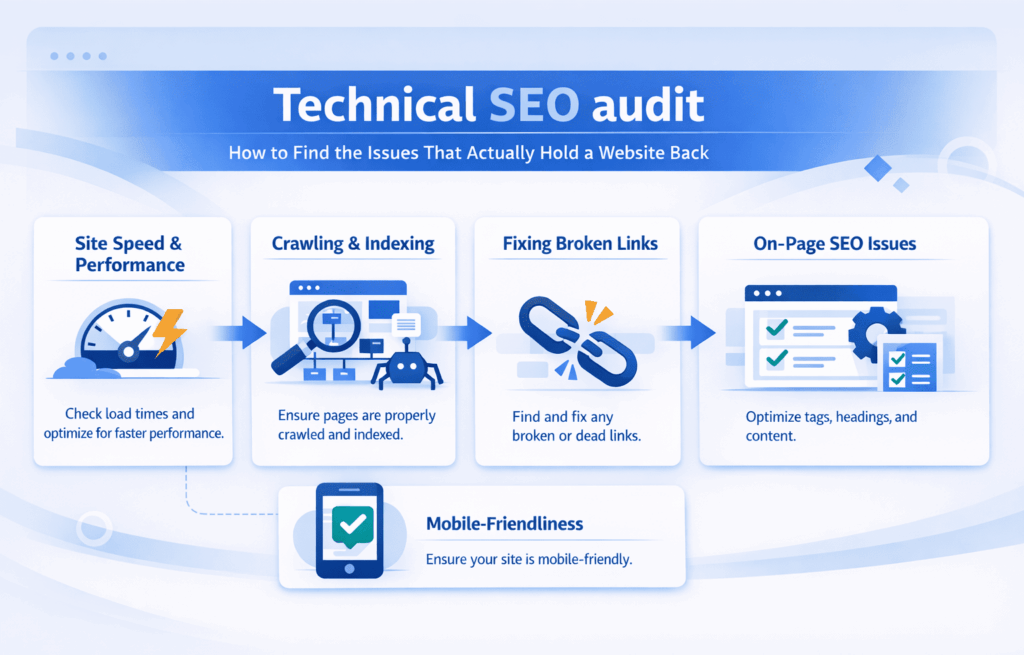

Technical SEO Audit: How to Find the Issues That Actually Hold a Website Back
A technical SEO audit is often treated like a checklist exercise: crawl the site, export the errors, fix what looks broken, and move on. In practice, a good audit is more strategic than that. It is not just about spotting problems. It is about understanding which technical issues are actually limiting search visibility, crawling efficiency, index quality, and overall site performance.
That distinction matters because many websites have technical warnings that do not meaningfully affect organic growth, while a smaller set of deeper issues quietly suppresses performance for months. A useful audit helps separate noise from real constraints.
This is why a technical SEO audit matters for any website serious about sustainable organic traffic. It gives structure to technical diagnosis, helps prioritize fixes, and creates a clearer link between technical health and SEO outcomes.
This article explains what a technical SEO audit is, why it matters, how it works, which areas it should cover, what people often get wrong, and how to approach it realistically.
What Is a Technical SEO Audit?
A technical SEO audit is a structured review of a website’s technical setup to identify issues that affect how search engines crawl, interpret, index, and evaluate the site.
In practical terms, it answers a simple question: is the website technically helping SEO, or getting in the way of it?
A proper technical SEO audit usually examines areas such as:
- crawling and indexation
- site architecture
- internal linking
- canonicalization
- XML sitemaps
- robots directives
- URL structure
- page speed and Core Web Vitals
- mobile usability
- redirects and status codes
- structured data
- duplicate content risks
That does not mean every audit should be equally broad. A small brochure website and a large ecommerce platform need different levels of technical scrutiny. But the purpose remains the same: identify the technical conditions that influence organic performance and prioritize the ones that matter most.
Why a Technical SEO Audit Matters
A technical SEO audit matters because SEO performance depends on more than content quality and backlinks. A site can have good content and still underperform if search engines are spending time on the wrong pages, selecting the wrong canonical versions, crawling inefficiently, or struggling with weak internal structure.
It reveals hidden blockers
Some technical SEO problems are obvious. Others are not. A site may look normal to users while still leaking value through crawl traps, duplicate URLs, orphaned pages, bad canonicals, or weak indexation control.
A technical SEO audit helps uncover those issues before they continue to compound.
It improves prioritization
Not all technical issues deserve the same urgency. An audit should not just identify problems. It should show which problems affect search visibility, crawl behavior, and business-critical pages first.
That makes the audit useful operationally, not just diagnostically.
It supports scaling and change
As sites grow, add templates, migrate platforms, expand content clusters, or change CMS behavior, technical complexity increases. Audits help maintain control and prevent SEO debt from accumulating quietly.
It connects technical work to business outcomes
A good technical SEO audit should tie findings back to real implications: important pages not indexed, commercial templates loading too slowly, internal links failing to support high-value URLs, or index bloat weakening the overall site.
How a Technical SEO Audit Works
A technical SEO audit works by comparing how the website is supposed to function with how search engines are likely experiencing it in reality.
That means looking at both systems and signals. The audit should examine how pages are linked, crawled, rendered, indexed, and prioritized, and then assess whether those behaviors align with SEO goals.
Start with crawl and index reality
A website can expose far more URLs than it intends to rank. The first task in a technical SEO audit is usually understanding which URLs exist, which ones are crawlable, which ones are indexable, and which ones actually deserve visibility.
This is where crawling and indexing analysis becomes central.
Review the structure of important page types
Audits are more useful when they focus on templates and patterns, not just isolated pages. A problem on one product page may affect thousands. A canonical issue on one category page may be systemic.
That is why template-level diagnosis is often more valuable than line-by-line inspection of individual URLs.
Compare technical signals across systems
Search engines read more than one signal at a time. Canonicals, sitemaps, internal links, redirects, noindex directives, and robots rules should work together. A technical SEO audit checks for contradictions across those systems.
Prioritize by impact
A long issue log is not the same as a useful audit. The audit should distinguish between minor cleanup tasks and problems that actually affect crawling, index quality, page experience, or priority pages.
Core Areas a Technical SEO Audit Should Cover
Crawling and indexation
This is usually the foundation of the audit. Search engines need to find the right pages, access them efficiently, and decide to index the correct versions.
The audit should examine:
- whether important pages are crawlable
- whether low-value pages are consuming crawl attention
- whether the right URLs are indexable
- whether any important pages are missing from the index
- whether there is evidence of index bloat
This connects naturally to related cluster topics such as crawling and indexing, robots.txt SEO, and XML sitemap SEO.
Site architecture and internal linking
A technical SEO audit should assess whether the website’s structure supports discovery, authority flow, and topical clarity.
This includes:
- page depth
- orphan pages
- internal link distribution
- navigation logic
- contextual linking between related content
For websites using a cluster model, architecture and internal linking are especially important because they help search engines understand the relationship between supporting and broader topic pages.
Canonicalization and duplicate control
Audits should identify where duplicate or near-duplicate URLs exist and whether canonical tags are reinforcing the correct version.
This is also where URL parameters, filtered paths, alternate category routes, and inconsistent linking patterns often appear.
A separate cluster page on canonical tags or duplicate content can go deeper, but the audit should still assess whether those systems are working coherently.
URL structure and redirects
URL logic affects maintainability and technical clarity. Redirect behavior affects both users and crawlers.
A technical SEO audit should review:
- inconsistent or bloated URL patterns
- redirect chains
- redirect loops
- outdated redirected URLs in sitemaps or internal links
- protocol and hostname consistency
Performance and Core Web Vitals
Technical SEO audits should evaluate performance where it affects real user experience and page quality, especially on mobile.
This includes:
- slow-loading templates
- heavy JavaScript
- oversized images
- unstable layout behavior
- poor responsiveness
This area connects naturally to related articles on website speed SEO and Core Web Vitals.
Mobile usability and rendering
Because search engines primarily use the mobile version of content, audits should verify that the mobile experience is not weakening the site’s interpretation.
This includes checking:
- content parity
- mobile rendering issues
- navigation accessibility
- structured data consistency
- hidden or delayed critical content
Structured data
The audit should assess whether structured data is present where appropriate, valid, aligned with visible content, and maintained consistently across templates.
Structured data is not the core of every audit, but it can be important when it helps define page types and search eligibility more clearly.
Common Technical SEO Audit Mistakes
Treating every issue as equally important
A long export of warnings does not equal a useful audit. Some findings are minor. Others have meaningful impact. The job is to separate the two.
Auditing pages instead of systems
Many technical problems are template-driven. Looking at individual pages without identifying the shared source of the issue leads to shallow recommendations.
Focusing only on tools, not interpretation
Crawl tools and SEO platforms are useful, but they do not think strategically. A technical SEO audit requires interpretation, not just data collection.
Ignoring business-critical pages
An audit that spends too much time on edge-case pages while ignoring core service pages, category pages, or product templates is misaligned with SEO priorities.
Missing contradictions between signals
A page can be in the sitemap, blocked from indexing, canonically pointed elsewhere, and linked inconsistently. Looking at each element separately can miss the bigger problem.
Practical Guidance for Running a Better Technical SEO Audit
The best technical SEO audit starts with context. Before reviewing technical issues, define what the site is trying to achieve and which pages matter most.
Start with high-value templates
Look first at the templates and sections that drive the most commercial or strategic value. These are often product pages, category pages, service pages, and key informational hubs.
Work from patterns, not edge cases
When you find a technical issue, ask whether it reflects a broader system problem. One broken canonical may matter less than a category template that creates hundreds of them.
Prioritize by SEO impact and implementation effort
A practical audit should help teams act. That means organizing findings by likely impact, affected page types, and implementation complexity.
Align the audit with the broader content structure
For sites building topical authority, technical recommendations should support the content model. Internal linking, crawl efficiency, and URL clarity should help the cluster structure work better, not fight against it.
This page, for example, naturally sits near related resources on technical SEO, crawling and indexing, canonical tags, robots.txt SEO, XML sitemap SEO, structured data SEO, and URL structure SEO.
Timing and Expectations
A technical SEO audit can identify problems quickly, but the impact of fixing them depends on the issue and the site.
Some changes, such as correcting blocked pages, cleaning up canonicals, or fixing major redirect problems, may affect crawling and indexing relatively fast once search engines revisit the site. Other improvements, such as architecture refinement or internal linking cleanup, may take longer to influence rankings.
It is also important to stay realistic. A technical SEO audit does not create growth by itself. It identifies and removes barriers. That helps the site perform closer to its potential, but it does not replace content quality, search intent alignment, or authority.
Conclusion
A technical SEO audit is most valuable when it does more than list problems. It should explain which technical conditions are holding the site back, why they matter, and how to prioritize them intelligently.
That is what turns an audit into a useful SEO tool rather than a technical inventory. It helps clarify whether the website is easy to crawl, easy to understand, and structurally aligned with the pages that actually matter.
For websites aiming to grow through organic search and topical authority, that clarity is important. A strong technical foundation does not guarantee rankings, but it gives every important page a better chance to compete without unnecessary friction.