

Core Web Vitals: What They Measure and Why They Matter for SEO
Core Web Vitals are one of the most discussed parts of technical SEO because they sit at the intersection of performance, usability, and search visibility. They are not a shortcut to rankings, and they do not outweigh content quality, relevance, or authority. But they do help describe whether a page delivers a stable, responsive experience in real use.
That is why they matter. A website can publish strong content and still create unnecessary friction through slow loading, delayed interaction, or layouts that shift while the page is rendering. When that happens, the problem is not just technical. It affects how trustworthy and usable the page feels.
For websites building topical authority, that matters more than many teams assume. Strong content clusters work best when the technical experience supports them. This article explains what Core Web Vitals are, why they matter, how they work, what commonly goes wrong, and how to approach improvements in a practical way.
What Are Core Web Vitals?
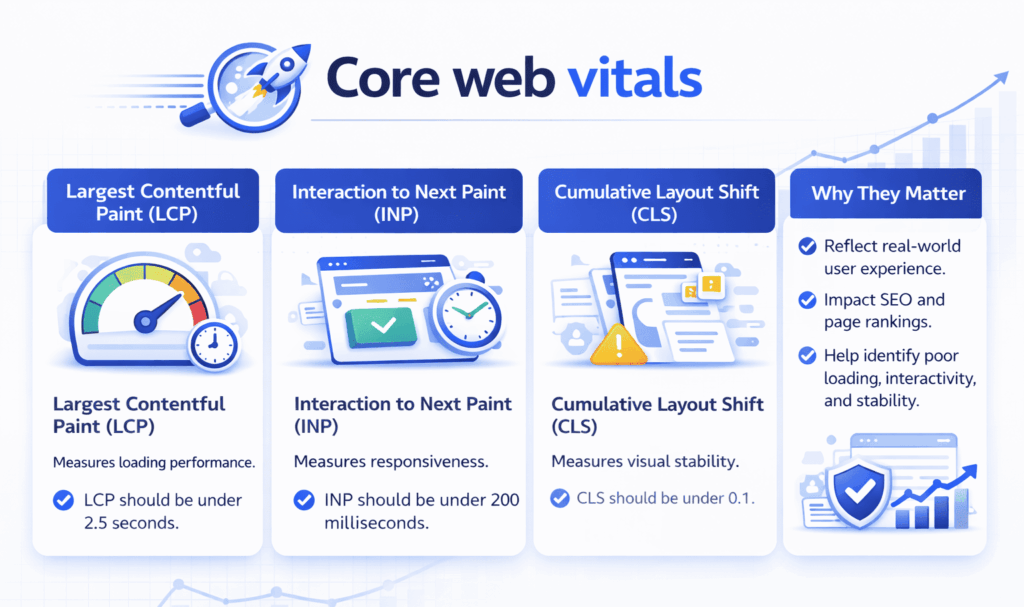
Core Web Vitals are a set of user experience metrics used to evaluate how a webpage performs in real-world conditions. They focus on three areas: loading speed, interactivity, and visual stability.
The three main metrics are:
- Largest Contentful Paint, or LCP
- Interaction to Next Paint, or INP
- Cumulative Layout Shift, or CLS
In practical terms, Core Web Vitals help answer three questions:
- How quickly does the main content appear?
- How responsive does the page feel when a user interacts with it?
- Does the layout remain stable while the page loads?
That is what makes them useful. They move the performance conversation away from vague claims about a site being “fast” and toward measurable user experience.
Why Core Web Vitals Matter
Core Web Vitals matter because they reflect how a page behaves for real users, especially on mobile devices and less-than-perfect connections.
They support page experience
A page that loads slowly, lags after clicks, or shifts while someone is trying to read it creates friction. That friction makes content harder to use, even when the content itself is strong.
Core Web Vitals help identify those experience problems in a structured way.
They contribute to technical SEO quality
Core Web Vitals are not the whole story in SEO, but they are part of the broader page experience picture. Search engines want pages that are usable, stable, and technically well built. A site with recurring performance problems creates weaker technical signals than a site that feels smooth and reliable.
They help performance discussions become more strategic
Without clear metrics, teams often chase generic speed improvements that do not solve the actual user problem. Core Web Vitals help prioritize the improvements that affect experience most directly.
They protect the value of good content
A technically weak page can dilute the impact of otherwise useful content. If users have to wait too long, struggle to interact, or accidentally tap the wrong element because the layout shifts, the page experience undermines the content experience.
How Core Web Vitals Work
Core Web Vitals work by measuring what users experience during real page visits rather than only relying on controlled lab tests.
Largest Contentful Paint
Largest Contentful Paint measures how long it takes for the main visible content element to appear. In many cases, that is a hero image, a large heading block, or a prominent content section near the top of the page.
LCP is useful because it reflects when the page starts to feel meaningfully loaded.
Interaction to Next Paint
Interaction to Next Paint measures responsiveness. It captures how quickly the page reacts after a user clicks, taps, or presses a key.
This matters because a page can look loaded but still feel slow if scripts, rendering, or main-thread work delay the response to interaction.
Cumulative Layout Shift
Cumulative Layout Shift measures visual stability. It captures how much elements move unexpectedly while the page is loading.
Users feel this when buttons jump, text shifts, or images load late and push content down the page. Even small shifts can make a page feel careless or difficult to use.
Why Each Metric Matters in Practice
LCP reflects perceived loading speed
Users rarely think in terms of total page weight or server timings. They care about when the main content becomes visible. A strong LCP usually means the page feels available sooner.
Poor LCP often comes from slow server response, oversized images, render-blocking resources, or heavy above-the-fold content.
INP reflects real usability
A page that loads visually but delays interaction feels broken. This is especially common on sites with heavy JavaScript, too many front-end effects, or complex third-party tools.
INP matters because responsiveness is part of trust. When people interact with a page, they expect feedback quickly.
CLS reflects polish and reliability
Unexpected movement creates frustration. It can also cause accidental taps and disrupt reading flow. CLS is often a design and implementation issue, not just a hosting issue.
Poor CLS commonly appears when images lack reserved dimensions, ads load unpredictably, or fonts and dynamic components shift the layout after rendering begins.
Common Problems That Hurt Core Web Vitals
Heavy image delivery
Large images are still one of the most common causes of weak LCP. When hero banners or featured visuals are oversized or poorly compressed, the page feels slow immediately.
Too much JavaScript
Excessive scripts can delay both loading and interaction. This often affects INP more than teams expect. Plugins, analytics tools, chat widgets, and front-end libraries can quietly slow a site down.
Slow server response
A slow server delays everything that follows. Even well-optimized front-end assets will underperform if the backend responds too slowly.
Layout instability from poor implementation
Missing image dimensions, intrusive banners, delayed embeds, and unstable font loading often contribute to CLS issues.
Treating every issue as isolated
Core Web Vitals problems are often template-level or system-level. Fixing one page rarely solves the problem if the same components affect hundreds of pages.
Common Mistakes
Chasing perfect scores instead of real improvements
A common mistake is treating Core Web Vitals as a competition for tool scores. Good performance matters, but the goal is better user experience, not a screenshot of a dashboard.
Optimizing for lab tests only
Lab tools are useful, but they do not always reflect real user conditions. Core Web Vitals are most valuable when grounded in real-world experience.
Ignoring mobile performance
Many sites look acceptable on desktop and struggle badly on mobile. Core Web Vitals should be approached with mobile conditions in mind, especially for content-heavy pages.
Focusing only on one metric
Teams often become obsessed with LCP because it feels the most visible. But a page can pass LCP and still feel frustrating if INP or CLS is weak.
Expecting rankings to change instantly
Core Web Vitals improvements can strengthen the page experience, but they do not operate as a simple ranking switch. Their value is cumulative and often works alongside broader technical and content improvements.
Practical Guidance for Improving Core Web Vitals
The best way to improve Core Web Vitals is to work from the page experience outward.
Start with your most important templates and high-value pages. These may include service pages, product pages, category pages, and strategic content hubs. Then identify what is actually slowing those pages down or making them unstable.
Improve LCP by simplifying above-the-fold delivery
Focus on what loads first. Compress and resize key images, reduce render-blocking resources, improve caching, and streamline server response where possible.
Improve INP by reducing main-thread work
Remove or delay non-essential scripts, simplify heavy interactions, and cut back on third-party tools that interfere with responsiveness.
Improve CLS by reserving layout space
Set image and media dimensions, stabilize dynamic modules, and make sure UI elements do not appear in ways that push other content around unexpectedly.
Work at the template level
If a page type has a weak performance pattern, the solution is usually in the shared template, component library, or asset loading strategy. This is where technical SEO and development workflows need to align.
How Core Web Vitals Fit Into a Broader SEO Strategy
Core Web Vitals should not be treated as an isolated optimization project. They fit into a wider technical framework that includes website speed SEO, mobile usability, JavaScript performance, crawling and indexing efficiency, and overall site quality.
They also connect naturally to cluster content. A page about Core Web Vitals can support related articles on website speed SEO, technical SEO, mobile SEO, JavaScript SEO, and image optimization. That keeps each page focused while still supporting broader topic authority.
Timing and Expectations
Core Web Vitals improvements can affect performance quickly on the user side, but the SEO impact is usually more gradual.
Some changes, such as image compression or layout stabilization, can improve the experience almost immediately. Others, such as major theme refactoring or JavaScript cleanup, take longer but create deeper benefits.
It is also important to stay realistic. Core Web Vitals can support SEO, but they do not replace relevance, authority, or content quality. Their biggest value often comes from removing friction and making strong pages more competitive.
Conclusion
Core Web Vitals matter because they measure whether a page feels fast, responsive, and stable in real use.
They are not the only part of technical SEO, and they are not a magic ranking lever. But they are one of the clearest ways to evaluate whether your website is delivering a usable experience. For websites building long-term topical authority, that matters. A strong site should not only publish useful content. It should also make that content easy to access, easy to interact with, and reliable while it loads.
That is the real strategic value of Core Web Vitals. They help turn performance from a vague technical concern into a practical measure of page quality.