
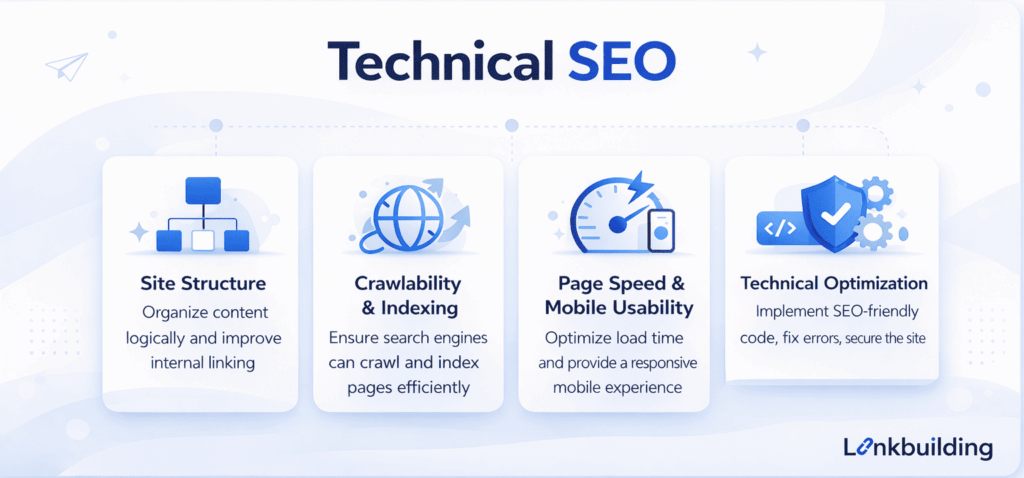

Technical SEO: Building a Search-Ready Website
Technical SEO is the part of search engine optimization that determines whether your website can be crawled, understood, and trusted efficiently by search engines. It is not the most visible side of SEO, but it often determines whether content, links, and broader optimization efforts can perform at all.
Many websites invest heavily in content production, keyword targeting, and link building, yet still struggle to grow because the technical foundation is weak. Pages are discovered slowly, duplicate URLs dilute relevance, internal links fail to distribute value properly, or important content sits behind crawl barriers that were never intended. In those cases, the issue is not the topic, the writing, or the keyword strategy. The issue is the website’s technical setup.
Technical SEO matters because search engines do not rank websites based on content quality alone. They also need to discover pages, crawl them efficiently, interpret their structure, understand which versions should be indexed, and evaluate how the site performs across devices. When those systems are misaligned, even strong content can underperform.
This article explains Technical SEO in practical, strategic terms. It covers what it is, why it matters, how it works, and how to approach it in a way that supports long-term organic growth.
What Is Technical SEO?
Technical SEO is the process of improving a website’s infrastructure so search engines can crawl it efficiently, understand its structure, index the right pages, and evaluate its performance correctly.
In practical terms, Technical SEO makes a website easier for search engines to access and interpret. It covers the behind-the-scenes systems and signals that influence how a site is discovered, rendered, organized, and trusted.
That usually includes areas such as:
- crawlability
- indexability
- site architecture
- URL structure
- internal linking
- canonicalization
- XML sitemaps
- page speed and performance
- mobile usability
- structured data
- duplicate content control
- redirect management
- HTTPS and security signals
A useful way to think about Technical SEO is this: content tells search engines what a page is about, but technical SEO helps search engines reach that page, understand its role, and decide how it fits into the rest of the site.
Without that foundation, SEO becomes less efficient and less predictable.
Why Technical SEO Matters
Technical SEO matters because search visibility depends on more than relevance alone. Search engines need to discover pages, crawl them efficiently, understand which versions matter, and interpret how those pages relate to each other.
A technically sound website creates fewer obstacles. That usually leads to better crawl efficiency, clearer indexing, stronger internal authority flow, and a more reliable user experience.
It improves crawl efficiency
Search engines do not crawl every website with unlimited attention. They allocate resources. On smaller sites, this is often less of a constraint, but on larger or more complex websites, crawl waste becomes expensive. If search engines spend time on duplicate parameters, broken pages, faceted URLs, or low-value archives, important pages may be discovered late or revisited less often.
A strong technical setup helps search engines focus on the URLs that actually matter.
It supports indexing quality
Not every crawlable page should be indexed. One of the most common Technical SEO problems is allowing search engines to access too many low-value or duplicative pages while failing to prioritize the pages that should rank.
Indexing quality matters just as much as indexing volume. A site with fewer, better-controlled indexed pages often performs better than a site that exposes everything.
It strengthens site architecture and topical authority
Search engines rely heavily on structure. When a website has clear hierarchies, logical internal linking, and well-grouped topics, it becomes easier to understand which pages are foundational and which pages provide supporting depth.
This matters especially for websites that are building topical authority across related subjects. When closely connected pages support one another naturally, the site sends stronger signals about expertise and subject depth.
It protects performance during growth
A website can look manageable at 20 pages and become chaotic at 2,000. Technical SEO becomes more important as sites scale, expand internationally, launch new templates, add filters, migrate platforms, or integrate third-party tools.
Strong technical governance prevents growth from creating invisible SEO debt.
How Technical SEO Works
Technical SEO works by aligning the website’s technical systems with the way search engines crawl and evaluate the web.
Search engines generally move through a sequence: discovery, crawling, rendering, understanding, indexing, and ranking. Technical SEO influences every stage.
Discovery
Search engines find URLs through internal links, XML sitemaps, backlinks, redirects, and historical crawl data. Pages that are poorly linked internally or buried deep in the site are often slower to discover.
This is one reason internal linking matters far beyond usability. It also helps search engines locate and prioritize content.
Crawling
Once a URL is discovered, search engines decide whether to crawl it. That decision is influenced by crawl demand, crawl health, response codes, server stability, robots directives, and the perceived value of the page.
Technical SEO improves crawling by removing waste and friction. That includes fixing broken links, consolidating duplicate URLs, cleaning redirect chains, and controlling index bloat.
Rendering and understanding
Modern search engines render many pages, especially those that rely on JavaScript. If important content, navigation, or links only appear after scripts execute poorly, search engines may not process them reliably.
This is where JavaScript SEO, page structure, and HTML clarity become important. A page should not require ideal rendering conditions to communicate its purpose.
Indexing
After a page is crawled and understood, search engines decide whether it belongs in the index. This is not automatic. Pages may be crawled but not indexed because they are too similar to other pages, too weak, too thin, or technically ambiguous.
Technical SEO helps by making index signals clearer. Canonical tags, noindex directives, pagination handling, and URL consolidation all contribute to better indexing decisions.
Ranking support
Technical SEO does not replace content quality or authority signals, but it supports them. When the right pages are indexed, fast enough, well-linked, mobile-friendly, and structurally clear, the content has a better chance to compete.
Core Components of Technical SEO
Crawlability and indexability
These are closely related, but they are not the same.
A page can be crawlable but blocked from indexing. It can also be indexable in theory but difficult to reach because internal linking is weak. Many SEO problems come from confusing those concepts.
A practical Technical SEO review should always ask:
- Can search engines access this page?
- Should this page be indexed?
- Is this the version we want to rank?
That line of thinking prevents a lot of wasted effort.
Site architecture
Site architecture is one of the most important parts of Technical SEO because it affects crawling, internal linking, user navigation, and topical clarity at the same time.
A strong structure usually has:
- a clear hierarchy from high-value pages to supporting pages
- shallow depth for important content
- consistent URL logic
- contextual internal links between closely related topics
- no orphan pages
For a site that wants sustainable organic growth, architecture is not just a usability decision. It is a ranking support system.
URL structure and canonicalization
URLs should be clean, consistent, and easy to interpret. They do not need to be over-optimized, but they should reinforce site structure rather than weaken it.
Canonicalization becomes important when multiple URLs can serve near-identical content. Common examples include tracking parameters, faceted navigation, printer-friendly versions, or inconsistent trailing slash handling.
Canonical tags are useful, but they are not a cure-all. The better solution is usually to reduce duplication at the source, then use canonicals to reinforce the preferred version.
XML sitemaps
XML sitemaps help search engines discover priority URLs, especially on large or frequently updated websites. They are not a substitute for internal linking, but they are a useful signal.
A good sitemap setup includes only URLs that:
- return a valid 200 status
- are indexable
- are canonical
- actually matter
One of the most common mistakes is submitting bloated sitemaps full of redirected, blocked, or non-canonical URLs. That creates confusion instead of clarity.
Internal linking
Internal linking sits at the intersection of content strategy and Technical SEO. It helps search engines discover pages, understand relationships, and distribute authority through the site.
A strong internal linking system connects closely related topics in a way that feels natural and useful to the reader. It also helps highlight priority pages and reduce the risk of valuable content becoming isolated.
Anchor text should vary naturally. Exact match can be used sparingly, but partial-match and semantic anchors usually create a more natural internal link profile.
Site speed and Core Web Vitals
Performance affects both usability and search evaluation. A slow, unstable site does not automatically lose rankings, but poor performance creates friction for users and often reflects deeper technical inefficiencies.
Core Web Vitals focus on loading, responsiveness, and visual stability. They should be treated as part of a broader performance strategy, not as isolated metrics to manipulate.
Real Technical SEO work here often involves:
- reducing render-blocking resources
- optimizing image delivery
- improving caching
- managing script bloat
- reducing layout shifts
- improving server response times
Mobile usability
Search engines primarily evaluate the mobile version of a page. If content, internal links, metadata, or structured data differ significantly between desktop and mobile, that can affect how pages are interpreted.
Technical SEO should verify that the mobile experience preserves the page’s essential meaning and structure.
Structured data
Structured data helps search engines understand entities, page types, and specific content attributes more clearly. It can also support eligibility for enhanced search features.
It should be implemented accurately and in a way that matches the visible content. Markup that overstates what the page contains or tries to manipulate search appearance creates trust issues rather than benefits.
Security and technical trust signals
HTTPS is the baseline, not a differentiator. Mixed content issues, insecure resources, broken certificate configurations, and inconsistent protocol handling still create avoidable problems.
Trust in Technical SEO often comes from consistency: correct redirects, stable server behavior, clean status codes, accessible pages, and predictable page structure.
Common Technical SEO Mistakes
Technical SEO problems are often caused by growth, not neglect. New templates get deployed, filters create URL explosions, teams launch pages without considering crawl behavior, or developers unintentionally block critical sections.
Some of the most common mistakes include the following.
Letting low-value pages flood the index
Tag pages, filtered URLs, internal search results, thin archives, and duplicate variants can consume crawl attention and dilute quality signals.
Relying too heavily on JavaScript for core content
If essential content or internal links are not reliably present in the rendered HTML path, discoverability and understanding can suffer.
Using canonicals as a patch for deeper structural issues
Canonical tags help, but they do not replace good URL control, internal linking discipline, or template cleanup.
Poor internal linking
Important pages often sit too deep, receive too few contextual links, or become disconnected entirely. That makes it harder for them to perform, even when the content is strong.
Broken redirects and migration errors
Site migrations are one of the highest-risk Technical SEO events. Redirect gaps, URL mapping mistakes, and inconsistent internal links can erase years of equity surprisingly fast.
Submitting inaccurate XML sitemaps
Search engines treat sitemaps as signals. If those signals are consistently wrong, they become less useful.
Practical Guidance for Applying Technical SEO Correctly
Technical SEO is easiest to manage when it is treated as an operational discipline, not a one-time audit.
Start with business-critical pages
Not every technical issue deserves equal attention. Begin with the pages that drive revenue, leads, or strategic visibility. Product pages, category pages, service pages, and core editorial hubs usually deserve priority.
Technical SEO should serve business goals, not just technical neatness.
Audit templates, not just pages
Many problems are template-driven. If a pagination template creates bad canonicals, or a category template loads unnecessary scripts, fixing one page does very little. Look for patterns across page types.
Align SEO, development, and content teams
Technical SEO often fails when it is isolated. The best results usually come when SEO strategy is integrated into design systems, CMS rules, deployment workflows, and quality assurance processes.
Build a clear indexation policy
Decide which pages should rank, which pages should support navigation only, and which pages should remain outside the index. That policy should guide internal linking, sitemap inclusion, canonical rules, and noindex usage.
Monitor over time
Technical SEO is not static. New plugins, redesigns, tracking scripts, faceted systems, and content expansion can change site behavior quickly.
Regular monitoring should include:
- crawl health
- index coverage
- internal linking changes
- page speed trends
- status code issues
- structured data validation
- mobile rendering checks
Timing and Expectations
Technical SEO improvements can produce different timelines depending on the issue.
Some changes, such as fixing blocked pages or broken canonicals, can influence crawling and indexing relatively quickly once search engines revisit the site. Others, such as architecture improvements or large-scale internal linking refinement, may take longer to affect rankings because they interact with broader quality and authority signals.
It is also important to set realistic expectations. Technical SEO does not guarantee ranking growth by itself. If the content is weak or the site lacks authority, technical improvements may simply allow the site to perform closer to its actual potential.
That said, on sites with strong content and weak technical execution, Technical SEO can unlock performance that was already being held back.
Related Areas That Deserve Deeper Attention
Technical SEO is a broad discipline, and several supporting topics often deserve their own dedicated articles. Depending on the site, those may include:
- technical SEO audits
- crawl budget
- robots.txt management
- XML sitemap optimization
- canonical tags
- hreflang implementation
- structured data
- Core Web Vitals
- internal linking
- JavaScript SEO
- website migrations
- duplicate content management
- index bloat control
Covering those areas in more depth helps build a stronger overall content structure while keeping each page focused on a clear user intent.
Conclusion
Technical SEO is not a secondary layer of optimization. It is the infrastructure that allows the rest of SEO to work properly.
A website can publish excellent content and still underperform if search engines cannot crawl it efficiently, interpret its structure clearly, or identify the right pages to index. That is why Technical SEO deserves strategic attention, especially on websites that want to scale organic traffic in a structured, sustainable way.
The goal is not technical perfection for its own sake. The goal is a site that is accessible, understandable, efficient, and structurally aligned with search intent. When that foundation is strong, content performs better, internal links carry more value, and the website becomes easier to grow without accumulating avoidable SEO debt.
For any business that takes organic search seriously, Technical SEO is not optional. It is the system that turns a website from a collection of pages into a search-ready asset.