

Why Linkbuilding Is Important for SEO Growth and Long-Term Authority
Many SEO discussions focus on tactics. How to get backlinks, which outreach method works best, or how many referring domains a site has. Those questions matter, but they often skip a more basic one: why linkbuilding is important in the first place.
That question deserves a clear answer because linkbuilding is easy to misunderstand. Some businesses treat it as an outdated ranking trick. Others invest in it without connecting it to page quality, search intent, or site structure. In both cases, the result is usually poor decision-making.
The real reason linkbuilding matters is not that links exist as a technical metric. It matters because search engines use backlinks as one of several signals to evaluate trust, relevance, and authority across the web. When approached strategically, linkbuilding helps strong pages compete, supports topical authority, and strengthens the overall SEO value of a content cluster.
This article explains why linkbuilding is important, how that importance shows up in practice, and what businesses need to understand before investing in it.
What Is Linkbuilding and Why Does Its Importance Matter?
Linkbuilding is the process of earning links from other websites to pages on your own site. These backlinks can help search engines understand that your content is useful enough to be referenced externally.
That basic definition is straightforward, but the importance of linkbuilding comes from what those links represent.
A backlink is not just a line of HTML. In SEO terms, it can act as a credibility signal. When relevant, trustworthy websites link to your pages, that can strengthen the perception that your content deserves visibility.
This does not mean every backlink is valuable, or that links alone determine rankings. Search engines evaluate many factors at once, including content quality, search intent, technical performance, and site structure. Still, backlinks remain important because they provide external validation that your own site cannot create for itself.
That is why linkbuilding is still part of serious SEO strategy. It supports authority in a way that on-page work alone cannot fully replicate.
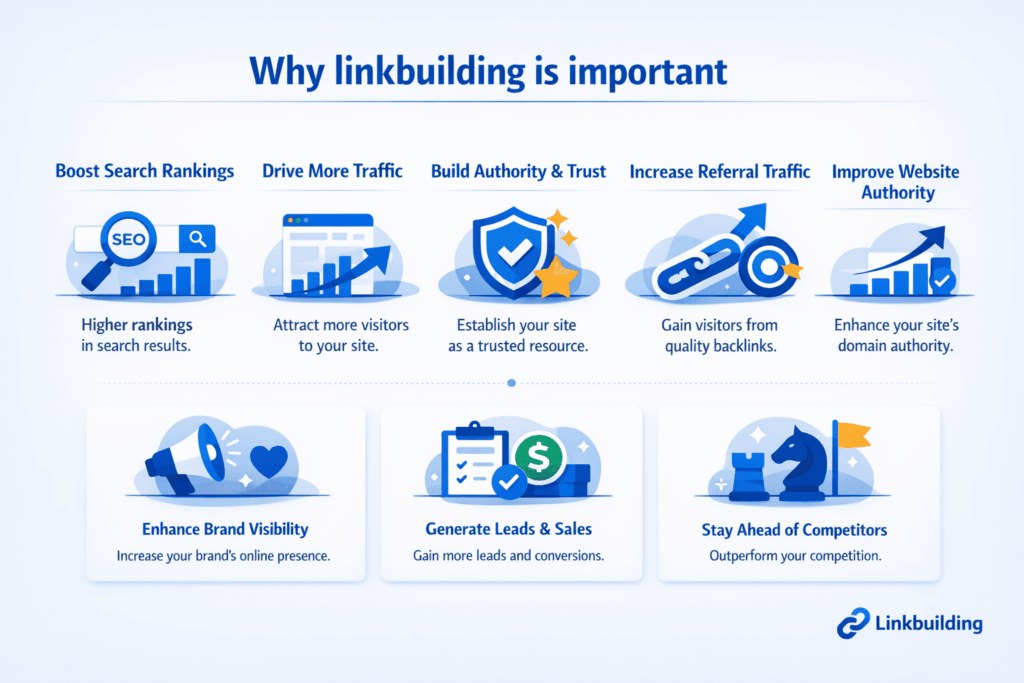
Why Linkbuilding Is Important
The simplest answer is that linkbuilding helps search engines judge whether your pages should be trusted and surfaced competitively.
But that importance goes deeper than rankings alone.
It helps establish authority
One of the main reasons linkbuilding is important is that it strengthens authority signals.
If multiple credible websites refer to your content, that creates a stronger case that your page is worth paying attention to. In competitive search results, where many pages are technically sound and reasonably well optimized, those authority signals often help distinguish stronger candidates from weaker ones.
Authority does not come from links alone, but backlinks are one of the clearest external signs that authority exists.
It improves competitive visibility
In many industries, good content is no longer enough by itself. Plenty of websites publish helpful articles, useful guides, and optimized service pages. When the quality gap narrows, linkbuilding becomes more important because it helps strong content compete more effectively.
This is especially true for high-value topics where established websites already have stronger brand signals and deeper backlink profiles.
It supports topical authority
For sites built around a pillar-and-cluster model, linkbuilding matters because it can strengthen the topic as a whole, not just a single page.
A well-linked informational page can help support related content through internal linking. That makes backlinks more valuable within a structured site architecture. Instead of treating pages as isolated assets, linkbuilding helps reinforce a broader topical ecosystem.
That is one reason a strong pillar page on linkbuilding benefits from supporting cluster articles on related subtopics such as anchor text, digital PR, linkable assets, and internal linking.
It reinforces trust
Search engines aim to surface pages that appear reliable and useful. Backlinks from relevant sources can contribute to that perception.
Good links do not automatically make a page trustworthy, but they can strengthen trust when the content itself is strong. If authoritative sites reference your work, that can support both search visibility and user confidence.
How Linkbuilding Creates SEO Value
To understand why linkbuilding is important, it helps to look at how the value is created.
Backlinks do not help because they are simply counted. Their value comes from context.
Search engines look at factors such as:
- the authority of the referring domain
- the relevance of the linking page
- the context in which the link appears
- the destination page
- the naturalness of the anchor text
- the overall backlink profile of the site
This means linkbuilding matters most when the links are relevant, credible, and connected to pages that deserve to rank.
Links validate content externally
Your own website can claim expertise, but backlinks are one way the wider web signals agreement. That is what makes them important.
If a useful guide, a research page, or a resource article earns links from relevant sites, that suggests it has value beyond self-promotion.
Links can strengthen key pages indirectly
Not every important page is easy to build links to directly. Commercial pages often convert well but attract fewer natural links. Informational pages, research pieces, and practical guides are usually more linkable.
This is where strategy matters. A business can earn links to strong informational assets, then use internal linking to pass value toward related commercial pages. That is one of the clearest examples of why linkbuilding is important within a structured SEO framework.
Links support discoverability and prominence
Backlinks can also help search engines better understand which pages are important and how they relate to the wider web. They are not a substitute for technical SEO, but they can reinforce prominence and visibility when the site is already well built.
Important Subtopics That Explain Why Linkbuilding Matters
Relevance matters more than raw numbers
A common mistake is assuming that the importance of linkbuilding comes from volume alone.
In reality, a smaller number of relevant, editorially placed links is often more useful than a larger number of weak ones. Relevance helps search engines interpret why the link exists and how the two pages connect.
That is why serious SEO teams do not judge linkbuilding success by total backlink count alone.
Internal linking makes backlinks more useful
External links build authority into a site, but internal links help distribute that value.
If a page earns strong backlinks but sits in isolation, much of the wider benefit stays limited. In a cluster model, internal links allow that authority to support related pages. This makes linkbuilding more efficient and strengthens topic coverage overall.
Linkable assets increase the impact of linkbuilding
The importance of linkbuilding is closely tied to the quality of what is being promoted.
A page is far more likely to earn links if it gives people a reason to cite it. That might be original research, a practical framework, a strong guide, or an expert opinion with real value. Without linkable assets, even aggressive outreach tends to produce weak outcomes.
Common Misunderstandings About Linkbuilding
Some businesses question why linkbuilding is important because they have only seen poor versions of it.
Mistaking bad linkbuilding for all linkbuilding
Low-quality guest posting, spammy directories, and paid links on irrelevant sites can make linkbuilding seem shallow or risky. But those examples reflect poor execution, not the full role of backlinks in SEO.
The problem is not that linkbuilding lacks value. The problem is weak strategy.
Assuming content alone will always be enough
Strong content is essential, but in competitive spaces it is often not enough on its own. If several sites publish content of similar quality, backlinks can help determine which one appears more authoritative.
Treating links as a shortcut
Another mistake is assuming that backlinks can compensate for poor content, weak intent alignment, or technical problems. They cannot. Linkbuilding is important, but it works best when it supports a site that already has solid foundations.
Practical Guidance for Businesses
If you are trying to decide whether linkbuilding deserves attention, the better question is not whether backlinks matter in theory. It is whether your current SEO goals require stronger authority signals.
For many businesses, the answer is yes.
A practical approach is to:
- identify the pages and topic areas that matter most
- assess whether those pages are truly worth linking to
- create stronger informational assets where needed
- focus on relevant, high-quality link opportunities
- connect linked pages to the wider cluster through internal links
This keeps linkbuilding tied to actual business outcomes rather than turning it into a disconnected reporting exercise.
The most valuable linkbuilding strategies are usually the ones that support broader SEO priorities: stronger topic coverage, better page authority, improved organic visibility, and more durable rankings over time.
Timing and Expectations
Linkbuilding is important, but it is rarely fast.
Backlinks need time to be discovered, crawled, and interpreted. Their impact also depends on the strength of the destination page, the competitiveness of the query, and the overall quality of the site.
That means businesses should think in terms of medium- to long-term gains rather than instant results.
If the site already has strong content and good technical foundations, linkbuilding can have a clearer impact. If core SEO problems remain unresolved, the effect may be slower or less visible.
That is normal. Linkbuilding is a growth lever, not a magic fix.
Conclusion
Why is linkbuilding important?
Because it helps search engines evaluate trust, authority, and prominence in a way that your own website cannot achieve alone. Backlinks act as external signals that reinforce the strength of useful content, support competitive rankings, and help build topical authority over time.
That importance becomes even clearer within a pillar-and-cluster model. A well-earned backlink does not just strengthen one page. With the right internal structure, it can support an entire topic area.
The key is to understand linkbuilding as a strategic part of SEO, not a shortcut. When quality, relevance, and site architecture are aligned, linkbuilding becomes one of the most effective ways to support long-term organic growth.