

What Is Linkbuilding? How It Works and Why It Matters
Linkbuilding is one of the core concepts in SEO, but it is often misunderstood. Many people reduce it to “getting backlinks,” which is only partly true. In practice, linkbuilding is about building authority through relevant, credible references from other websites.
That distinction matters. If you treat linkbuilding as a numbers game, the result is usually low-quality tactics and weak SEO outcomes. If you understand it properly, it becomes a strategic part of a broader SEO plan.
This article explains what linkbuilding is, why it matters, how it works, and what businesses should focus on if they want long-term results.
What Is Linkbuilding?
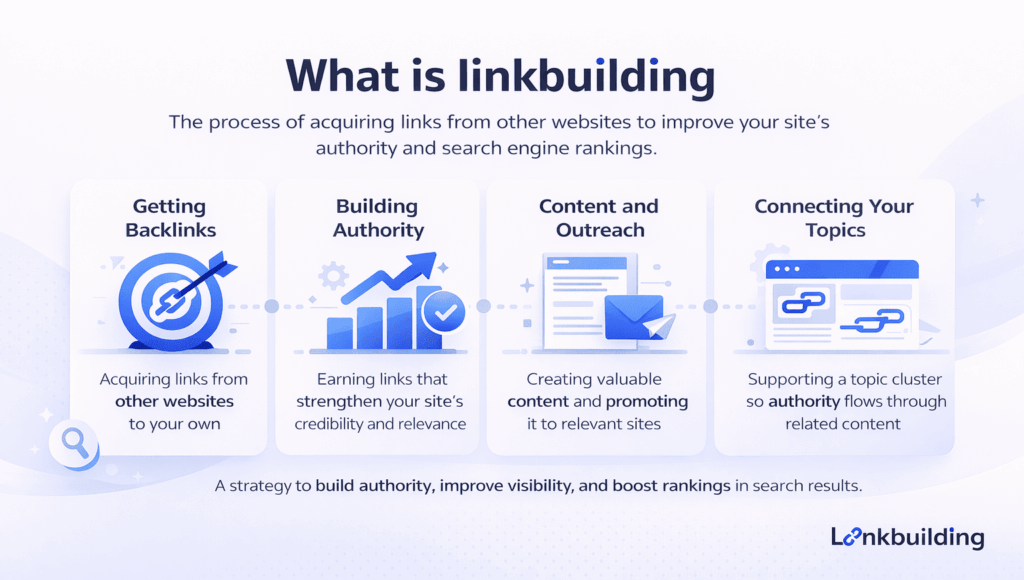
Linkbuilding is the process of getting other websites to link to pages on your website.
These inbound links are called backlinks. Search engines use them as one of many signals to understand whether a page is credible, relevant, and worth showing in search results.
In simple terms, linkbuilding is about earning external references that strengthen your site’s authority.
That does not mean every link has equal value. A link from a trusted, relevant website is usually far more useful than many links from weak or unrelated domains. That is why serious linkbuilding focuses on quality, relevance, and context rather than volume alone.
What linkbuilding means in practice
In real SEO work, linkbuilding often includes:
- publishing content worth citing
- promoting that content to relevant websites
- earning editorial mentions
- building relationships that lead to natural references
- supporting important pages through stronger authority signals
So while backlinks are the outcome, linkbuilding is really the process behind earning them.
Why Linkbuilding Matters
Linkbuilding matters because search engines do not evaluate pages in isolation. They also look at how the wider web responds to them.
If strong content proves relevance, backlinks can help prove authority.
When other credible websites link to your content, that can reinforce the idea that your page is useful and trustworthy. In competitive search results, that external validation can make a real difference.
It supports rankings
Backlinks remain one of the most important off-page SEO signals. They can help pages compete more effectively, especially in industries where many sites already have decent on-page optimization.
Links do not guarantee rankings, but they often influence which pages are seen as more authoritative.
It strengthens topical authority
Linkbuilding also helps build topical authority. When your website earns links from sources connected to your niche, it becomes easier for search engines to understand what your site is known for.
This is especially important for websites using a pillar-and-cluster structure. Relevant backlinks can support not just one page, but the broader topic area around it.
It contributes to trust
Good linkbuilding can also support brand credibility. Being referenced by respected industry websites, publications, or niche resources can strengthen how both users and search engines perceive your business.
That is one reason the best linkbuilding strategies often overlap with content marketing and digital PR.
How Linkbuilding Works
Linkbuilding works by increasing the authority signals pointing to your site, but it is not just about collecting more links.
Search engines look at factors such as:
- the relevance of the linking page
- the authority of the referring domain
- the context of the link
- the destination page
- the naturalness of the anchor text
- the overall backlink profile of the site
This means a backlink has more value when it makes sense editorially and contextually.
Not all links are equal
A link from a respected site in your industry is generally stronger than a link from an unrelated blog with little credibility. Relevance matters because it helps search engines understand why the link exists.
That is why buying random links or chasing easy placements usually leads to poor results.
Not all pages attract links naturally
Some pages are easier to earn links to than others. A useful guide, original research piece, or practical resource is often more linkable than a standard service page.
This is why many SEO strategies build links to high-value informational content, then use internal linking to support commercial pages.
Links work best when the page already deserves to rank
Backlinks can strengthen a page, but they do not fix weak content. If a page does not match search intent or lacks real value, links alone will not make it perform as well as it should.
Linkbuilding works best when it supports content that is already useful, well structured, and relevant.
Important Subtopics in Linkbuilding
Relevance
Relevance is one of the most important principles in linkbuilding.
A smaller number of highly relevant links is often more valuable than a large number of low-quality or unrelated ones. Relevant links are easier for search engines to interpret and usually create a more natural backlink profile.
Anchor text
Anchor text is the clickable text used in a hyperlink. It helps give context to the destination page.
A natural backlink profile usually includes a mix of branded anchors, plain URLs, and descriptive phrases. Overusing exact-match keywords can make the profile look manipulated.
Internal linking
External backlinks matter, but internal linking helps distribute their value across your website.
If a page earns links but sits in isolation, much of that benefit stays limited to that one URL. A strong internal linking structure helps pass authority to related pages within the cluster.
Digital PR
Modern linkbuilding often overlaps with digital PR. Many of the strongest links come from campaigns built around expert insights, original data, or content with a clear editorial angle.
This is one reason effective linkbuilding today is often more sophisticated than simple outreach.
Common Linkbuilding Mistakes
A lot of poor SEO decisions come from misunderstanding what linkbuilding is supposed to do.
Chasing quantity over quality
This is still the most common mistake. A long list of weak backlinks may look impressive in a report, but often adds little real value.
Quality, relevance, and context matter far more than raw numbers.
Building links without page strategy
Some businesses build links to pages that have little SEO or commercial value. Others try to force links to pages that are difficult to justify editorially.
Good linkbuilding starts with choosing the right destination pages.
Ignoring site quality
Links are not a substitute for good SEO fundamentals. If the site has weak content, poor structure, or technical problems, linkbuilding will have limited impact.
Expecting fast results
Linkbuilding is not an instant tactic. Search engines need time to crawl links, evaluate them, and reflect that value in rankings.
Results usually take time, especially in competitive markets.
Practical Guidance
A sensible linkbuilding strategy is usually more disciplined than aggressive.
Start by identifying the pages and topics that matter most. Then ask whether those pages are genuinely useful and worth citing. If they are not, improve them first.
A practical approach usually includes:
- choosing pages with clear strategic value
- creating content that deserves links
- targeting relevant websites for outreach
- earning editorial mentions where possible
- supporting linked pages through strong internal linking
This keeps linkbuilding connected to business goals instead of turning it into a standalone tactic.
Timing and Expectations
Linkbuilding should be viewed as a medium- to long-term investment.
Some new links may be found quickly, but meaningful impact usually takes time. Search engines need to interpret those signals alongside content quality, technical SEO, competition, and search intent.
If the rest of your SEO foundation is strong, good links can have a clearer impact. If the site is weak in other areas, linkbuilding alone will not solve the problem.
That is why realistic expectations are important. Sustainable authority is built over time.
Conclusion
So, what is linkbuilding?
It is the process of earning backlinks from other websites to improve the authority and visibility of your own pages. But in practice, it is more than just acquiring links. It is about building relevant, credible signals that support stronger SEO performance.
The most effective linkbuilding strategies focus on quality over volume, relevance over shortcuts, and long-term authority over quick wins.
When approached properly, linkbuilding becomes a strategic part of SEO rather than a tactical checkbox.