

What Is a Backlink? A Clear SEO Guide for Beginners and Businesses
Many SEO terms sound more complicated than they are, and backlink is one of them. At its simplest, a backlink is just a link from one website to another. But in SEO, that simple idea carries much more strategic weight.
If you are trying to understand how search engines evaluate websites, what makes some pages more competitive than others, or why linkbuilding matters, you need a clear understanding of what a backlink actually is.
This article explains what a backlink is, why backlinks matter, how they work, what types of backlinks exist, and what businesses should pay attention to if they want to use them intelligently within a broader SEO strategy.
What Is a Backlink?
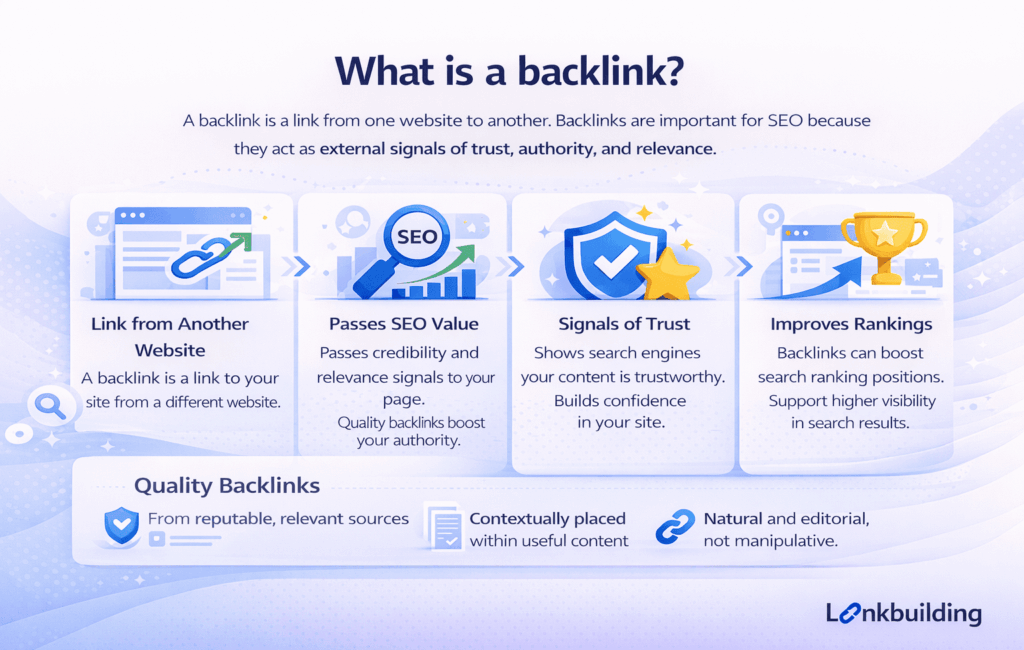
A backlink is a hyperlink from one website that points to a page on another website.
For example, if an industry blog links to your article, that link is a backlink for your page. From the other website’s perspective, it is an external link. From your perspective, it is a backlink.
In SEO, backlinks matter because they act as signals that help search engines understand how pages relate to one another across the web. A page that earns relevant backlinks from trusted websites may appear more credible or authoritative than a similar page with no external references.
That does not mean every backlink is valuable. A backlink only becomes strategically useful when its context, relevance, and source quality make sense.
A backlink is not just a technical link
It is easy to define a backlink as a clickable URL between two websites, but that definition is too narrow for SEO purposes.
In practice, a backlink can represent:
- a citation
- a recommendation
- a reference
- a source attribution
- a signal of relevance or trust
That is why serious SEO work does not treat backlinks as isolated technical elements. They are part of a wider authority system.
Why Backlinks Matter
Backlinks matter because search engines do not rely only on what a website says about itself. They also evaluate how the wider web responds to that website.
If other relevant websites link to your content, that may reinforce the idea that your page is useful, trustworthy, or worth surfacing in search results.
They support authority
One of the main reasons backlinks matter is authority. When credible websites link to your content, they can strengthen the perception that your page deserves attention.
This is particularly important in competitive topics where many pages are well written and properly optimized. In those cases, backlinks often help separate pages with stronger external validation from those with weaker signals.
They can improve organic visibility
Backlinks are one of the best-known off-page SEO signals. They do not guarantee rankings, but they can support stronger performance when the page itself already satisfies search intent and offers real value.
A weak page with backlinks is still weak. A strong page with relevant backlinks is often much more competitive.
They help support topical authority
Backlinks also matter at the topic level, not just the page level. If your website consistently earns references from relevant sources within a niche, that can help strengthen your broader topical authority.
This is especially useful in a pillar-and-cluster model, where strong pages can support related content through thoughtful internal linking.
How a Backlink Works
A backlink works by creating a connection between two websites. Search engines use that connection as one of many signals when evaluating the destination page.
But a backlink is not judged in isolation. Its value depends on several factors, including:
- the quality of the linking website
- the relevance of the linking page
- the context of the link
- the destination page
- the anchor text used
- the overall backlink profile of the receiving site
This is why one good backlink can be more useful than many poor ones.
Search engines evaluate context, not just existence
Years ago, SEO discussions often focused too heavily on link quantity. Modern SEO is more nuanced.
A backlink from a trusted, relevant page within your industry is generally more useful than a random link from an unrelated website. Search engines are far better at assessing whether a link appears natural, editorial, and contextually appropriate.
Backlinks pass more than traffic
Some backlinks generate referral traffic, but that is not their only role.
They also help search engines understand:
- which pages are being cited
- which sites appear authoritative within a topic
- how content is connected across the web
- which pages may deserve more prominence
That is why backlinks matter even when they do not send large amounts of direct traffic.
Important Subtopics to Understand
Follow and nofollow links
Not all backlinks are treated the same way.
Some links are standard links that search engines can use more directly as ranking signals. Others use attributes such as nofollow, sponsored, or ugc to indicate a different relationship.
That does not mean non-standard links are worthless. They can still provide visibility, traffic, and brand value. But when people discuss backlinks in SEO, they are often referring to links that can contribute more directly to authority signals.
Anchor text
Anchor text is the clickable text used in a hyperlink.
For example, if a website links to your article using the phrase “technical SEO checklist,” that phrase is the anchor text. It helps users and search engines understand what the linked page is about.
A healthy backlink profile usually includes varied anchor text, such as brand names, plain URLs, and descriptive phrases. Overuse of exact-match keyword anchors can look unnatural.
Referring domains
A backlink profile is not just about the total number of links. It is also about the number and quality of referring domains, meaning unique websites linking to you.
Ten links from ten relevant websites usually tell a different story than ten links from one weak website. This is one reason SEO professionals often look beyond raw backlink counts.
Editorial vs manipulated links
A strong backlink is usually editorial. That means it was placed because the linking page genuinely found value in referencing the destination page.
Manipulated links, on the other hand, are created mainly to influence rankings rather than to help users. Those are the links that tend to create risk and deliver poor long-term value.
Common Mistakes When Thinking About Backlinks
A lot of confusion around SEO comes from misunderstanding what backlinks actually mean.
Assuming every backlink is good
Not every backlink helps. Some links add little value because they come from irrelevant, low-quality, or clearly artificial websites.
The presence of a backlink alone is not what matters. Its context matters.
Focusing only on quantity
A higher backlink count does not automatically mean better SEO. A smaller number of trusted, relevant links is often more useful than a large number of weak ones.
Ignoring the destination page
A backlink can only do so much if it points to a page that is thin, outdated, or poorly aligned with search intent. Backlinks work best when they support pages that already deserve visibility.
Treating backlinks as a shortcut
Backlinks are important, but they do not replace strong content, technical SEO, or site structure. They are part of a broader system, not a substitute for the rest of it.
Practical Guidance for Businesses
If you are evaluating backlinks for your own website, start with quality rather than volume.
Ask practical questions:
- Is the linking site relevant to your niche?
- Does the link appear naturally in useful content?
- Is the destination page worth linking to?
- Does the link support a real SEO goal?
- Does your internal linking help distribute value from that page?
This leads to better decisions than simply chasing more backlinks.
A sensible approach is to focus on creating pages that deserve references. Useful guides, research, practical frameworks, expert commentary, and strong resource pages are often better backlink targets than generic promotional pages.
That is also why backlinks should be considered together with linkbuilding, internal linking, anchor text, and content strategy rather than as a standalone metric.
Timing and Expectations
Backlinks can influence SEO performance, but they rarely produce instant results.
Search engines need time to discover, crawl, and interpret new backlinks. The impact also depends on the quality of the linking page, the competitiveness of the topic, and the overall strength of your site.
This means backlinks should be understood as part of long-term SEO development, not as an immediate fix.
A page with strong content and a few relevant backlinks may improve steadily over time. A weak page with many poor links may do very little at all.
Conclusion
So, what is a backlink?
It is a link from one website to another, but in SEO terms, it is much more than a technical connection. A backlink can act as a signal of relevance, authority, and trust when it comes from the right source and points to the right page.
That is why backlinks matter so much in search engine optimization. They help search engines evaluate pages beyond what those pages claim about themselves.
The key is to think about backlinks strategically. Focus on relevance, source quality, page quality, and the broader role those links play within your site architecture. When viewed that way, backlinks stop being a vague SEO buzzword and become a practical part of building long-term organic visibility.