

Types of Backlinks: Which Ones Matter for SEO?
If you want to build authority through SEO, it is not enough to know that backlinks matter. You also need to understand that different types of backlinks carry different levels of value.
A link from a relevant industry site is not the same as a link from a weak directory. A naturally earned editorial mention is not the same as a low-quality guest post placed only to manipulate rankings. That is why backlink analysis should never stop at raw numbers.
This article explains the main types of backlinks, why the differences matter, how they influence SEO, and what businesses should focus on when evaluating link quality.
What Are Types of Backlinks?
Types of backlinks are the different categories of links pointing from other websites to your site.
They can be grouped in two useful ways. The first is by source, such as editorial links, guest post links, directory links, or media links. The second is by technical attributes, such as follow, nofollow, sponsored, or user-generated content links.
In practice, both views matter. A backlink is still a backlink, but the type tells you more about how natural, relevant, and useful that link is likely to be.
Why classification matters
The question is not just whether a site links to you. The more important question is what kind of signal that link sends.
Some links suggest genuine trust and editorial relevance. Others mainly support brand presence or local business validation. Some add little value at all.
That is why a healthy backlink profile is usually a mix, but the strongest SEO value tends to come from relevant, editorially justified links.
Why Types of Backlinks Matter
Understanding the different types of backlinks helps you judge quality more accurately.
A site with fewer but better links can outperform a site with far more low-value links. The difference often comes down to source relevance, editorial context, and the overall trust of the linking page.
Different backlinks create different value
Some links strengthen authority. Some help confirm business legitimacy. Some drive referral traffic. Others exist mostly because they were easy to create.
That does not mean every weaker backlink is harmful, but it does mean not all links deserve equal attention in strategy or reporting.
Better evaluation leads to better linkbuilding
When you understand backlink types, you make better decisions about outreach, digital PR, content promotion, and page targeting. You also become less likely to waste budget on links that look impressive in a spreadsheet but do little for rankings.
How Types of Backlinks Work in SEO
Search engines do not treat every backlink equally. They look at more than the existence of a link.
They consider factors such as:
- relevance of the linking page
- authority and trust of the source site
- editorial nature of the placement
- anchor text
- destination page quality
- overall link profile patterns
This is why backlink type matters. A link is not just a technical connection. It is a contextual signal.
Important Types of Backlinks
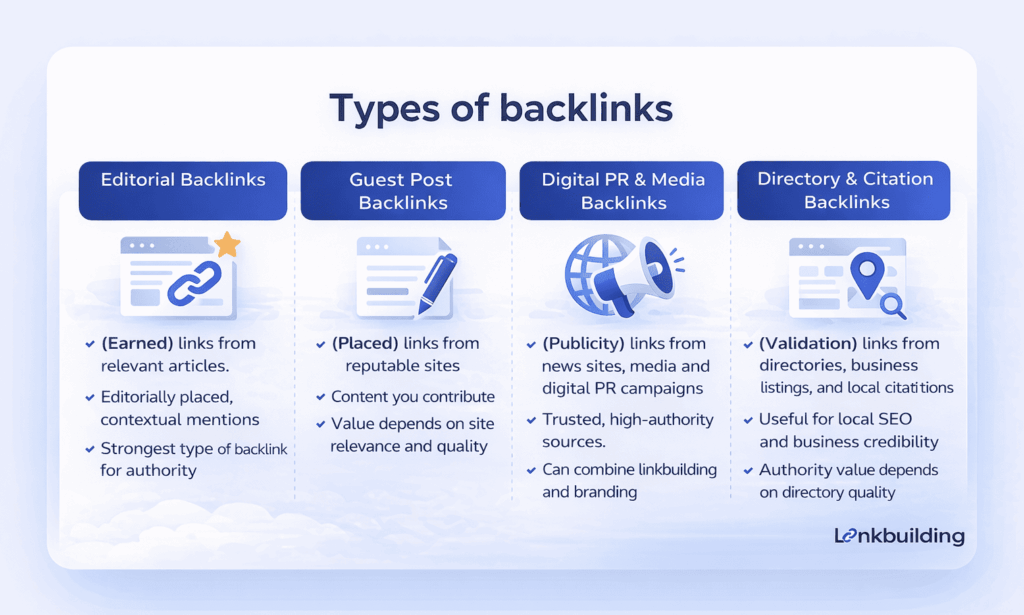
Editorial backlinks
Editorial backlinks are usually the strongest type.
These are links placed naturally because another site chose to reference your content. They often appear in articles, guides, research pieces, and expert commentary.
They are valuable because they reflect real relevance and editorial judgment, not just a link request.
Guest post backlinks
Guest post backlinks come from articles you contribute to another site.
These can still be useful when the website is reputable, the content is genuinely valuable, and the audience is relevant. But guest posting becomes far less useful when it is done at scale on weak sites with little editorial oversight.
The quality of the placement matters more than the label.
Digital PR and media backlinks
These links come from publishers, news sites, industry magazines, and media platforms.
They are often among the most valuable because they combine visibility, authority, and editorial trust. A strong media mention can support both SEO and brand credibility.
This is one reason digital PR plays such an important role in modern linkbuilding.
Directory and citation backlinks
These links come from business directories, local listings, trade associations, and citation sites.
They are often useful for local SEO and business validation, especially when they come from reputable, relevant sources. But generic low-quality directories rarely provide meaningful value.
Resource page backlinks
These are links from curated lists, recommended tools pages, educational resources, or industry reference pages.
When the page is relevant and well maintained, this type of backlink can be strong because it shows your content is considered useful enough to recommend.
Forum and community backlinks
These backlinks come from forums, Q&A sites, discussion platforms, and community threads.
In most cases, they are weaker as direct authority signals, especially when they are nofollow or casually placed. Still, they can support visibility and referral traffic when they come from genuine participation.
Social profile and platform backlinks
These links come from social platforms, profile pages, and public content-sharing sites.
They usually do not drive strong ranking impact on their own, but they can support discovery, brand presence, and a more natural digital footprint.
Follow, nofollow, sponsored, and UGC links
This is the technical classification.
Standard links may pass stronger ranking signals than links marked nofollow. Sponsored links indicate paid placements. UGC links usually appear in user-generated environments such as comments or forums.
These attributes matter, but they should not be treated too rigidly. A nofollow link from a major publisher may still have real value in terms of visibility, trust, and traffic.
Which Types of Backlinks Matter Most?
The best types of backlinks usually combine four things:
- relevance
- credibility
- editorial quality
- natural placement
That is why editorial links, media links, strong guest contributions, and reputable resource links tend to matter most.
A natural backlink profile does not need to include only one type of link. In fact, some variety is normal. The key is that the strongest and most meaningful links come from trustworthy sources that make sense for your niche.
Common Mistakes When Evaluating Backlinks
Focusing only on volume
A high backlink count often looks impressive, but it does not tell you much on its own. A small number of strong links is often more valuable than a large number of weak ones.
Trusting metrics too much
Third-party authority scores can be useful indicators, but they are not a substitute for judgment. Relevance, editorial context, and source quality still matter more than a single number.
Treating all guest posts the same
Some guest post links are excellent. Others are close to worthless. The difference is the quality of the site, the article, and the reason the link exists.
Ignoring topical fit
A link from an unrelated site is usually less useful than a link from a relevant one, even if the unrelated site looks stronger on paper.
Practical Guidance
If you want to assess backlink types strategically, ask better questions.
Does the link make sense on that page? Is the source credible? Is the content relevant to your niche? Would the link still feel valuable if search engines did not count it?
That final question is often the most useful one.
In practice, most businesses should focus on earning more backlinks through:
- useful content assets
- expert-led articles
- digital PR
- strong resource pages
- relevant editorial placements
That usually leads to better long-term results than chasing whatever link is easiest to get.
Timing and Expectations
The most valuable types of backlinks are rarely the fastest to acquire.
Editorial mentions, media links, and strong resource placements usually take more work because they depend on better content, better outreach, or a stronger story. That is normal.
Quick backlinks are often weaker backlinks. A slower, more credible link profile is usually much better for long-term SEO performance.
Conclusion
Understanding the different types of backlinks helps you move beyond surface-level SEO thinking.
A backlink is not valuable just because it exists. Its value depends on where it comes from, why it was placed, how relevant it is, and whether it reflects real editorial trust.
That is the strategic point. Do not evaluate backlinks as a single number. Evaluate the types of backlinks your site is earning, because that is where the real difference in SEO value usually appears.