
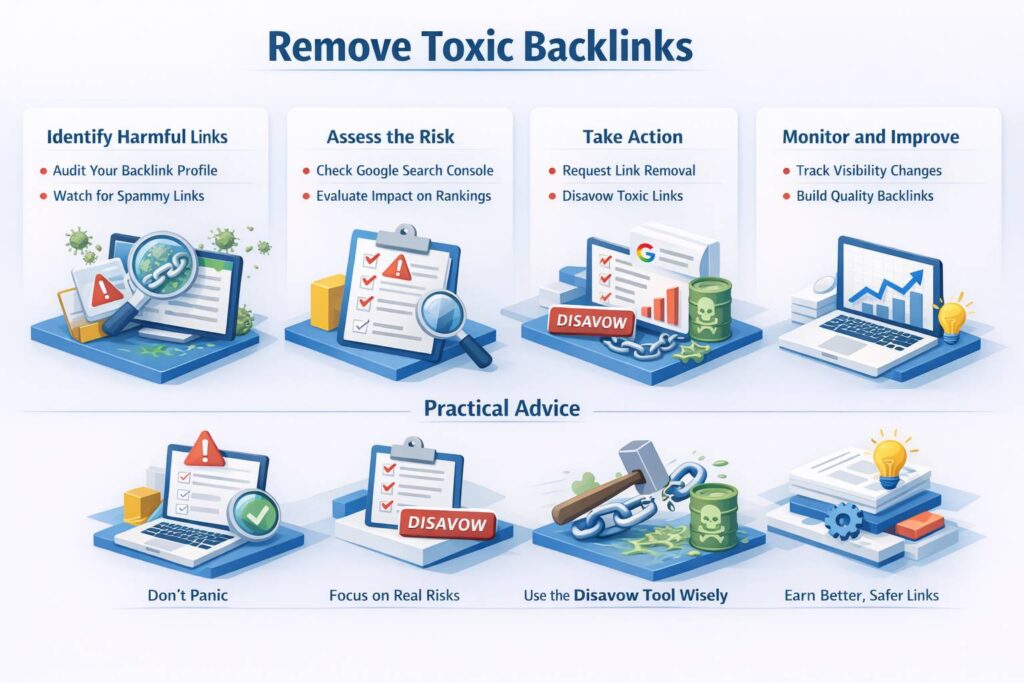

Remove Toxic Backlinks: What It Means, When It Matters, and What to Do in Practice
“Remove toxic backlinks” is one of the most common phrases in SEO, but it is also one of the most misunderstood. Many tools, agencies, and site owners use the term as if every low-quality or suspicious backlink needs urgent removal. Google’s own guidance is more cautious.
Google says that in most cases, its systems can assess which links to trust without extra input, so most sites will not need to use the disavow tool. Google recommends disavowing backlinks only when there is a considerable number of spammy, artificial, or low-quality links pointing to your site and those links have caused a manual action, or are likely to cause one. (Google Help)
That distinction matters. The right response to suspicious backlinks is not always immediate removal or disavowal. In many cases, Google may already be ignoring them. In other cases, especially where manipulative linkbuilding has been used deliberately, cleanup can become necessary.
For businesses, marketers, and SEO professionals, the real question is not just how to remove toxic backlinks. It is how to judge whether a backlink profile is actually creating risk, how Google currently handles bad links, and what actions are sensible versus excessive. This article explains that in practical terms and follows the writing guidance you supplied for an informational cluster page.
What Does “Remove Toxic Backlinks” Mean?
“Remove toxic backlinks” usually refers to identifying backlinks that appear spammy, manipulative, artificial, irrelevant, or low quality, and then trying to eliminate their negative SEO impact.
In practice, that can mean two different actions:
- asking the linking site to remove the backlink
- using Google’s disavow tool to tell Google not to take certain backlinks into account
These are not the same thing. Removing a link changes the web directly. Disavowing a link does not remove it from the web; it signals to Google that you do not want that backlink considered for your site.
The term “toxic backlink” itself is not an official Google category. It is mostly an SEO industry label. That is important because tool-generated “toxicity” scores can be useful as prompts for review, but they are not the same thing as Google saying a link is harmful.
Why It Matters
Removing toxic backlinks matters in the right circumstances because manipulative link patterns can still create search visibility problems.
Some backlink patterns can lead to manual actions
Google’s spam policies say links intended to manipulate rankings count as link spam, and violating spam policies can result in pages or entire sites being ranked lower or removed from Search. Google’s manual actions documentation also says manual actions are applied when human reviewers determine that a site is not complying with spam policies. (Google for Developers)
Some bad links may simply be ignored
This is the nuance many people miss. Google’s own disavow guidance says that in most cases Google can assess which links to trust without extra guidance. That means not every ugly-looking backlink needs active cleanup. (Google Help)
Overreacting can cause harm
Google warns that the disavow tool is advanced and that incorrect use can potentially harm your site’s performance in Google Search. That means aggressive cleanup based only on third-party tool scores can do more harm than good. (Google Help)
It affects long-term link strategy
A site that repeatedly has to worry about toxic backlinks often has a broader link acquisition problem. In many cases, the better solution is not just cleanup, but changing how backlinks are built in the first place through stronger content, better outreach, and more editorially credible acquisition. That also fits the wider pillar-and-cluster structure in your writing brief.
How Google Currently Treats Bad Backlinks
This is the most important section for practical SEO decision-making.
Google’s official disavow documentation says most sites do not need to use the disavow tool because Google can often determine which links to trust on its own. It recommends disavowal only when there are many spammy, artificial, or low-quality links and those links have caused, or are likely to cause, a manual action. (Google Help)
Google’s spam updates documentation also explains that when spammy links are neutralized by Google’s systems, any ranking benefit those links previously generated can be lost. That means some “toxic backlinks” issues show up not as a visible penalty, but as a loss of artificial ranking support. (Google for Developers)
So in practice, there are three common scenarios:
Google ignores the low-quality links
This is probably the most common case for random spammy backlinks a site did not build itself. Google tries hard to ensure that third-party actions do not negatively affect a website unfairly. (Google Help)
Google discounts manipulative link value
If a site benefited from spammy backlinks and Google’s systems get better at recognizing them, those links may stop helping. Rankings can fall even without a manual action. (Google for Developers)
Google applies a manual action
If the site has a serious policy-violating link profile, a human reviewer may apply a manual action. In that case, cleanup becomes much more urgent and deliberate. (Google Help)
How to Decide Whether You Should Remove Toxic Backlinks
A sensible process starts with context, not panic.
Look for real signs of risk
You are more likely to need action when there is evidence such as:
- a manual action in Search Console
- a history of paid links, link schemes, or manipulative outreach
- a large concentration of obviously artificial backlinks
- repeated exact-match anchor text from low-quality sites
- mass links from irrelevant directories, spam blogs, or automated sources
Google’s spam policies explicitly identify tactics like paid links for ranking purposes, excessive link exchanges, large-scale guest posting with keyword-rich anchors, and automated link creation as link spam. (Google for Developers)
Do not rely only on third-party “toxic” scores
A backlink tool may label a domain as dangerous based on its own model, but that does not mean Google is treating the link as a threat. Tool scores can help you review patterns, but they should not replace judgment.
Check Search Console
If there is a manual action, Search Console is the place where Google tells you. Google’s manual actions report exists for exactly this reason. (Google Help)
Distinguish random junk from deliberate manipulation
A few strange backlinks from scraper sites or random low-quality domains are usually not the same thing as a coordinated scheme of bought or manufactured links. That distinction matters because Google’s own guidance suggests most sites do not need aggressive intervention for random bad links. (Google Help)
Important Subtopics Within Remove Toxic Backlinks
Link removal outreach
In some cases, especially after manipulative linkbuilding, contacting webmasters to request link removal is a reasonable first step. It shows an effort to clean up the problem at the source.
Disavow tool
Google’s disavow tool is for telling Google not to consider certain backlinks. But Google clearly describes it as an advanced feature and says most sites will not need it. (Google Help)
Manual actions
If you have a manual action related to unnatural links, cleanup is much more urgent. This is one of the clearest scenarios where link removal and disavow work become appropriate. (Google Help)
Earning better links going forward
Cleanup is only part of the answer. A healthier backlink profile is built by earning relevant, editorial, trustworthy links through content, digital PR, tools, research, and better outreach. That is also the more durable long-term strategy.
Common Mistakes
Assuming every suspicious backlink must be removed
Google’s official position is more restrained than much of the SEO industry. Most sites do not need to use the disavow tool. (Google Help)
Disavowing too aggressively
Google warns that incorrect use of the disavow tool can hurt site performance. Disavowing large portions of a backlink profile without clear reason can remove links that were not actually causing harm. (Google Help)
Treating tool labels as proof
A backlink labeled “toxic” by software is not the same thing as a confirmed SEO threat. Review the actual pattern, context, and site history before acting.
Ignoring the real cause
If a site has serious backlink risk, the bigger issue is often prior manipulative linkbuilding. Cleanup without changing strategy only repeats the cycle.
Waiting too long after a manual action
If Search Console shows a manual action, hesitation is less useful than a structured cleanup process. That is the scenario where focused action matters most. (Google Help)
Practical Guidance
A practical way to approach “remove toxic backlinks” is this:
First, verify whether there is an actual problem. Check Search Console, review recent visibility changes, and assess whether the backlink profile contains a large pattern of artificial or manipulative links.
Second, separate random low-quality noise from serious risk. A few weak links are common. A broad footprint of link schemes is different.
Third, if there is a real manipulative pattern, try to remove the worst links directly where possible.
Fourth, use the disavow tool only when there is a clear reason, especially where you have many spammy or artificial links and manual action risk is real. That aligns directly with Google’s own guidance. (Google Help)
Finally, shift the strategy away from questionable acquisition tactics and toward stronger, more defensible linkbuilding: useful resources, strong informational pages, digital PR, relevant outreach, and clear internal linking across the cluster.
Timing and Expectations
Removing toxic backlinks is not always a fast fix. If the issue is a manual action, cleanup can take time and may require removal attempts, disavow submission, and reconsideration steps. If the issue is algorithmic, the site may not bounce back immediately, especially if prior rankings depended on manipulative links that are no longer counted. (Google for Developers)
It is also important to set realistic expectations. Cleanup can reduce risk and improve alignment with Google’s guidance, but it does not automatically restore rankings if those rankings were built partly on unnatural signals in the first place.
Conclusion
“Remove toxic backlinks” is a useful idea only when applied carefully. Not every suspicious backlink needs removal, and Google explicitly says that most sites will not need to use the disavow tool because its systems can usually assess which links to trust. The time to take stronger action is when there is a considerable pattern of spammy, artificial, or low-quality links and a real risk of manual action. (Google Help)
The strategic takeaway is simple. Do not treat every ugly backlink as an emergency. Treat backlink cleanup as a focused response to real risk, and build the long-term SEO strategy around earning better links rather than constantly trying to recover from bad ones.