

Niche Edits: What They Are, How They Work, and When They Make Sense for SEO
Niche edits are a linkbuilding tactic where a backlink is added to an existing article on another website, rather than placed inside a newly written guest post. In practical SEO terms, the idea is simple: instead of creating fresh content for a third-party site, you identify a relevant page that already exists and request or arrange for your link to be inserted where it fits naturally.
That sounds efficient, and in some cases it can be. But niche edits are also one of the more misunderstood areas of link acquisition. Many people treat them as a shortcut to faster backlinks without thinking carefully about relevance, editorial quality, risk, or whether the placement actually makes sense for users.
That is why niche edits need to be approached with more nuance than they often receive. The question is not just whether a link can be inserted into an existing article. The real question is whether that link belongs there, whether the page is worth being associated with, and whether the result strengthens your SEO strategy in a meaningful way.
This guide explains what niche edits are, why they matter, how they work, which supporting concepts matter most, what mistakes to avoid, and how to approach them realistically within a wider linkbuilding strategy. It follows the supplied SEO and writing guidance for an informational cluster page.
What Are Niche Edits?
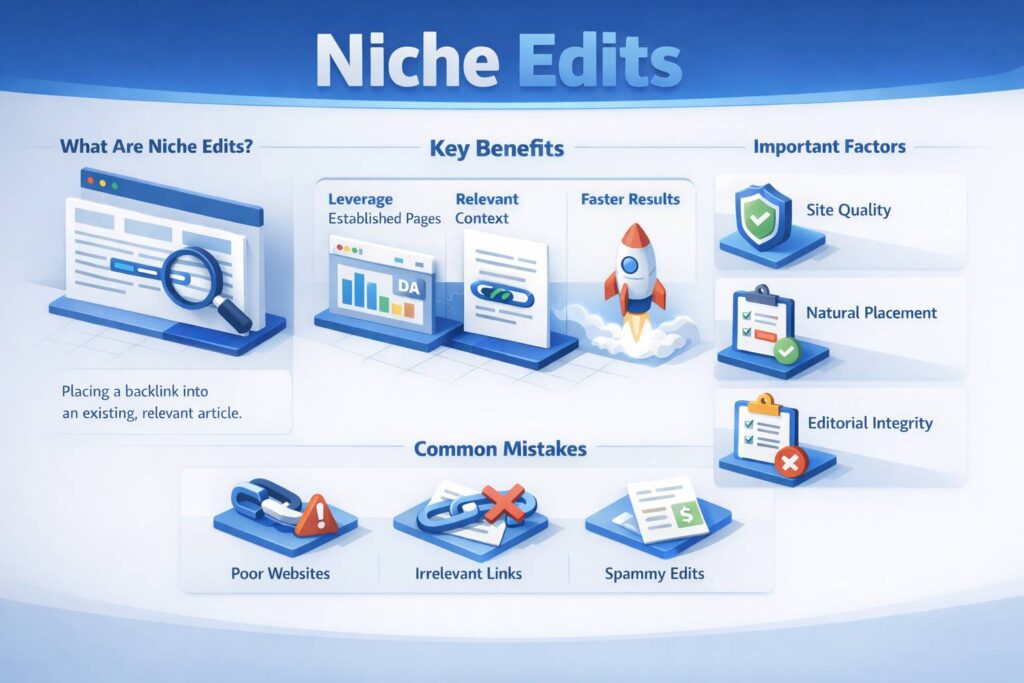
Niche edits are backlinks added to existing content on another website, usually within an article that has already been published and indexed.
In practice, the goal is to place a link inside a page that already has topical relevance, some level of authority, and ideally some search visibility. Rather than waiting for a new article to be written, the linkbuilder works with content that already exists.
These placements are sometimes also described as curated links or contextual link insertions. The wording varies, but the core idea is the same: a relevant existing page is edited to include a backlink.
The appeal is easy to understand. If the target page is already indexed and performing, the backlink may begin passing value more quickly than a link on a newly published page that has not yet established any visibility. But that advantage only matters if the placement is strong.
A niche edit is not automatically valuable just because it appears on an older page. The real value depends on the quality of the host site, the relevance of the article, the natural fit of the link, and the editorial credibility of the update.
Why Niche Edits Matter
Niche edits matter because they can offer a more efficient path to contextual backlinks when good opportunities are chosen carefully.
They can use pages that already have authority
One of the main advantages of niche edits is that the link is added to an already published page. If that page has existing authority, traffic, or stable rankings, the placement may be more strategically useful than a link on a brand-new article with no visibility.
That does not guarantee better results, but it can make niche edits attractive in certain campaigns.
They can provide contextual placement
When done properly, niche edits place links inside content that is already closely related to the destination page. That can make the backlink feel more natural than links placed in weak author bios or in poorly matched articles.
Context matters in SEO. A relevant link within a relevant article is usually more useful than an isolated mention with little topical connection.
They can support targeted pages
Niche edits are often used to support important commercial pages, resource pages, or cluster content that benefits from additional authority signals. This can make them useful in a broader linkbuilding campaign, especially when combined with strong internal linking.
They can become risky when handled poorly
This is also why the tactic needs care. Because niche edits are sometimes sold as a quick backlink solution, they are often associated with low-quality practices such as irrelevant placements, obvious paid insertions, and links added to weak sites with thin editorial standards.
So while niche edits can matter, they only help when quality control is strong. Otherwise, they become another example of linkbuilding activity that looks efficient but adds little real value.
How Niche Edits Work
Niche edits work by identifying existing pages on third-party sites where a backlink could be added naturally and usefully.
Start with the target page on your own site
Before looking outward, define which page on your own site should receive the link and why.
This is important because niche edits should support a wider SEO goal, not just increase backlink counts. You need to know whether the destination page is a cluster article, a pillar page, a commercial landing page, or a resource that deserves more visibility.
If the destination page is weak, unclear, or poorly aligned with user intent, then even a strong backlink may not contribute much.
Find existing articles with real topical fit
The next step is identifying existing articles on other websites where your page could genuinely add value.
That means the host page should already be discussing a topic closely related to your linked page. The backlink should feel like a useful addition to the article, not an obvious insertion added for SEO alone.
A page about linkbuilding strategy, for example, might reasonably reference a useful resource on niche edits. A loosely related article about general digital marketing may be a weaker fit.
Evaluate site and page quality carefully
This is where many niche edit campaigns go wrong. People focus on the fact that the page exists and may have metrics, but overlook whether the site is actually worth pursuing.
Important questions include:
- Is the site topically credible?
- Does it publish useful content?
- Does the page appear to have genuine editorial quality?
- Do outbound links look natural or excessive?
- Does the site seem built for users or mainly for placements?
A niche edit on a poor site is still a poor backlink, even if the page is indexed and old.
Add the link only where it belongs
The best niche edits are contextual. The sentence around the link should still read naturally, and the linked resource should improve the article rather than interrupt it.
If the paragraph has to be awkwardly rewritten to force the link into place, the fit is probably weak.
This is an important difference between strategic linkbuilding and mechanical insertion. Good niche edits feel like editorial improvements. Bad niche edits feel like afterthoughts.
Important Subtopics Within Niche Edits
Contextual relevance
Relevance is one of the most important factors in any backlink, but it is especially important in niche edits because the link is being added after publication.
If the surrounding article is clearly related to the target page, the link can feel natural and useful. If not, the insertion becomes more obvious and less credible.
Editorial integrity
A strong niche edit should preserve the integrity of the article. That means the host page should not look like it has been modified simply to accommodate backlinks.
The more editorially natural the update feels, the better. If the page starts to resemble a patchwork of inserted links, the value of the placement becomes questionable.
Link quality versus speed
Niche edits are often attractive because they can be faster than some other linkbuilding methods. But speed is not the same as quality.
A quickly placed backlink on a weak article is still weak. It is usually better to secure fewer niche edits with strong contextual fit than many placements chosen mainly for convenience.
Destination page strategy
Not every page should be the target of niche edits. In many cases, the best destinations are useful, link-worthy resources that genuinely help readers continue learning.
This is one reason niche edits should be connected to site structure. A strong cluster page can benefit from relevant backlinks, and that value can then support related pages through internal linking. In a pillar-and-cluster model, that makes niche edits more strategically useful than random page-level acquisition.
Common Mistakes
Niche edits often fail because the campaign prioritizes easy placements over good placements.
Choosing sites based only on metrics
Authority metrics can be helpful, but they do not replace editorial judgment. A page with decent metrics can still be irrelevant, low quality, or overloaded with unnatural outbound links.
Forcing links into weak contexts
If the article does not genuinely need the link, the edit will feel unnatural. That weakens both the user experience and the value of the backlink.
Ignoring site quality
Some sites exist mainly to sell placements. They may have indexed pages and acceptable metrics, but little real credibility. Links from these sites are often much less useful than they appear.
Treating niche edits as a shortcut
Niche edits can be efficient, but they are not a substitute for content quality, internal linking, or a broader SEO strategy. When treated as a shortcut, they often become low-quality acquisition.
Targeting pages that do not deserve support
A backlink is only as useful as the page it points to. If the destination page is thin, poorly structured, or misaligned with search intent, the campaign is weaker from the start.
Practical Guidance for Using Niche Edits Well
A strong niche edit strategy begins with selectivity. Start by identifying pages on your own site that are genuinely worth strengthening. Then look for existing third-party articles where your page would be a natural and useful reference.
The goal should not be to insert a link wherever possible. The goal should be to find places where the link improves the article.
This usually means prioritizing:
- real topical relevance
- credible host sites
- natural contextual placement
- restrained anchor text
- destination pages with clear SEO purpose
It also helps to think about how niche edits support the wider content structure. A niche edit pointing to a relevant cluster article can strengthen that page directly, while internal links help distribute value toward the broader linkbuilding pillar and related supporting pages. That is a more strategic use of backlinks than sending them to disconnected pages without a clear architectural role.
In practical SEO terms, niche edits work best when they are treated as one tool among many. They should complement broader efforts such as linkable asset creation, digital PR, guest contributions, and strong internal linking.
Timing and Expectations
Niche edits can sometimes produce faster placement timelines than guest posting because the page already exists. But that does not mean the SEO effect is immediate or guaranteed.
Search impact still depends on the quality of the site, the relevance of the article, the strength of the destination page, the competitiveness of the query, and the overall condition of the site receiving the link.
It is also worth remembering that not all existing pages are valuable just because they are old. Age alone is not a quality signal. A well-maintained, relevant article can be useful. An old page on a weak site is usually not.
Conclusion
Niche edits are a linkbuilding tactic based on adding backlinks to existing third-party content rather than creating entirely new placements. In the right context, they can be useful because they allow you to secure relevant contextual links from pages that may already have authority and visibility.
But the tactic only works well when it is handled with care. Good niche edits depend on relevance, editorial quality, natural insertion, and a clear purpose for the destination page. Poor niche edits are usually easy to spot, easy to overuse, and easy to overvalue.
For websites building authority through a structured SEO strategy, niche edits can play a supporting role. They are most useful when they strengthen pages that already deserve links and fit naturally into a wider system of content quality, internal linking, and topical coverage. Used that way, niche edits are not just faster link placements. They become part of a more deliberate approach to linkbuilding.