
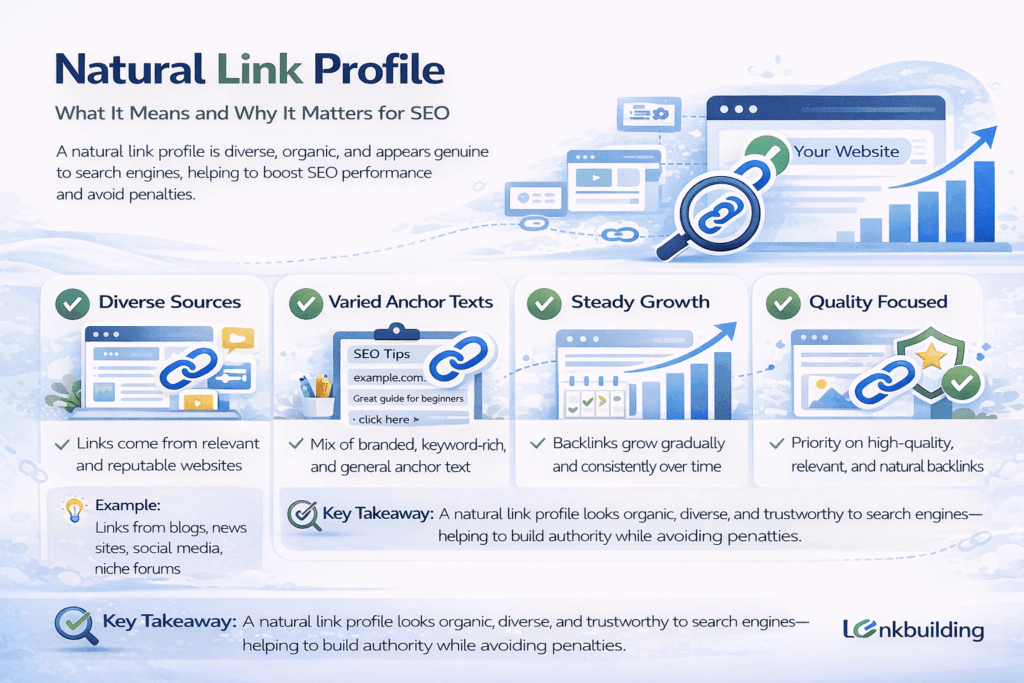

Natural Link Profile: What It Means and Why It Matters for SEO
A strong backlink profile is not just about getting more links. It is about building the right mix of links in a way that looks credible, relevant, and earned over time. That is what people mean when they talk about a natural link profile.
This matters because search engines do not evaluate backlinks one by one in isolation. They also look at overall patterns. If a website has a backlink profile filled with repetitive anchor text, irrelevant domains, and obvious placement patterns, that can look artificial. If the profile shows variety, relevance, and editorial logic, it is much easier to trust.
This article explains what a natural link profile is, why it matters, how it works in practice, and what businesses should focus on if they want long-term SEO value rather than short-term link volume.
What Is a Natural Link Profile?
A natural link profile is a backlink profile that looks like the result of genuine visibility, useful content, and normal web activity rather than deliberate manipulation.
In practice, that means the links pointing to your site come from a reasonable mix of sources, pages, anchor texts, and link types. The pattern does not look overly engineered around exact-match keywords or low-quality placements.
A natural link profile usually includes:
- links from different relevant websites
- a mix of branded, descriptive, and generic anchor text
- links to different types of pages, not only one commercial URL
- both stronger and weaker links in normal proportions
- a realistic pace of link growth over time
That does not mean every link needs to be perfect. It means the overall pattern should make sense.
Natural does not mean random
This is an important distinction.
A natural link profile is not messy or accidental. It is simply the kind of profile a website would build if it earned links because its content was useful, its brand was visible, and other websites had real reasons to reference it.
In other words, natural does not mean unplanned. It means believable.
Why a Natural Link Profile Matters
A natural link profile matters because search engines care about patterns, not just counts.
A site can have many backlinks and still look weak if those links come from low-quality pages, use repetitive anchor text, or appear to exist only for SEO purposes. A smaller but more balanced profile often looks much stronger.
It supports trust
One of the main reasons a natural link profile matters is trust.
If your backlinks come from relevant sources, use varied anchor text, and point to pages that genuinely deserve links, the profile is easier for search engines to interpret as legitimate. That supports broader authority signals.
It reduces over-optimization risk
Over-optimized link profiles often have patterns such as:
- too many exact-match anchor texts
- too many links from unrelated sites
- too many links to one money page
- too many similar placements across low-quality domains
A natural link profile avoids these signals by showing more realistic variation.
It supports long-term SEO stability
Artificial profiles may create short-term movement, but they are rarely a good long-term foundation. A natural link profile tends to age better because it is built on relevance, editorial quality, and broader authority rather than shortcut tactics.
How a Natural Link Profile Works
A natural link profile works because it reflects the kind of link behavior that happens when a site earns attention normally.
Search engines can assess patterns such as:
- which kinds of sites link to you
- how relevant those sites are to your niche
- what anchor texts are used
- which pages attract links
- whether links appear editorially placed
- how link growth happens over time
No single factor defines naturalness on its own. It is the combination that matters.
Variety is a key signal
A natural link profile usually includes different link sources and different link formats.
Some links may be editorial mentions. Some may be directory or citation links. Some may be branded mentions from media coverage. Some may be nofollow. Some may point to informational assets, while others point to your homepage.
That variety often makes the profile more credible.
Relevance keeps the profile coherent
Variety does not mean anything goes.
A natural link profile still needs topical logic. If your site is about SEO, it makes sense to earn links from marketing blogs, business publications, software platforms, and related resources. It makes less sense to collect large numbers of links from unrelated niches with no clear connection.
Growth should look believable
A natural link profile often grows at a pace that matches the visibility of the site.
That does not mean growth must always be slow. A site can earn many links quickly if it publishes something highly useful or newsworthy. But the growth pattern should still make sense relative to the content and brand activity behind it.
Important Elements of a Natural Link Profile
Anchor text diversity
Anchor text is one of the clearest signals in a backlink profile.
A natural profile usually includes:
- branded anchors
- plain URL anchors
- partial-match phrases
- generic anchors
- occasional exact-match anchors
What looks unnatural is not the existence of exact-match anchors. It is over-reliance on them.
Source diversity
A natural link profile includes links from different types of relevant sites, not just one source category.
That may include:
- industry blogs
- publishers
- resource pages
- business directories
- niche communities
- local citations
- partner mentions
The exact mix depends on the business, but healthy variety usually helps.
Page distribution
If every backlink points to a single commercial page, the profile may look engineered.
A natural link profile often includes links to:
- the homepage
- blog content
- research or resource pages
- tools or guides
- category or service pages where appropriate
This spread reflects how real websites get referenced.
Follow and nofollow balance
A natural backlink profile often contains both follow and nofollow links.
That is normal. Not every relevant mention will pass direct SEO value in the same way, but a mix of link attributes usually looks more realistic than a profile built only around follow links.
Common Mistakes
Forcing exact-match anchor text
This is one of the fastest ways to make a profile look unnatural.
If too many backlinks use the same keyword-rich anchor, the pattern starts to look manipulated rather than editorial.
Building links only to commercial pages
Commercial pages matter, but they are not always the most linkable. When every link points to a sales-focused page, the backlink profile can lose credibility.
Chasing easy links at scale
Low-quality directories, weak guest posts, irrelevant forums, and thin content placements often create profiles that look inflated rather than strong.
Ignoring topical relevance
A natural link profile is not just varied. It is thematically believable. Large numbers of off-topic links often weaken that signal.
Practical Guidance
If you want to build a more natural link profile, the best starting point is not to ask how to make links “look natural.” It is to ask what kind of content and visibility would naturally earn links in your niche.
That shift matters.
A practical approach includes:
- creating content worth citing
- earning links from relevant sources
- keeping anchor text varied and readable
- building links to different page types
- accepting a mix of follow and nofollow links
- avoiding rigid, repeated placement patterns
It also helps to review your profile at a pattern level rather than link by link. Look for signs of imbalance. Are too many links coming from one source type? Is anchor text too repetitive? Are all links pointing to one URL?
A natural link profile is usually the result of better strategy, not better camouflage.
Timing and Expectations
Building a natural link profile takes time because natural authority takes time.
A healthy profile usually grows through a mix of content, promotion, brand exposure, digital PR, partnerships, and steady relevance. That growth is often uneven, and that is normal. Some pages attract more links than others. Some periods are quieter. Some assets earn bursts of attention.
What matters is that the broader pattern remains credible.
Businesses that try to force that process too quickly often end up with backlink profiles that look manufactured rather than earned.
Conclusion
A natural link profile is a backlink profile that looks credible, relevant, and earned over time.
It is not defined by one metric or one ideal ratio. It is defined by patterns: varied anchor text, relevant sources, sensible page distribution, mixed link attributes, and a believable growth path. That is what makes it valuable in SEO.
The real takeaway is simple. Do not try to imitate a natural link profile through shortcuts. Build one by earning links the way trustworthy websites usually do: through useful content, relevant visibility, and real reasons for other sites to reference your pages.
That approach is slower than artificial linkbuilding, but it is far more durable.