

Linkbuilding via Content Marketing: How Content Earns Backlinks Strategically
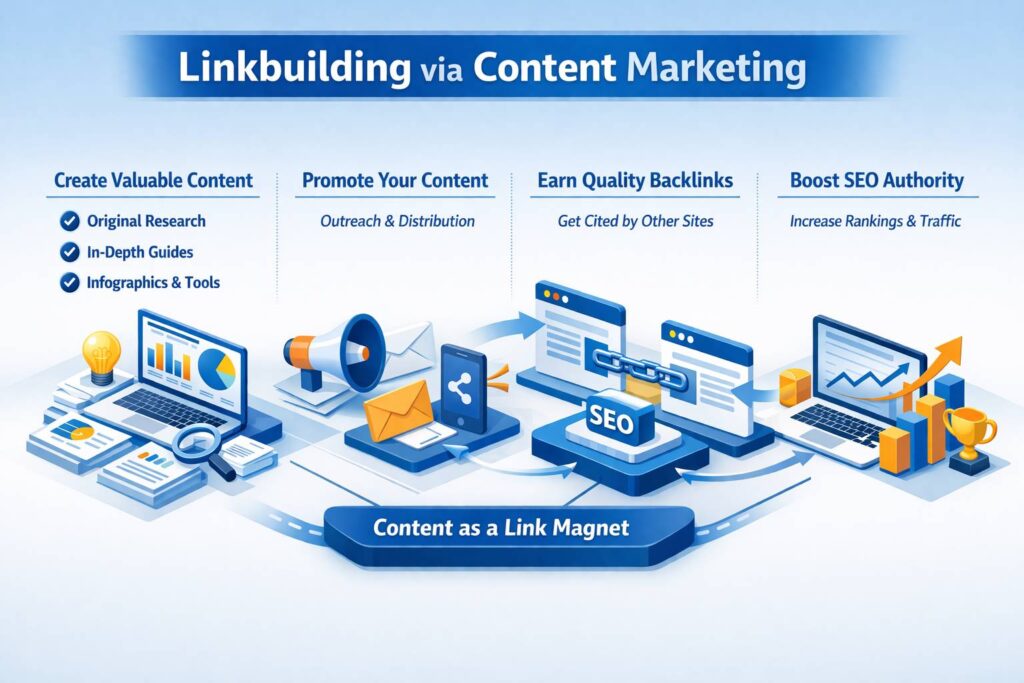
Linkbuilding via content marketing is the process of creating and promoting content specifically designed to attract relevant backlinks. Instead of relying only on direct link requests or placement-based tactics, this approach uses useful, publishable, and reference-worthy content as the core driver of link acquisition.
That distinction matters because not every linkbuilding method works the same way. Some tactics focus on outreach first and content second. Content marketing-led linkbuilding reverses that logic. The content itself becomes the asset that makes backlinks more likely.
For businesses, marketers, and SEO professionals, this is often one of the most sustainable ways to build authority. It aligns link acquisition with real value creation. It also fits naturally into a broader SEO strategy built around topical authority, pillar pages, cluster content, and internal linking.
This article explains what linkbuilding via content marketing is, why it matters, how it works, which content formats tend to support backlink growth, what mistakes to avoid, and how to approach it in a realistic way. It follows the supplied writing and SEO guidance for an informational cluster page within a pillar-and-cluster structure.
What Is Linkbuilding via Content Marketing?
Linkbuilding via content marketing is the practice of earning backlinks by publishing content that other websites genuinely want to reference.
In practical terms, this means creating content that has citation value, not just ranking value. A page can rank for keywords and still attract very few backlinks if it does not offer anything other publishers feel compelled to reference. Content-led linkbuilding focuses on closing that gap.
This kind of content often includes:
- original research
- industry studies
- statistics pages
- detailed guides
- opinion-led expert commentary
- tools, templates, or calculators
- visual assets such as infographics or frameworks
The goal is not simply to publish more content. The goal is to publish assets that are useful enough to be cited in articles, shared in newsletters, referenced in roundups, or used by journalists, bloggers, and editors.
That is why linkbuilding content marketing sits at the intersection of SEO, content strategy, and digital PR. It is not just about writing blog posts. It is about producing content with enough substance, utility, or distinctiveness to earn links.
Why It Matters
Linkbuilding via content marketing matters because the strongest backlinks are often earned by pages that give publishers a clear reason to reference them.
It aligns links with real value
One of the biggest advantages of this approach is that it ties link acquisition to usefulness. When a page earns backlinks because it genuinely helps other writers support a point, explain a topic, or reference data, the link is usually more credible and durable.
That makes content-led linkbuilding more sustainable than tactics that depend heavily on manufactured placements.
It supports authority building at scale
A strong content asset can attract backlinks from multiple websites over time. Unlike one-to-one placement tactics, a good content marketing asset may continue earning links long after it is published if it remains useful and visible.
This creates compounding value. One excellent page can support both direct backlink growth and wider authority building across the site.
It strengthens topical authority
When a website consistently publishes strong content around a topic and earns links to those resources, it reinforces its credibility in that subject area. This is particularly useful in a pillar-and-cluster model, where one content asset can support several related pages through internal linking.
For example, a strong cluster article on linkbuilding via content marketing may support the broader linkbuilding pillar, while also connecting to related pages on outreach, guest blogging, digital PR, and linkable assets.
It improves outreach effectiveness
Content marketing and outreach are not separate. In many campaigns, better content makes outreach easier because the pitch becomes stronger. When you contact publishers with a genuinely useful asset, you are offering value instead of just requesting a backlink.
That improves both response quality and placement quality.
How It Works
Linkbuilding via content marketing works best when content creation and promotion are planned together from the start.
Start with link-worthy content ideas
Not every content topic is likely to earn backlinks. Many informational articles are useful for ranking and education, but do not naturally attract references.
A stronger starting point is asking which kinds of content people in your industry actually cite. These often include pages that provide:
- new data
- clearer explanations
- practical resources
- consolidated statistics
- expert interpretation
- reusable frameworks
This is why ideation matters. If the page has no natural citation value, it will be much harder to use for linkbuilding.
Match the content format to the link opportunity
Different content formats attract links for different reasons.
A statistics page may earn links from writers needing quick data points. A deep guide may earn links from educational roundups. An original study may attract journalists or industry blogs. A template or calculator may earn links because it solves a practical problem.
The key is understanding why someone would link to the page. If that reason is not clear, the asset may need improvement before promotion begins.
Create the asset to a high standard
Because content is doing the heavy lifting in this strategy, quality matters even more. Thin, generic, or derivative pages usually do not earn strong backlinks consistently.
A strong asset often includes:
- clear structure
- useful depth
- strong design or readability
- original insight or organization
- credible framing
- a clear reason it deserves citation
This is where many campaigns fall short. Teams create content that is “good enough” for publication, but not distinctive enough for link acquisition.
Promote the content deliberately
Even good assets often need promotion. Content marketing-led linkbuilding does not mean publishing something and hoping links appear. It usually involves outreach, relationship-building, distribution, and sometimes digital PR.
This can include contacting relevant publishers, journalists, editors, bloggers, newsletter writers, or communities that may find the asset useful. The difference is that the outreach is powered by the content itself.
Important Subtopics Within Linkbuilding Content Marketing
Linkable assets
A linkable asset is a page specifically designed to attract backlinks. This is one of the most important ideas in content-led linkbuilding because not every page on a site should serve the same purpose.
Some pages are built to convert. Some are built to rank. Some are built to support users within the funnel. Linkable assets are built to earn attention and references from other websites.
Original research
Original research is one of the strongest content formats for linkbuilding because it gives publishers something unique to cite. If the data is useful, clearly presented, and relevant to the market, it can create link opportunities that generic opinion content cannot.
Not every business can produce large research projects, but even smaller proprietary data sets or well-framed internal insights can sometimes work.
Statistics and data pages
Statistics pages are frequently linked because writers often need sourceable numbers quickly. A well-maintained statistics or benchmark page can become a recurring citation source if it is accurate, well-organized, and updated when necessary.
This makes it a particularly effective format for linkbuilding via content marketing.
Content promotion and outreach
Content alone is not always enough. Promotion is usually what helps a strong asset reach the people most likely to link to it.
This is where linkbuilding via content marketing overlaps with linkbuilding outreach. The two are closely connected. Better content creates stronger outreach opportunities, and better outreach gives strong content more visibility.
Common Mistakes
Content marketing-led linkbuilding often underperforms for predictable reasons.
Creating content that is useful but not cite-worthy
A page may be informative for readers without giving publishers a strong reason to link to it. That is one of the most common problems. Ranking content and linkable content are not always the same thing.
Publishing generic assets
If the page looks like dozens of competing articles, it will struggle to attract editorial attention. Strong content marketing for linkbuilding usually needs a clearer angle, better execution, or more useful structure.
Treating content as promotion-free
Even excellent content may not earn meaningful links without active distribution. Publishing alone is rarely enough in competitive spaces.
Ignoring the role of site structure
A link-worthy asset becomes more valuable when it connects to the rest of the site strategically. If a page earns backlinks but sits in isolation with weak internal linking, much of its broader SEO value is underused.
Expecting every article to earn backlinks
Not every piece of content needs to function as a link magnet. Trying to make every page serve every SEO goal usually weakens the strategy. It is often better to create specific assets for link earning and let other pages serve ranking or conversion purposes.
Practical Guidance
A strong approach to linkbuilding via content marketing starts by deciding which themes in your niche are most likely to attract citations. From there, build assets that are not just informative, but reference-worthy.
That usually means focusing on content with one or more of these qualities:
- originality
- utility
- clarity
- authority
- reusability
Then connect those assets to the wider site structure. A well-placed internal linking system helps ensure that backlinks earned by one content asset support other strategic pages, including relevant cluster articles and the broader pillar page on linkbuilding. That is where content marketing becomes more than a publishing tactic. It becomes a structural SEO asset.
It is also important to stay realistic. Content-led linkbuilding is often slower than direct placement-based tactics in the short term, but it is usually stronger in the long term because it is built around assets that continue to have value after the initial campaign.
Timing and Expectations
Linkbuilding via content marketing usually takes time. Creating the asset, refining it, promoting it, and earning links is rarely instant.
Some content formats, especially research-driven or highly useful resources, can attract links relatively quickly if promoted well. Others gain traction more gradually as they are discovered, cited, and circulated. The timeline depends on the strength of the topic, the quality of the asset, the competitiveness of the niche, and the effectiveness of promotion.
It is also worth remembering that not all value appears immediately in rankings. A strong asset may first build links, then support wider authority through internal linking over time.
Conclusion
Linkbuilding via content marketing is the process of earning backlinks by creating content worth citing. At its best, it is one of the most sustainable forms of link acquisition because it ties backlinks to genuine usefulness rather than forced placement.
That does not mean every piece of content will naturally attract links. The pages most likely to support linkbuilding are those built with clear citation value, strong execution, and deliberate promotion. When those assets are connected to a broader site architecture, they can strengthen not only the linked page, but also the wider topical cluster around it.
For businesses taking SEO seriously, linkbuilding content marketing is not just about publishing more. It is about publishing the right kinds of assets, promoting them intelligently, and using the authority they earn to support long-term organic growth.