
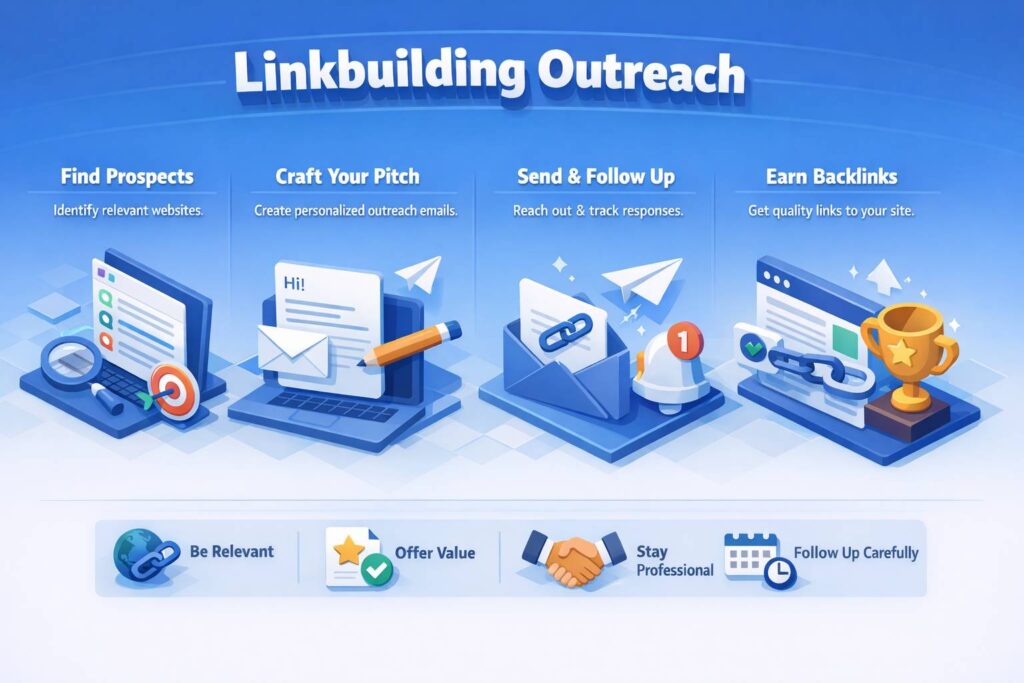

Linkbuilding Outreach: How to Build Backlinks Through Strategic, Relevant Outreach
Linkbuilding outreach is the process of contacting relevant website owners, editors, journalists, bloggers, or content managers to present a page, resource, or idea that may deserve a backlink. In practical SEO terms, it is how you connect strong content with people who might realistically reference it.
This matters because good content does not always earn links on its own. Many useful pages remain invisible unless they are actively promoted to the right people. At the same time, poor outreach can damage credibility, waste time, and produce weak results even when the page being promoted is good.
For businesses, marketers, and SEO professionals, linkbuilding outreach is not about sending large volumes of generic emails. It is about relevance, timing, page quality, and clear communication. Done well, it helps a website earn editorial backlinks that support authority, rankings, and wider visibility. Done badly, it turns into spam.
This article explains what linkbuilding outreach is, why it matters, how it works, which supporting concepts matter most, what mistakes to avoid, and how to approach it in a realistic and sustainable way. It follows the supplied writing and SEO guidance for an informational cluster page within a broader pillar-and-cluster content model.
What Is Linkbuilding Outreach?
Linkbuilding outreach is the outreach process used to earn backlinks by presenting genuinely useful content, resources, or contributions to relevant third parties.
The key point is that outreach itself is not the value. Outreach is only the delivery mechanism. The actual value comes from what you are offering and why it is worth linking to.
In practice, linkbuilding outreach can support several types of activity, including:
- promoting a strong guide or resource
- suggesting a useful addition to an existing article
- pitching original research or data
- offering expert commentary
- reclaiming unlinked brand mentions
- proposing guest contributions where relevant and appropriate
Although the tactics can vary, the principle remains the same. You are asking another site to consider referencing your page because it helps their audience, strengthens their content, or fills a gap.
That is why successful linkbuilding outreach depends heavily on page quality and contextual fit. A well-written email cannot rescue a weak asset.
Why Linkbuilding Outreach Matters
Linkbuilding outreach matters because many good backlinks are not earned passively. Even strong content often needs deliberate promotion before the right publishers discover it.
It helps strong pages get seen
A useful resource may deserve links, but it still needs exposure. Outreach helps place that resource in front of editors and writers who already publish relevant content.
This is especially important for newer websites, smaller brands, or sites in competitive industries where visibility does not come naturally.
It supports authority and rankings
Relevant editorial backlinks can strengthen the authority signals of important pages. That can help a page compete more effectively in search results, especially when other ranking factors are already in place.
Linkbuilding outreach does not replace technical SEO, content quality, or internal linking. It works alongside them. In most cases, outreach is most effective when it supports pages that are already strategically important within the site structure.
It creates more targeted link acquisition
Passive link earning can be unpredictable. Outreach allows you to focus on the publishers, topics, and pages that are actually relevant to your niche.
That makes the process more intentional. Instead of waiting for random discovery, you actively identify realistic opportunities.
It connects content strategy to promotion
A site building topical authority needs more than content production. It also needs visibility and external validation. Linkbuilding outreach helps close that gap by promoting high-value assets that support the wider content cluster. That makes it a useful companion to a broader linkbuilding strategy rather than a standalone activity.
How Linkbuilding Outreach Works
Linkbuilding outreach works best when it follows a clear process. The mechanics are simple, but the quality of execution makes a major difference.
Start with a page worth promoting
Before prospecting or emailing anyone, review the page you want to promote.
Ask whether it is genuinely useful, complete, and relevant enough to deserve a link. If the page is thin, generic, or interchangeable with dozens of other articles, outreach performance will usually be poor.
Strong outreach assets often include:
- in-depth guides
- original data
- useful templates
- practical tools
- expert commentary
- well-designed resource pages
This is why linkbuilding outreach is tightly connected to content quality. Outreach works better when the asset gives people a real reason to say yes.
Build a relevant prospect list
The next step is identifying websites and pages that are realistically connected to your topic.
That means looking for sites that already publish related content, reference external sources, and have audiences that overlap with the page you are promoting. Relevance is more important than scale. A moderately authoritative but highly relevant site can be more valuable than a larger publication with weak topical overlap.
Prospecting should focus on fit, not volume.
Understand the context before emailing
Good outreach is rarely generic. Before contacting someone, review the site, the relevant article, and the likely reason your page could be useful.
Are you suggesting a resource that fills a gap in an existing article? Are you offering data that supports a claim? Are you reaching out because the publisher has linked to similar content before?
The clearer the context, the stronger the pitch.
Send a concise, relevant pitch
Effective outreach emails are usually short, specific, and professional. They explain why you are reaching out, what page you are suggesting, and why it may be useful in that exact context.
The message should not sound manipulative or overly promotional. It should sound like a credible suggestion from someone who has actually reviewed the content.
Follow up carefully
Not every good outreach email gets a reply. Editors are busy, inboxes are crowded, and even relevant pitches can be missed.
A polite follow-up can help, but repeated pressure usually hurts more than it helps. Linkbuilding outreach should be persistent enough to be effective, but restrained enough to remain professional.
Important Subtopics Within Linkbuilding Outreach
To do linkbuilding outreach well, it helps to understand the supporting ideas that shape results.
Personalization
Personalization in outreach means adapting the message to the site, article, and recipient rather than sending a template with superficial edits.
Real personalization is not using someone’s first name and calling it tailored. It is showing that you understand their content and have a specific reason for reaching out.
This matters because most recipients can identify mass outreach immediately. Genuine relevance stands out. Fake personalization usually does not.
Prospect relevance
Prospect relevance is one of the strongest filters in outreach. A site may be authoritative, but if it has little connection to your topic, the opportunity may be weak.
Relevance should be judged at both the domain and page level. A site might cover marketing broadly, but if the page you are targeting is about email deliverability, a pitch for a linkbuilding outreach guide may be a poor fit.
This is one reason outreach lists should be curated rather than scraped in bulk.
Linkable assets
Linkbuilding outreach performs better when the target page is a clear linkable asset. Some pages are easier to pitch because they provide something useful that supports another publisher’s content.
That could be a research-based article, a practical checklist, a glossary, a statistics page, or a genuinely comprehensive guide. Outreach becomes much harder when the page is primarily commercial and offers little editorial value.
Relationship building
Strong outreach is not only transactional. Over time, good outreach can help build relationships with editors, writers, and publishers in your space.
That does not mean every contact becomes an ongoing partnership. But respectful, relevant outreach can make future collaboration more likely, especially if your content remains consistently useful.
This is part of why professionalism matters. Even when a pitch does not lead to a link, it can still affect how your brand is perceived.
Common Linkbuilding Outreach Mistakes
Many outreach campaigns fail for predictable reasons. The issue is often not effort, but direction.
Sending generic mass emails
Large-scale generic outreach usually produces low response rates because it gives recipients no clear reason to care. A template can support efficiency, but it still needs real contextual adaptation.
Promoting weak pages
A poor asset creates a weak pitch. If the page does not offer something distinct, useful, or well-structured, even excellent outreach execution will struggle.
Targeting irrelevant sites
Irrelevant prospecting wastes time and weakens results. Strong outreach starts with a narrow definition of fit, not a broad list of email addresses.
Focusing only on link metrics
Authority metrics can be useful, but they should not dominate prospecting decisions. A relevant page on a credible site is often a stronger opportunity than a higher-metric page with weaker topical alignment.
Over-following up
A polite follow-up can be effective. Multiple pressure-driven emails usually are not. Outreach should feel professional, not intrusive.
Treating outreach as separate from SEO strategy
Linkbuilding outreach works best when it supports a larger SEO plan. That includes knowing which pages matter most, how those pages fit into the site’s internal linking structure, and which topics deserve stronger authority signals.
Practical Guidance for Doing Linkbuilding Outreach Well
A strong outreach process is selective, disciplined, and realistic.
Start by choosing pages that are genuinely worth promoting. Then review the search landscape and publisher landscape around that topic. Identify sites that already reference similar resources or cover related themes. Build a prospect list based on relevance, not just raw authority scores.
When writing emails, keep the pitch clear and specific. Explain why the content may be useful, not why you want a backlink. That difference matters. The best outreach frames the page in terms of value to the publisher’s audience.
It also helps to align outreach with your wider content architecture. For example, a strong cluster page on linkbuilding outreach may support the broader pillar page on linkbuilding through internal linking. If the cluster earns relevant backlinks, that value can contribute to the wider topical structure of the site. This is one reason outreach should be planned alongside content and internal linking, not treated as a separate workflow.
Finally, measure outreach quality, not just activity. Sending more emails does not automatically mean better performance. Useful indicators include response quality, positive replies, editorial link placements, and the relevance of acquired links.
Timing and Expectations
Linkbuilding outreach can produce results relatively quickly at the activity level, but SEO impact usually takes longer.
You may identify prospects, send emails, and secure placements within days or weeks. But the ranking effect of those links depends on many other factors, including page quality, site strength, crawl timing, competition, and the overall SEO condition of the website.
It is also important to expect non-responses. Even good outreach campaigns usually involve a large share of ignored emails. That is normal. Outreach performance should be judged on relevance, quality of placements, and long-term contribution, not on unrealistic reply expectations.
Conclusion
Linkbuilding outreach is the process of presenting valuable content to relevant publishers in a way that gives them a credible reason to link. At its best, it is not spam, volume, or manipulation. It is targeted promotion built on relevance, usefulness, and professional communication.
For websites investing in SEO seriously, linkbuilding outreach can help strong pages earn the visibility and editorial backlinks they would not always gain on their own. But it only works consistently when the outreach supports content that deserves attention and fits into a wider strategy for topical authority, internal linking, and sustainable growth.
That is the real role of linkbuilding outreach. It is not a shortcut to rankings. It is a strategic method for helping good content reach the people most likely to value and reference it.