
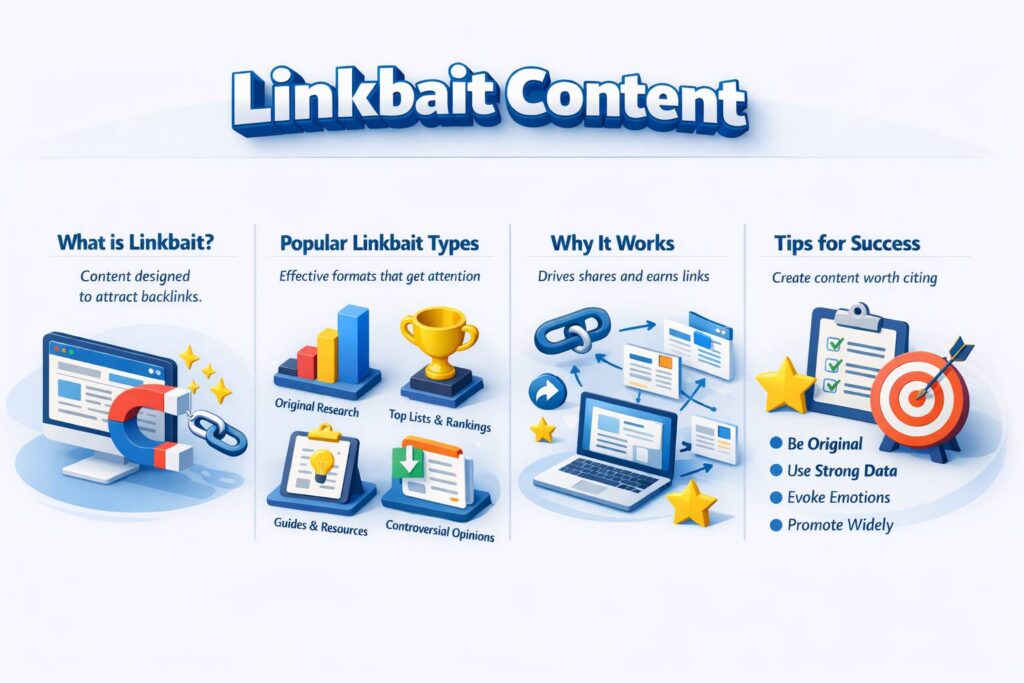

Linkbait Content: What It Is, Why It Works, and How to Use It Without Sacrificing Quality
Linkbait content is content created specifically to attract attention, shares, mentions, and backlinks. In SEO, the goal of linkbait is not only to generate interest. It is to publish something compelling enough that other websites naturally want to reference it.
That definition often creates confusion because the term “linkbait” can sound manipulative. In practice, linkbait content can range from genuinely useful resources and original research to highly opinionated takes, surprising data, or creative visual assets. The real distinction is not whether the content is designed to attract links. Many strong SEO assets are. The more important question is whether the content earns attention through real value or through shallow tactics.
That is where strategy matters. Poor linkbait content chases clicks and reactions without building trust. Strong linkbait content earns backlinks because it offers something notable, useful, unusual, or highly reference-worthy. When approached well, it can support authority growth, strengthen content marketing, and help a site earn links beyond direct outreach.
For businesses, marketers, and SEO professionals, linkbait content is best understood as a deliberate content format within a broader linkbuilding strategy. This article explains what linkbait content is, why it matters, how it works, which forms are most effective, what mistakes to avoid, and how to approach it in a way that supports long-term SEO rather than short-term attention. It follows the supplied guidance for an informational cluster page within a pillar-and-cluster structure.
What Is Linkbait Content?
Linkbait content is content designed to attract backlinks because it gives other publishers, writers, or creators a reason to reference it.
In practical terms, this means creating something that stands out enough to be cited, discussed, embedded, or shared. That “something” could be a strong asset such as:
- original data or research
- a useful industry study
- a statistics page
- a bold opinion or contrarian analysis
- a free tool or template
- a highly visual explainer
- a surprising ranking, comparison, or framework
The common thread is that the content has link appeal. It is not just optimized to rank for a keyword. It is built to trigger attention from people who create content themselves.
That is why linkbait content sits close to linkbuilding via content marketing. The main difference is emphasis. Content marketing can include many content types that primarily educate or convert. Linkbait content is more specifically aimed at earning backlinks and public attention.
The term can sometimes carry negative baggage because low-quality publishers have used it to describe sensational or misleading content. But not all linkbait is low quality. In many cases, the best linkbait content is simply well-designed, well-timed, and exceptionally reference-worthy.
Why It Matters
Linkbait content matters because many backlinks are earned by pages that stand out, not just pages that exist.
It helps content earn links more naturally
One of the main advantages of linkbait content is that it creates a reason for people to link without being heavily dependent on one-to-one placement tactics. The more compelling the asset, the easier it becomes for other sites to cite it voluntarily.
That can make link acquisition more scalable than outreach alone.
It supports authority building
A strong linkbait asset can earn links from blogs, newsletters, journalists, industry roundups, and resource pages. If those links are relevant and editorially earned, they can strengthen the authority of the page and support the wider site.
This is especially useful for websites trying to build visibility in competitive topics where passive link growth is otherwise slow.
It can attract attention beyond SEO
Good linkbait content may also produce value through brand awareness, referral traffic, social sharing, and market visibility. That does not replace SEO value, but it often complements it.
Some of the strongest content assets work because they are useful both for searchers and for publishers looking for something worth mentioning.
It strengthens a broader topical cluster
Within a pillar-and-cluster structure, a strong linkbait asset can support more than one page. If it earns backlinks and is well integrated through internal linking, some of that authority can support related cluster pages and the wider pillar page on linkbuilding. That makes linkbait content more strategically useful than a standalone viral attempt.
How Linkbait Content Works
Linkbait content works when it combines genuine value with a strong reason for others to reference it.
Start with the right angle
Not every topic can become effective linkbait. A page needs an angle that gives it publishing value.
That might come from novelty, clarity, usefulness, surprise, data, controversy, or strong presentation. The point is not simply to cover a topic. The point is to cover it in a way that makes people feel it is worth citing.
For example, a basic article explaining linkbuilding may be useful for readers. A well-structured study showing which linkbuilding tactics publishers trust most could be far more likely to earn backlinks.
Choose a format that encourages citations
Different formats support different kinds of backlinks.
Data-driven pages can attract journalists and bloggers. Visual explainers can earn embeds and references. Useful templates can attract practical mentions. Opinion-led content can attract debate and discussion.
The format should match the reason you expect others to link.
Build the asset to a high standard
Because the content is doing the work of attracting links, quality matters heavily. Thin or gimmicky content may get attention briefly, but it usually does not earn the kind of links that support a serious SEO strategy.
A good linkbait asset usually has:
- a clear idea
- strong execution
- easy-to-cite structure
- credible framing
- visual clarity where relevant
- a distinct reason it matters
This is where a lot of attempts fail. The idea may be good, but the execution is too generic to deserve attention.
Promote it deliberately
Even strong linkbait content often needs distribution. That can include outreach to publishers, seeding it with communities, sharing it through newsletters, or connecting it to digital PR efforts.
Linkbait content is not just “publish and hope.” It often performs best when paired with active promotion.
Important Subtopics Within Linkbait Content
Originality
Originality is often the difference between ordinary content and linkbait content. That does not always mean original data, although that can help. It can also mean an original framing, better organization, stronger visuals, or a more useful interpretation of a topic.
If the content feels interchangeable with dozens of existing pages, it is unlikely to attract many links.
Emotional pull
Many linkbait assets work because they trigger a response. That might be surprise, curiosity, disagreement, admiration, or urgency.
Used carefully, emotional pull can help content spread. Used poorly, it becomes clickbait. The goal is not manipulation. The goal is to create a compelling reason to pay attention.
Reference value
Reference value is one of the strongest practical tests for linkbait content. Ask whether another publisher could realistically use this page to support an article, explain a concept, cite a stat, or guide readers to a useful resource.
If the answer is no, the asset may still be good content, but it is less likely to function as strong linkbait.
Promotion and outreach
Even highly linkable content benefits from strategic promotion. This is where linkbait content overlaps with linkbuilding outreach and content-led link acquisition. The better the asset, the stronger the outreach becomes.
Common Mistakes
Linkbait content often underperforms when people chase reaction instead of relevance.
Confusing linkbait with clickbait
This is one of the biggest mistakes. Clickbait is designed to attract clicks, often through exaggeration or weak substance. Linkbait content should aim for backlinks by offering something reference-worthy.
Attention without trust usually does not create durable SEO value.
Prioritizing shock over usefulness
A surprising headline may attract curiosity, but unless the page delivers real substance, it is unlikely to earn strong editorial backlinks.
Publishing assets with no citation value
Some content is entertaining or readable without being particularly linkable. If the page gives publishers no practical reason to reference it, backlink growth will be limited.
Ignoring brand fit
Not every kind of linkbait suits every business. A tactic that works for a media publisher may feel off-brand for a serious B2B company. The content still needs to fit the brand’s tone and credibility.
Failing to connect the asset to site structure
If a linkbait page earns attention but sits in isolation, much of its wider SEO value can be lost. Internal linking is important because it helps the asset support other strategic pages across the cluster.
Practical Guidance
A strong approach to linkbait content begins with choosing subjects where your brand can publish something notably useful, distinctive, or surprising. That does not always mean large-scale creative campaigns. In many cases, a strong dataset, a very useful resource, or a sharply framed industry insight is enough.
The best opportunities often sit at the intersection of three things:
- what your audience cares about
- what publishers in your space are likely to cite
- what your business can credibly produce
From there, focus on making the asset easy to reference. Clear headings, quotable ideas, clean visuals, and strong structure all help.
It is also important to connect linkbait content to the rest of the site. A strong asset on linkbait content, for example, can support related cluster pages on content marketing-led linkbuilding, digital PR, outreach, and the main linkbuilding pillar through thoughtful internal links. That allows one successful asset to contribute to wider topical authority rather than acting as an isolated win.
Finally, measure success beyond raw attention. A page that gets shares but earns weak links may be less valuable than a page that attracts fewer views but stronger editorial references.
Timing and Expectations
Linkbait content can sometimes gain attention faster than standard educational content, especially if the angle is timely or unusually strong. But that does not mean results are automatic.
Some assets earn links quickly after launch. Others build traction gradually as they are discovered, shared, and cited over time. The outcome depends on the quality of the angle, the strength of execution, the competitiveness of the niche, and the promotion behind it.
It is also important to set realistic expectations. Not every creative asset becomes widely cited. Not every strong page becomes a breakout success. Linkbait content improves the odds of earning backlinks, but it still depends on fit, distribution, and editorial interest.
Conclusion
Linkbait content is content designed to attract backlinks by being notable enough to reference. At its best, it is not shallow hype or manipulative click chasing. It is strategic content with strong citation value, clear relevance, and enough distinctiveness to stand out in a crowded publishing environment.
For businesses investing in SEO seriously, linkbait content can be a useful part of a broader linkbuilding strategy. It works best when the asset is genuinely useful or original, the promotion is deliberate, and the page is connected to a wider site structure through internal linking and topical coverage.
Used well, linkbait content does more than generate attention. It helps a site earn authority by publishing content that other websites actually want to mention.