
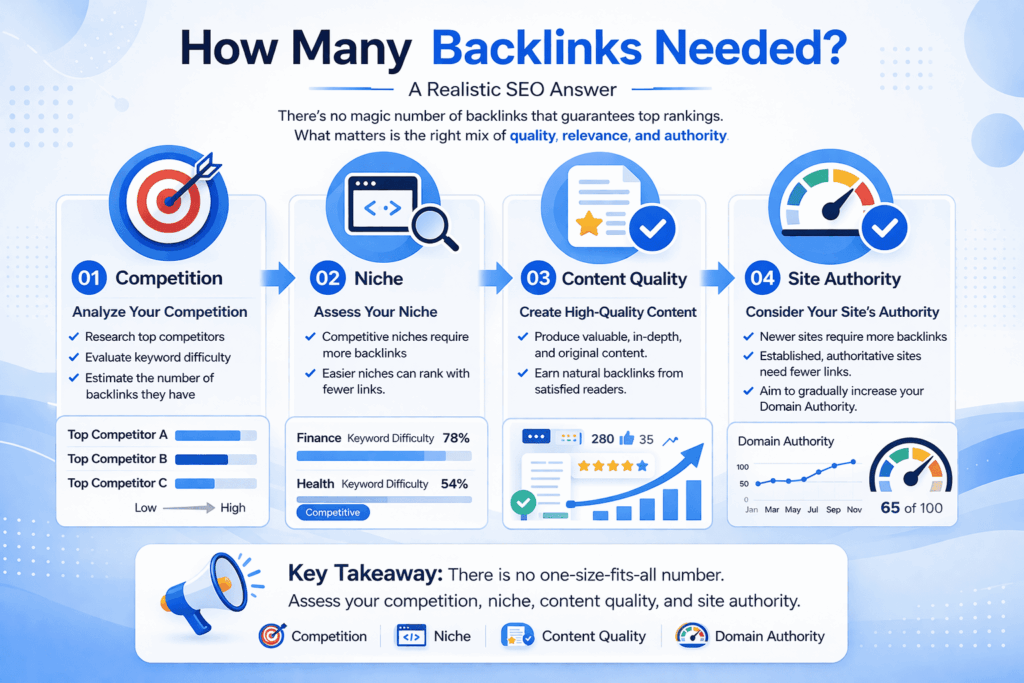

How Many Backlinks Needed? A Realistic SEO Answer
“How many backlinks needed” is one of the most common questions in SEO, and also one of the easiest to answer badly.
Many businesses want a fixed number. Ten links, fifty links, one hundred links. The problem is that backlinks do not work like a checklist. SEO does not reward a page simply because it crossed a certain link threshold. A page ranks because it is strong enough, relevant enough, and authoritative enough to compete against the pages already visible in search.
That means the real answer is not about volume alone. It is about the quality of the links, the strength of the page, the competition in the search results, and the overall authority of your site.
This article explains how to think about how many backlinks needed in a practical way, why there is no universal number, what actually influences the answer, and how to set better expectations.
What Does “How Many Backlinks Needed” Actually Mean?
When people ask how many backlinks needed, they are usually asking one of three things:
- how many backlinks are needed to rank a page
- how many backlinks are needed to outrank competitors
- how many backlinks are needed for a new site to gain authority
These are related questions, but not identical.
A low-competition informational page may rank with very few backlinks if the content is strong and the site already has topical relevance. A competitive commercial page may need substantially more authority support, either directly or indirectly through linked supporting content.
So the question is valid, but the framing needs refinement. The useful version is not “what number do I need?” It is “what level of authority do I need relative to the SERP I want to compete in?”
Why This Question Matters
This topic matters because backlink planning often goes wrong at the budgeting stage.
Some businesses assume they need a huge volume of links and overspend on poor-quality placements. Others assume a handful of links will solve everything, even when the page has weak content or sits in a competitive market.
A better understanding of how many backlinks needed helps with:
- setting realistic SEO expectations
- prioritizing link quality over volume
- judging competition more accurately
- avoiding wasted linkbuilding budget
- aligning backlinks with broader content strategy
In other words, this is not just a curiosity question. It affects how SEO is planned and measured.
How Many Backlinks Needed Depends on Context
There is no fixed number of backlinks that guarantees rankings.
A page may rank with a few strong backlinks, or struggle despite having many more. The outcome depends on the quality and relevance of the links, not just the count.
Competition matters first
The strongest factor is the search results you are trying to enter.
If the top-ranking pages are published on strong domains with deep topical authority and many relevant backlinks, your page will likely need more authority support to compete. If the search results are weak, outdated, or thin, the backlink requirement may be lower.
That is why backlink targets should always be set relative to the actual SERP, not in isolation.
Page quality changes the answer
A page with strong search intent alignment, useful structure, real expertise, and clear topical depth can do more with fewer backlinks than a weak page.
Backlinks amplify strong pages. They do not reliably rescue weak ones.
This is one reason businesses misjudge how many backlinks needed. They assume the problem is link volume when the real issue is that the destination page does not deserve to rank yet.
Site authority affects page-level needs
An established website with topical authority may need fewer new backlinks for a fresh page than a brand-new domain would.
That is because strong sites already benefit from existing trust, internal linking, and broader authority across the cluster. A newer site often needs more external validation just to reach the same starting point.
How Backlinks Actually Help Rankings
Backlinks contribute by helping search engines evaluate trust, prominence, and authority. But they work as part of a wider system.
Search engines also assess:
- content quality
- search intent alignment
- internal linking
- topical depth
- site structure
- crawlability and technical health
That means the number of backlinks alone is never the full story.
Fewer strong links can outperform many weak ones
A small number of relevant, editorially placed backlinks can outperform dozens of low-quality links from weak sites.
This is why counting backlinks without evaluating backlink quality creates poor strategy. A competitor with twenty strong referring domains may be much harder to beat than one with two hundred weak backlinks.
Referring domains matter more than raw link count
In many cases, the number of unique websites linking to a page or domain matters more than the total number of links.
Ten links from ten relevant websites usually send a stronger signal than ten links from one source. This is especially true when the links are contextual, editorial, and topically relevant.
Important Factors That Determine How Many Backlinks Needed
Search intent and keyword difficulty
The more commercially valuable or competitive the query, the more authority is usually required.
Informational long-tail topics may rank with fewer backlinks if the content is highly relevant and better than what currently exists. High-intent commercial keywords often require stronger page authority and stronger overall domain strength.
Topical authority of the site
A site with an established content cluster often needs fewer additional backlinks than a site trying to rank on a topic for the first time.
This is why pillar-and-cluster architecture matters. A well-built topic cluster can reduce how dependent each individual page is on direct backlinks.
Link quality
The answer to how many backlinks needed changes dramatically depending on link quality.
If the links are relevant, contextual, and from trusted sources, fewer may be needed. If the links are weak, off-topic, or low editorial quality, even a larger number may do very little.
Internal linking support
A page does not always need all of its authority built directly.
Sometimes the smarter approach is to earn backlinks to strong informational assets and use internal linking to support commercial or strategic pages. This makes linkbuilding more efficient and often more realistic.
Common Mistakes When Asking How Many Backlinks Needed
Looking for a universal number
This is the biggest mistake.
There is no standard number that works for every site, keyword, or industry. Anyone giving a fixed backlink number without context is oversimplifying the problem.
Focusing on backlinks before fixing the page
If the page is poorly written, weakly structured, or mismatched with search intent, backlinks may not solve the ranking problem.
Comparing totals without comparing quality
Businesses often compare themselves to competitors by counting backlinks only. That usually leads to distorted decisions.
What matters more is:
- relevance
- editorial quality
- referring domain strength
- page-level topical fit
- natural link placement
Ignoring the role of the wider site
Sometimes a page underperforms not because it lacks backlinks, but because the site lacks topical depth or internal link support. Backlink needs should be evaluated in the context of the whole site, not just one URL.
Practical Guidance
If you want a useful answer to how many backlinks needed, start by comparing your page to the current top-ranking results.
Look at:
- the quality of competing pages
- how strong the domains are
- how many relevant referring domains support those pages
- whether the ranking pages are directly linked or supported indirectly by stronger site architecture
- whether your page is genuinely better than what is already ranking
Then set goals based on the gap, not on arbitrary numbers.
A practical rule is this: aim to build enough authority to be competitive, not enough links to hit a round number.
For many businesses, that means focusing on:
- stronger content
- better internal linking
- linkable informational assets
- relevant editorial placements
- gradual authority growth across the cluster
That usually works better than chasing backlink volume for its own sake.
Timing and Expectations
Even when you build the right links, results are rarely immediate.
Search engines need time to crawl new backlinks, reassess page authority, and weigh that against the rest of the ranking signals. In competitive niches, the impact may take months rather than weeks.
It is also normal for the answer to how many backlinks needed to change over time. Competitors continue earning links, publishing content, and strengthening their sites. SEO is not static.
That is why backlink planning should be ongoing rather than treated as a one-time threshold to reach.
Conclusion
So, how many backlinks needed?
There is no universal number. The right answer depends on the competition, the quality of your page, the authority of your site, the quality of the links, and how well your broader content structure supports the page.
That is the strategic reality. Strong SEO does not come from hitting a backlink quota. It comes from building enough relevant authority to deserve visibility in the search results you want to enter.
For most businesses, the better question is not “how many backlinks do we need?” It is “what kind of authority gap are we trying to close?” Once that is clear, backlink strategy becomes much more practical and much less wasteful.