

How Linkbuilding Works: A Practical Guide to the Process Behind Better SEO Authority
Many businesses understand that backlinks matter, but fewer understand how linkbuilding works in practice. That is where confusion usually starts. Some assume it is just outreach. Others think it means buying links, publishing guest posts everywhere, or chasing high domain metrics without a real strategy behind them.
In reality, linkbuilding works when it strengthens the authority of the right pages through relevant, credible references from other websites. It is not just about acquiring links. It is about earning signals that support trust, visibility, and topical relevance.
That distinction matters because linkbuilding only delivers meaningful SEO value when it is connected to page quality, search intent, and site structure. If the content is weak or the target page is poorly chosen, links alone will not fix the problem.
This article explains how linkbuilding works, why the process matters, what supports it, and where businesses often go wrong.
What Is How Linkbuilding Works?
When people ask how linkbuilding works, they are really asking how backlinks influence SEO performance and how those links are acquired strategically.
Linkbuilding works by getting other websites to link to your content. Those backlinks act as external signals that can help search engines evaluate the importance, relevance, and credibility of your pages.
That does not mean every link passes equal value, or that rankings improve simply because a new backlink appears. Search engines look at the quality of the linking site, the relevance of the page, the context of the link, and the overall profile of the site receiving those links.
In practical terms, linkbuilding works best when:
- the linking page is relevant to your topic
- the referring site is credible
- the destination page is worth linking to
- the link appears naturally within useful content
- the broader site has strong technical and content foundations
So the process is not random. It works through a combination of authority, context, and relevance.
Why Linkbuilding Matters
Linkbuilding matters because SEO is not based only on what you say about your own website. Search engines also evaluate how the wider web responds to it.
If your page is useful, well targeted, and aligned with search intent, backlinks can help reinforce that it deserves visibility.
It helps search engines assess authority
Backlinks are one of the clearest external signals that a page has value beyond its own domain. When reputable sites reference your content, that can strengthen the case that your page is trustworthy and useful.
This is especially important in competitive search results where multiple pages cover similar topics with similar on-page optimization.
It supports organic visibility
Linkbuilding helps pages compete more effectively, particularly when a topic is commercially valuable or heavily contested. It does not replace content quality, but it can improve the strength of a page that already deserves to rank.
It strengthens topic clusters
In a pillar-and-cluster model, linkbuilding can support more than one page. When backlinks point to strong informational assets, internal links can help distribute authority to related content across the cluster. That makes linkbuilding more strategic than simply building links to whichever page is easiest to promote.
How Linkbuilding Works in Practice
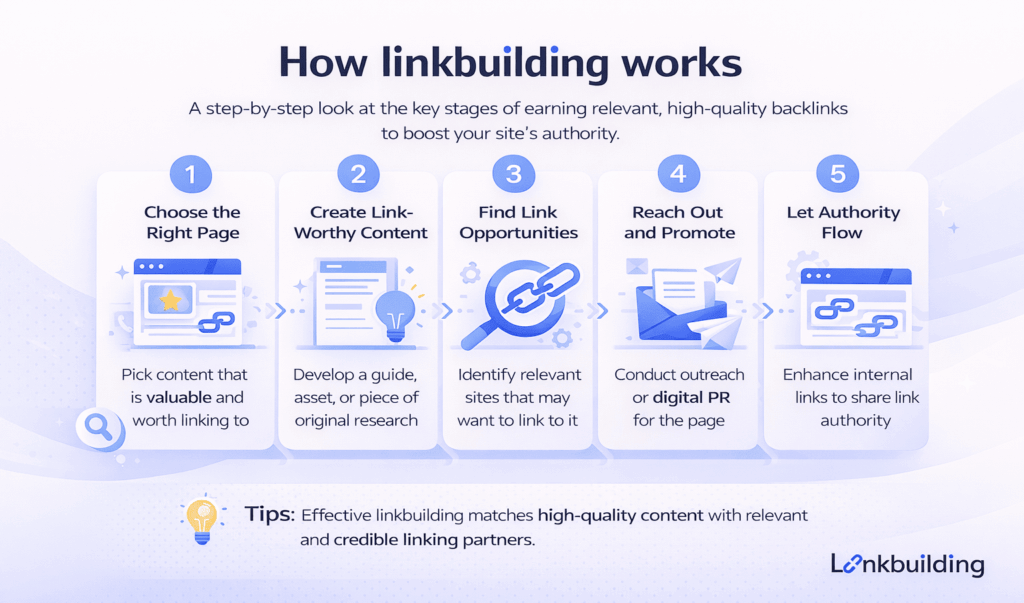
To understand how linkbuilding works, it helps to break the process into stages. Strong linkbuilding is usually the result of alignment between content, targeting, outreach, and internal structure.
Step 1: Choosing the right page
The process starts with page selection.
Not every page is a good link target. A sales page may be commercially important, but not naturally attractive to publishers or bloggers. A useful guide, original study, resource page, or expert article is often far easier to promote.
This is why many effective SEO strategies build links to informational assets first, then use internal linking to support related commercial pages.
Step 2: Creating something worth linking to
Linkbuilding works far better when the page being promoted offers a clear reason to link.
That could be:
- original research
- a practical guide
- expert commentary
- a resource hub
- a useful framework
- unique data or opinion
If the page says nothing new, adds little value, or simply repeats what already exists, outreach becomes much harder and results tend to be weaker.
Step 3: Finding relevant linking opportunities
Once the content is strong enough, the next stage is identifying websites that may have a genuine reason to reference it.
These might include:
- industry blogs
- niche publications
- news sites
- partner sites
- resource pages
- journalists looking for expert input
- relevant communities or associations
This is where relevance becomes critical. A backlink works better when it makes sense contextually, not just when it comes from a site with strong metrics.
Step 4: Outreach, promotion, or PR
After that, the page needs visibility.
Sometimes links are earned naturally over time, but in most cases promotion is needed. That may involve direct outreach, digital PR, expert contributions, reactive commentary, or content promotion to relevant publishers.
The key point is that linkbuilding works best when the pitch is based on real value. Weak outreach usually fails because the content itself gives people no reason to care.
Step 5: Authority flows through the site
When the backlinks are earned, the value does not stop at the landing page.
A strong internal linking structure helps distribute authority across related pages. That is why linkbuilding and site architecture should work together. If a linked page sits in isolation, much of the wider SEO value is lost.
Important Subtopics That Influence How Linkbuilding Works
Relevance shapes link value
One of the most important parts of linkbuilding is relevance.
A backlink from a site closely connected to your niche is usually more useful than a link from an unrelated site, even if the unrelated site appears stronger on paper. Search engines use context to understand why the link exists and what relationship the two pages have.
That is why topical fit matters so much in modern SEO.
Anchor text provides context
Anchor text is the clickable wording used in the link. It helps users and search engines understand what the linked page is about.
A natural backlink profile usually includes a varied mix of branded anchors, plain URLs, and descriptive phrases. Overusing exact-match keywords can create an artificial pattern, which is why anchor text should be handled carefully.
Internal linking multiplies the benefit
External backlinks build authority, but internal links help direct that authority to other important pages.
In a content cluster, this is particularly important. A guide or data page may attract links more easily than a service page, but internal linking allows that strength to support the wider topic structure.
Content quality still determines outcomes
A page with backlinks still needs to satisfy intent. If it is thin, outdated, poorly written, or misaligned with what users want, links will not solve the underlying issue.
This is one of the most common reasons businesses overestimate what linkbuilding can do. It is powerful, but only when it supports genuinely strong content.
Common Mistakes in Linkbuilding
Many poor campaigns fail not because linkbuilding no longer works, but because the process behind it is flawed.
Focusing on quantity instead of quality
A high number of backlinks may look impressive in a report, but that does not mean they are helping. Low-quality or irrelevant links often add little real value.
Building links to weak pages
If the destination page is not useful, not linkable, or not aligned with search intent, even good links may underperform. Page selection is one of the most overlooked parts of the process.
Ignoring internal linking
Some teams build links successfully but fail to connect those pages to the wider site structure. That limits the broader SEO benefit.
Expecting instant results
Linkbuilding does not work overnight. Search engines need time to crawl new links, interpret them, and reflect that value alongside all the other factors affecting rankings.
Practical Guidance
If you want to make linkbuilding work, focus on the mechanics behind it rather than the vanity metrics around it.
Start by identifying the topics and pages that matter most to your business. Then ask whether those pages are genuinely useful and whether they give others a reason to link.
A practical process usually includes:
- selecting pages with strategic value
- improving or creating content worth citing
- targeting relevant websites rather than random domains
- promoting content through thoughtful outreach or PR
- strengthening internal links between related pages
This approach is more sustainable than chasing links for their own sake.
Timing and Expectations
Linkbuilding should be viewed as a medium- to long-term SEO activity.
Some links may be indexed quickly, but meaningful impact usually takes time. Search engines reassess pages gradually, and links are only one part of the broader ranking picture.
Results depend on several factors, including content quality, competition, technical health, topical authority, and the quality of the backlinks being earned.
That is why realistic expectations matter. Good linkbuilding can improve performance, but it works best as part of a complete SEO strategy.
Conclusion
So, how does linkbuilding work?
It works by earning relevant backlinks that help search engines understand which pages deserve more trust, authority, and visibility. But the real process is more strategic than simply getting links. It depends on choosing the right pages, creating content worth citing, promoting it intelligently, and connecting that value through strong site architecture.
That is why effective linkbuilding is never just an outreach tactic. It is a system that supports long-term authority when content, relevance, and structure are all working together.
When businesses understand that process clearly, linkbuilding becomes far more effective and far less wasteful.