
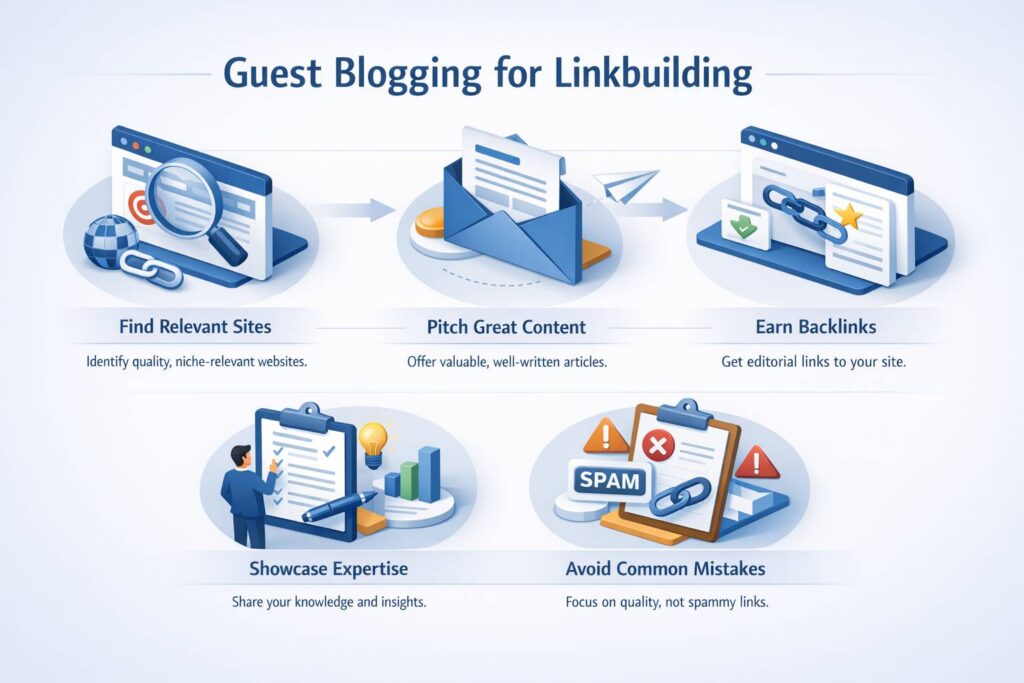

Guest Blogging for Linkbuilding: How It Works, When It Helps, and What to Avoid
Guest blogging for linkbuilding is the practice of writing content for another website in order to earn a relevant backlink, strengthen visibility, and support a broader SEO strategy. It remains one of the most discussed link acquisition methods because it can work well when done selectively and strategically, but it can also become low-quality and ineffective when treated as a scale tactic.
That distinction matters. Many businesses hear that guest posting is a good way to get backlinks, then approach it as a numbers game. They pitch irrelevant sites, write generic articles, and focus on placements instead of value. That usually leads to weak results and poor-quality links.
Used properly, guest blogging linkbuilding is more selective. It focuses on relevance, editorial quality, audience fit, and the role each placement plays within a wider SEO strategy. In that sense, guest blogging is not just about getting a backlink. It is about publishing useful content in the right places and earning links that make sense for both users and search engines.
This guide explains what guest blogging for linkbuilding is, why it matters, how it works, which supporting concepts matter most, what mistakes to avoid, and how to approach it realistically as part of a cluster-based SEO strategy. It follows the provided writing and SEO guidance for an informational cluster page.
What Is Guest Blogging for Linkbuilding?
Guest blogging for linkbuilding is the process of contributing an article to another website with the goal of earning a contextual backlink to your own site.
In practical terms, this usually involves identifying relevant websites, pitching a topic that suits their audience, writing the article, and including a natural link to a useful page on your site where appropriate. Sometimes the link appears in the body of the article. In other cases, it may appear in the author bio, though editorial in-content links are usually more strategically valuable when they are relevant and naturally placed.
The important point is that guest blogging should not be reduced to “write article, get link.” The real value depends on several factors:
- the relevance of the host site
- the editorial quality of the article
- the usefulness of the linked page
- the natural fit of the anchor text
- the wider SEO role of the link
This is why guest blogging linkbuilding sits somewhere between content marketing, outreach, and authority building. It is not just a content task, and it is not just a linkbuilding task.
Why It Matters
Guest blogging still matters because it can help websites earn relevant backlinks, reach new audiences, and strengthen authority when good opportunities are chosen carefully.
It can earn relevant editorial links
One reason guest blogging remains useful is that it can create backlinks in a context you help shape. If the site is relevant and the article is genuinely useful, the resulting link can be both editorial and topically aligned.
That makes it different from lower-value placement tactics where links appear in weak, thin, or irrelevant content.
It can support authority in competitive spaces
Some topics are highly competitive, and earning passive links can be difficult, especially for smaller or newer sites. Guest blogging can help bridge that gap by creating opportunities to publish expert content where your audience already pays attention.
That does not make it a shortcut. It simply gives you a more active way to build visibility when combined with strong content and outreach.
It can strengthen brand exposure
A good guest article may do more than provide a backlink. It can introduce your brand to a relevant audience, reinforce expertise, and create referral traffic from readers who actually care about the topic.
This matters because the best link opportunities often have value beyond SEO alone.
It can complement a wider linkbuilding strategy
Guest blogging should rarely be the only link acquisition method a site uses. It works best as part of a broader strategy that also includes strong linkable assets, digital PR, resource promotion, and internal linking.
Within a pillar-and-cluster model, guest blogging can help strengthen both cluster pages and the wider linkbuilding pillar when used selectively and tied to the site’s most important topics.
How Guest Blogging for Linkbuilding Works
Guest blogging linkbuilding works best when each stage is treated carefully. The process is simple on paper, but results depend on how selective and strategic the execution is.
Start with relevant target sites
The first step is finding websites that are topically connected to your niche and publish content that overlaps meaningfully with your expertise.
Relevance matters more than volume. A moderately authoritative site with real topical fit is often more useful than a larger site with only loose relevance.
When evaluating opportunities, look at:
- the subjects the site covers
- the quality of its published articles
- whether it appears editorially credible
- whether links in articles feel natural
- whether the audience is relevant to your business
A guest blogging opportunity is only strong if the host site makes sense.
Pitch useful topics, not generic ideas
Once a target site is identified, the next step is pitching a topic that suits its audience and content standards.
Weak guest post pitches are usually broad, vague, or obviously self-serving. Strong pitches are specific and show an understanding of what the site already publishes. They also avoid suggesting topics that have already been covered repeatedly.
A good pitch is less about what you want to place and more about what would genuinely be useful for that site’s readers.
Write content that deserves publication
The article itself needs to be strong enough to stand on its own. If the content feels thin, generic, or promotional, the link loses value because the entire placement is weaker.
A good guest article should:
- address a clear topic
- provide real value
- reflect subject knowledge
- fit the editorial style of the site
- avoid sounding like disguised advertising
This is where many campaigns fail. They focus so much on the backlink that they underinvest in the article.
Add links naturally
The backlink should fit the article naturally. That means linking to a page on your site only where it genuinely adds context, support, or extra value.
Forced links are easy to spot. Strong guest blogging linkbuilding uses contextual links that make sense to the reader.
Anchor text also needs restraint. Over-optimized exact-match anchors can make placements look manipulative. Natural variation is usually healthier and more credible.
Important Subtopics Within Guest Blogging Linkbuilding
Site relevance
Relevance is one of the most important filters in guest blogging. A placement on a site that actually covers your area is far more useful than one on a generic site that accepts almost anything.
Search engines do not evaluate links in isolation. The surrounding site and content context matter.
Editorial quality
Not every website that accepts guest posts is worth targeting. Some sites exist mainly to publish contributed content at scale with limited editorial control. These placements may offer little strategic value.
A strong guest blogging opportunity usually comes from a site with clear standards, decent content quality, and a real audience.
Anchor text strategy
Anchor text should support clarity without looking engineered. Brand mentions, descriptive phrases, and partial-match anchors are often more natural than aggressive exact-match keyword anchors.
The goal is not to squeeze a keyword into every placement. It is to create links that look and read naturally.
Target page selection
Not every page on your site deserves to receive guest post links. In many cases, it is better to link to useful resources, strong guides, or strategically important pages rather than forcing links to commercial pages that do not fit the article.
This is another reason guest blogging should be tied to site architecture. The target page should serve a real SEO purpose within the broader cluster.
Common Mistakes
Guest blogging often becomes ineffective when businesses treat it as a scalable placement tactic instead of an editorial strategy.
Targeting any site that accepts guest posts
A site accepting guest content is not enough on its own. If the site lacks topical relevance or editorial quality, the placement is probably weak.
Writing for the link instead of the audience
A guest article that exists only to hold a backlink is easy to spot. The best guest posts are genuinely useful even if the link were removed.
Over-optimizing anchor text
Using the same keyword-rich anchor repeatedly can create an unnatural profile. A more varied and contextual approach is safer and usually more effective.
Using low-quality sites at scale
Large numbers of weak guest post placements can create the appearance of activity without building meaningful authority. Scale does not automatically create value.
Treating guest blogging as the whole strategy
Guest blogging can help, but it is only one tactic. Without strong content on your own site, thoughtful internal linking, and wider authority-building efforts, it becomes much less effective.
Practical Guidance
A good guest blogging strategy starts with selectivity. Choose sites carefully, pitch thoughtfully, and write articles that would still be worth publishing even without the backlink.
It also helps to think about where guest blogging fits within the wider content structure of the site. For example, a cluster page on guest blogging for linkbuilding can support the broader pillar page on linkbuilding, while also connecting naturally to related topics such as linkbuilding outreach, anchor text strategy, and editorial backlinks. That kind of internal structure helps ensure the value of acquired links supports more than one isolated page.
In practice, guest blogging tends to work best when you:
- prioritize relevance over quantity
- publish only on sites you would genuinely want your brand associated with
- link to useful pages, not just convenient targets
- vary anchor text naturally
- treat the article as a real editorial contribution
This approach is slower than mass guest posting, but it is usually much more durable.
Timing and Expectations
Guest blogging can produce links faster than some passive link earning methods, but the SEO impact is still not immediate.
You may secure placements within weeks, but ranking improvements depend on many factors beyond the backlink itself. These include the authority of your site, the quality of the linked page, competition in the SERP, internal linking, and the overall SEO condition of the website.
It is also important to recognize that not every guest post will have equal value. A few strong, relevant placements often matter more than many weak ones.
Conclusion
Guest blogging for linkbuilding can still be an effective SEO tactic when it is used with restraint, relevance, and editorial judgment. The real value does not come from the fact that a site accepted your article. It comes from publishing useful content in the right place and earning a backlink that makes sense in context.
That is why good guest blogging linkbuilding is not a volume exercise. It is a quality-driven process built on site selection, topic fit, strong writing, and natural linking. For websites building authority through a pillar-and-cluster model, it can be a useful supporting tactic, especially when it strengthens strategically important pages and fits into a wider content and outreach plan.
Used well, guest blogging is not about chasing placements. It is about contributing something worth publishing and earning the right links as a result.