

Dofollow vs Nofollow: What the Difference Means for SEO
When people start evaluating backlinks, one of the first terms they encounter is dofollow vs nofollow. The topic sounds technical, but the underlying question is practical: which links pass SEO value, and which ones do not?
That question matters because not every backlink works in the same way. Some links can contribute more directly to authority signals, while others are treated differently by search engines. If you misunderstand that distinction, it becomes easy to overvalue the wrong links or ignore useful ones for the wrong reasons.
This article explains dofollow vs nofollow in clear terms, why the difference matters, how both link types work, and what businesses should focus on when assessing link opportunities.
What Is Dofollow vs Nofollow?
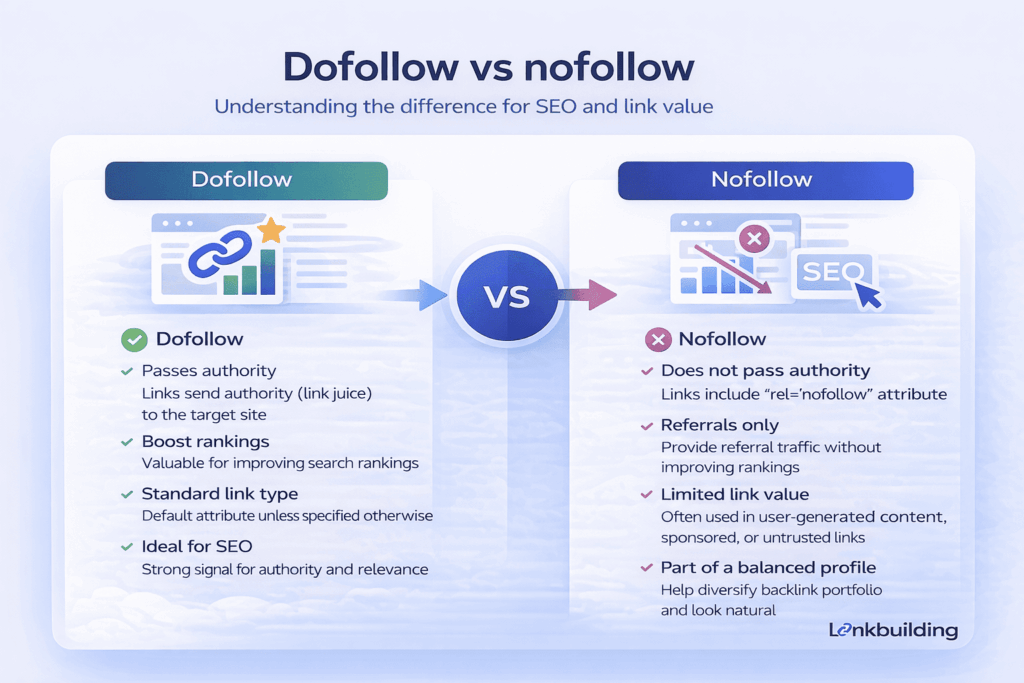
Dofollow vs nofollow refers to the difference between a standard link and a link marked with a nofollow attribute.
A dofollow link is the normal kind of hyperlink. It does not usually need a special label in conversation, because it is simply the default state of a link. When people say “dofollow,” they usually mean a standard link that search engines can use more directly as a ranking signal.
A nofollow link includes a specific attribute in the HTML telling search engines that the link should be treated differently.
In practical SEO terms, the distinction is about how search engines may interpret the link and whether it is likely to pass direct authority signals in the same way as a standard link.
The naming is slightly misleading
Strictly speaking, there is no special dofollow tag in normal HTML. A link is simply followed unless it carries an attribute such as nofollow, sponsored, or ugc.
That matters because many SEO discussions treat “dofollow” as a technical setting when it is really just shorthand for a normal link.
Why Dofollow vs Nofollow Matters
This topic matters because backlinks are not all interpreted equally.
If you are building links, auditing a backlink profile, or evaluating outreach opportunities, you need to understand that link attributes affect how a backlink may contribute to SEO.
Dofollow links can contribute more directly to authority
A standard link is generally more important for link equity and traditional authority signals. When a relevant, editorially placed page links to your content without a restrictive attribute, that link is usually seen as more influential from a ranking perspective.
This is why businesses often prioritize earning strong editorial backlinks that are effectively dofollow.
Nofollow links still have value
A common mistake is assuming nofollow links are worthless. They are not.
A nofollow link can still:
- drive referral traffic
- build brand visibility
- put your content in front of relevant audiences
- support a natural backlink profile
- create indirect SEO value through discovery and awareness
In some cases, a nofollow link from a major publication can be more valuable overall than a low-quality dofollow link from a weak site.
The real issue is context, not labels alone
The difference between dofollow vs nofollow matters, but it should not be isolated from relevance, placement, and source quality.
A relevant nofollow link on a trusted site can still be meaningful. A dofollow link on an irrelevant or manipulative site may add little value.
How Dofollow vs Nofollow Works
The difference is created in the HTML of the link.
A standard link looks like a normal hyperlink. A nofollow link includes an attribute that signals a different treatment for search engines.
From an SEO perspective, the key point is that search engines may use these attributes as guidance when deciding how much weight to assign to a link.
Dofollow links
When people refer to dofollow links, they usually mean standard links that search engines can crawl and potentially use as ranking signals more directly.
These links are often the ones businesses want most from:
- editorial mentions
- resource pages
- relevant guest posts
- digital PR placements
- naturally earned citations
Nofollow links
Nofollow links carry an attribute telling search engines the link should not be treated the same way as a standard link.
They often appear in places such as:
- blog comments
- forum posts
- sponsored placements
- some publisher outbound links
- user-generated content platforms
That said, the source and context still matter. Some high-authority publishers apply nofollow broadly, but their links can still drive meaningful visibility.
Important Subtopics Around Dofollow vs Nofollow
Sponsored and UGC attributes
The dofollow vs nofollow conversation is often incomplete without mentioning other link attributes.
Sponsored links are used to indicate paid or commercial relationships. UGC stands for user-generated content and is used for links in areas such as forums, reviews, or comments.
These attributes help search engines understand the nature of the link. They are part of a broader move toward more transparent link classification.
Link equity
One reason dofollow vs nofollow matters is link equity, meaning the authority or value that may flow through a link.
A standard editorial backlink is more likely to contribute directly to this kind of authority signal. That is why linkbuilders often focus on earning links that are not restricted by nofollow or similar attributes.
Natural backlink profiles
A healthy backlink profile usually includes a mix of link types.
If a site has only keyword-rich dofollow backlinks from suspicious sources, that pattern can look artificial. A more natural profile often includes branded links, nofollow mentions, media references, community links, and stronger editorial placements.
This is one reason businesses should avoid treating nofollow links as useless clutter.
Common Mistakes
Treating nofollow links as worthless
This is probably the biggest misunderstanding.
A nofollow link may not pass the same direct SEO value as a standard link, but it can still provide traffic, credibility, exposure, and indirect benefits.
Chasing dofollow links at any cost
Some businesses become so focused on dofollow backlinks that they ignore source quality.
That is a mistake. A weak dofollow link from a poor site is not automatically better than a relevant nofollow link from a strong publisher.
Ignoring relevance
The difference between dofollow vs nofollow does not override topical fit. Relevance still matters.
A link that makes sense editorially is usually more valuable than one that exists only because it was easy to place.
Overlooking link intent
If a link is clearly paid, promotional, or user-generated, the appropriate attributes should reflect that. Treating all links as if they should be dofollow creates unnecessary risk and poor-quality linkbuilding habits.
Practical Guidance
If you are evaluating backlinks or planning linkbuilding, use dofollow vs nofollow as one part of your assessment, not the whole decision.
A useful framework is:
- Is the source relevant?
- Is the site credible?
- Does the link appear naturally?
- Is the destination page worth linking to?
- Is the link type appropriate for the context?
- Would this placement still be valuable without direct SEO benefit?
That last question is especially important. It keeps your thinking grounded in quality rather than labels.
In most cases, businesses should aim to earn more strong, relevant editorial links that function as dofollow links, while still recognizing the value of nofollow mentions from reputable sources.
Timing and Expectations
The effect of link attributes is rarely something you can isolate instantly.
A new backlink needs to be discovered, crawled, and interpreted in the context of the whole site. Even strong dofollow links do not produce immediate rankings by themselves. Their impact depends on content quality, competition, internal linking, and the broader authority of the site.
Nofollow links may create value in less direct ways, often through visibility, brand exposure, and audience reach. That means they can still be worthwhile even when they are not the main driver of ranking improvement.
Conclusion
Dofollow vs nofollow is an important distinction in SEO, but it should not be simplified into “good links” and “bad links.”
A dofollow link is usually more valuable from a direct authority perspective because it can contribute more clearly to ranking signals. A nofollow link is treated differently, but it can still support traffic, awareness, credibility, and a natural backlink profile.
The strategic takeaway is simple: understand the difference, but do not let the label become the only thing you evaluate. Relevance, source quality, editorial context, and destination page value still matter more than the shorthand alone.
That is how dofollow vs nofollow should be approached in modern SEO: as part of a broader quality judgment, not as a shortcut.