
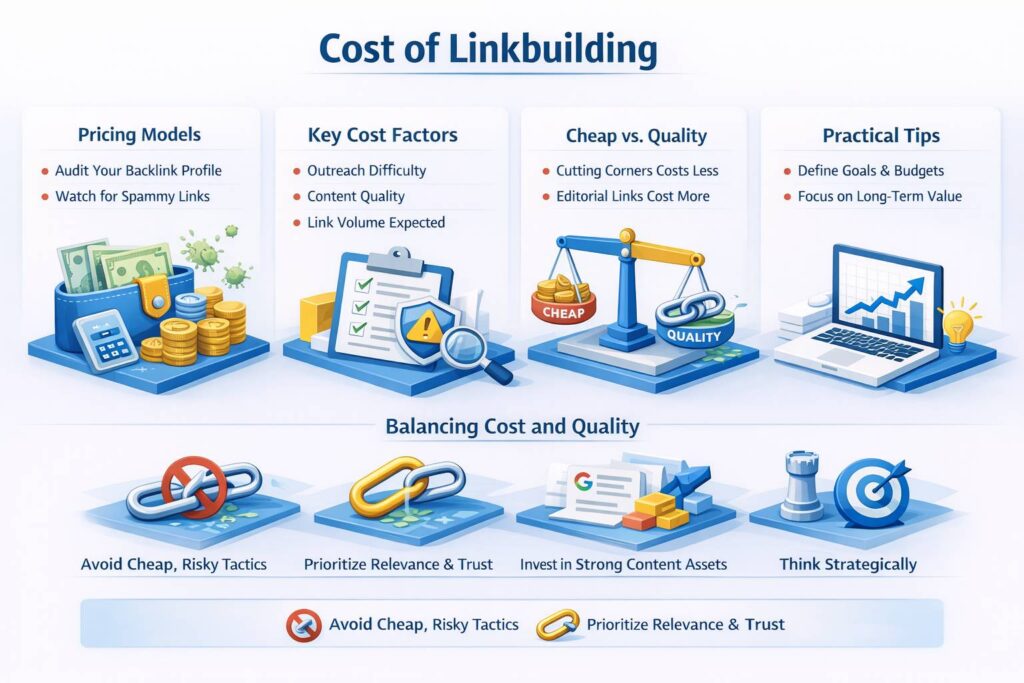

Cost of Linkbuilding: What Shapes Pricing and What Businesses Should Really Expect
The cost of linkbuilding is one of the most searched questions in SEO because backlinks can influence authority, rankings, and visibility, but pricing varies dramatically depending on the method, the market, and the standard of work involved.
That variation is exactly why broad answers on linkbuilding cost are often unhelpful. There is no single universal rate. A business might spend on digital PR, outreach, content creation, agency retainers, internal staff time, tools, or sponsored placements. Each model carries a different cost structure, a different risk profile, and a different long-term SEO value.
It is also important to separate what linkbuilding costs from what unsafe shortcuts cost. Google’s spam policies say buying or selling links for ranking purposes is link spam, and compensated links should be qualified appropriately, such as with rel="sponsored" or rel="nofollow". That means a low headline price for “links” is not automatically a good SEO investment if the tactic conflicts with search guidelines or creates unstable results. (Google for Developers)
For businesses, marketers, and SEO professionals, the useful question is not just “how much does linkbuilding cost?” It is “what are we paying for, what quality level does that budget buy, and does the spend support a sustainable SEO strategy?” This article explains the cost of linkbuilding in practical terms, the main pricing models, what drives costs up or down, common mistakes, and how to think about budget realistically. It also follows the supplied writing guidance for an informational cluster page.
What Is the Cost of Linkbuilding?
The cost of linkbuilding is the total investment required to acquire backlinks through SEO activity. That investment is broader than a per-link price.
In practice, linkbuilding cost may include:
- content creation
- prospect research
- outreach time
- relationship building
- digital PR
- design for visual assets
- agency retainers
- freelance support
- SEO tools
- reporting and management
This matters because many people think only in terms of “cost per link,” when the real cost is often the full workflow needed to earn credible links.
For example, if a company publishes original research and pitches it to journalists, the spend is not just the links that result. It includes the time, writing, data work, and promotion behind the campaign. On the other hand, if someone buys placement directly, the cost may look lower at first glance, but the strategic and policy risks can be much higher. (Google for Developers)
Why Linkbuilding Cost Matters
Linkbuilding cost matters because backlinks are still resource-intensive to earn well. A realistic budget helps businesses avoid both underinvestment and poor decision-making.
It shapes quality expectations
A very small budget usually cannot support high-quality outreach, strong content assets, and consistent editorial link acquisition at scale. That gap often leads businesses toward lower-value or riskier tactics.
It affects the kind of strategy you can run
Different budgets support different linkbuilding models. A business with a modest budget may focus on a few strong content assets and selective outreach. A larger brand may invest in digital PR, research campaigns, or a dedicated agency plus internal support.
It influences long-term ROI
Cheap links are not always good value. Expensive campaigns are not always efficient. The real question is whether the spend produces links that strengthen authority, fit the topic, and continue supporting the site over time.
It affects broader site architecture
In a pillar-and-cluster model, linkbuilding cost should be evaluated in the context of the pages being supported. A strong linkbuilding investment may help a strategic pillar or cluster page, which then supports related pages through internal linking. That is more valuable than buying isolated placements with no wider architectural role.
How Linkbuilding Pricing Usually Works
There is no single pricing model for linkbuilding. Most businesses encounter one or more of these structures.
Monthly retainer pricing
Many agencies price linkbuilding as a monthly retainer. This usually covers strategy, outreach, prospecting, management, reporting, and some amount of content support.
Ahrefs’ survey of 439 SEO service providers found that monthly retainers were the most common SEO pricing model, with many respondents charging within broad monthly bands rather than fixed per-deliverable pricing. While that survey covered SEO services more broadly, it helps show why linkbuilding is often packaged as recurring work rather than as a one-time fee. (Ahrefs)
For linkbuilding specifically, retainers often make sense because relationship-building and outreach are ongoing processes.
Per-link pricing
Some providers quote a direct cost per backlink. This model is easy to compare on paper, but it can be misleading because the quality gap between links is huge.
Ahrefs’ 2024 update on buying backlinks reported an average paid link cost of $83, while also noting that many paid links cost much more and that buying backlinks to help rankings violates Google’s spam policies. That figure is useful as a market signal for what some people pay, but it should not be treated as a recommendation or a quality benchmark. (Ahrefs)
A low per-link price often suggests weaker placements, lower editorial standards, or higher policy risk.
Project-based pricing
Some linkbuilding campaigns are priced by project. This often applies to digital PR campaigns, original studies, interactive assets, or one-off resource promotion efforts.
This can work well when the campaign has a clear deliverable and timeline, but the cost may be less predictable because outcomes vary.
Internal team cost
Some businesses run linkbuilding in-house. In that case, the spend is not paid as a single vendor line item, but it still exists through salaries, tools, content production, and management time.
This is often overlooked. “Doing it in-house” is not free. It simply changes where the cost sits.
What Drives the Cost of Linkbuilding Up or Down
The cost of linkbuilding depends much more on inputs and standards than on the word “linkbuilding” itself.
Content quality and asset creation
If the campaign depends on original research, expert-led guides, visual assets, or tools, costs rise because the asset itself takes time and skill to produce.
Outreach difficulty
Some industries are crowded, skeptical, or highly competitive. Getting links in those spaces usually takes more effort, which increases cost.
Niche competitiveness
A business in a low-competition niche may earn good links with fewer campaigns and simpler assets. A business competing in software, finance, legal, or other aggressive markets may face much higher acquisition costs.
Relevance and editorial standard
A relevant editorial link on a credible site generally costs more to earn than a low-quality placement because it usually requires better content, better fit, and stronger outreach.
Volume expectations
The more links a business expects in a short period, the more pressure the budget faces. Scale usually increases cost, and when it does not, quality often drops instead.
Important Subtopics Within Linkbuilding Cost
Cheap links versus sustainable links
One of the most useful ways to think about linkbuilding cost is to compare cheap links with sustainable links.
Cheap links may look affordable, but if they come from manipulative tactics, irrelevant placements, or compensated arrangements intended to pass ranking value, they may create weak or unstable results. Google’s spam policies and link qualification guidance are clear that paid links intended to influence rankings are a problem, and compensated links should be qualified appropriately. (Google for Developers)
Sustainable links usually cost more because they depend on stronger assets and real editorial judgment.
Cost per link versus cost per campaign
A single link price can hide important context. A campaign that costs more overall may still be a better investment if it produces stronger links, better brand visibility, and assets that keep attracting references later.
Linkbuilding versus general SEO pricing
General SEO pricing surveys can help frame expectations, but linkbuilding has its own cost profile because it is especially labor-intensive. Ahrefs’ broader pricing survey shows how varied SEO pricing is overall, which reinforces why any specific linkbuilding quote needs to be evaluated in context rather than against one supposed market rate. (Ahrefs)
Common Mistakes
Assuming the cheapest option is efficient
A low linkbuilding cost often means corners are being cut somewhere: site quality, outreach quality, relevance, or policy safety.
Comparing links as if they are identical
Not all backlinks are equal. One highly relevant editorial link can be more valuable than many weak placements.
Ignoring policy risk
If a pricing model depends on paid links for ranking purposes, that is not just a budget question. It is also a compliance and stability question under Google’s spam policies. (Google for Developers)
Expecting precise outcomes from uncertain work
Linkbuilding involves outreach, editorial judgment, and variable response rates. Businesses should be wary of pricing models that imply guaranteed outcomes without explaining quality controls.
Budgeting for links without budgeting for the page being promoted
A link to a weak page is a weaker investment. Linkbuilding cost only makes sense when the destination page is worth strengthening.
Practical Guidance
A realistic approach to the cost of linkbuilding starts by defining what you actually want the budget to achieve.
If the goal is long-term authority growth, the budget should support:
- pages worth linking to
- consistent outreach
- relevant prospecting
- strong content or assets
- internal linking that spreads value across the cluster
That usually means thinking in campaign or retainer terms rather than chasing the lowest cost per backlink.
It also helps to separate marketing spend from ranking manipulation. Sponsored placements may still have brand or referral value, but if compensation is involved, Google expects those links to be qualified with sponsored or nofollow. That makes them a different category from earned editorial links. (Google for Developers)
For many businesses, the best use of budget is not maximum link volume. It is funding fewer, stronger campaigns that support strategically important pages and fit the wider topic cluster.
Timing and Expectations
Linkbuilding cost and timeline are connected. Lower budgets often mean slower output, fewer experiments, and a tighter focus on priority pages. Larger budgets can accelerate activity, but they do not remove the need for patience.
Linkbuilding is still constrained by outreach cycles, editorial decisions, and campaign quality. Even expensive campaigns do not always produce immediate ranking gains. Semrush’s broader SEO pricing guidance also notes that SEO is a long-term process that can take months before significant results appear, which is useful context when setting expectations for linkbuilding spend as part of SEO more broadly. (Semrush)
Conclusion
The cost of linkbuilding is not one number. It is the cost of the strategy, content, outreach, relationships, and quality needed to earn backlinks that actually support long-term SEO.
That is why “linkbuilding cost” should be judged less by the cheapest quote and more by what the budget buys in relevance, credibility, and durability. Cheap links can be easy to find. Strong links are harder because they depend on real value and real editorial fit. Google’s current guidance also makes clear that paid links intended to manipulate rankings are not a safe shortcut, and compensated links should be qualified appropriately. (Google for Developers)
For businesses building topical authority seriously, the better question is not “what is the lowest possible cost of linkbuilding?” It is “what level of investment supports the kind of link profile our site can keep benefiting from over time?”