

Contextual Backlinks: What They Are and Why They Matter for SEO
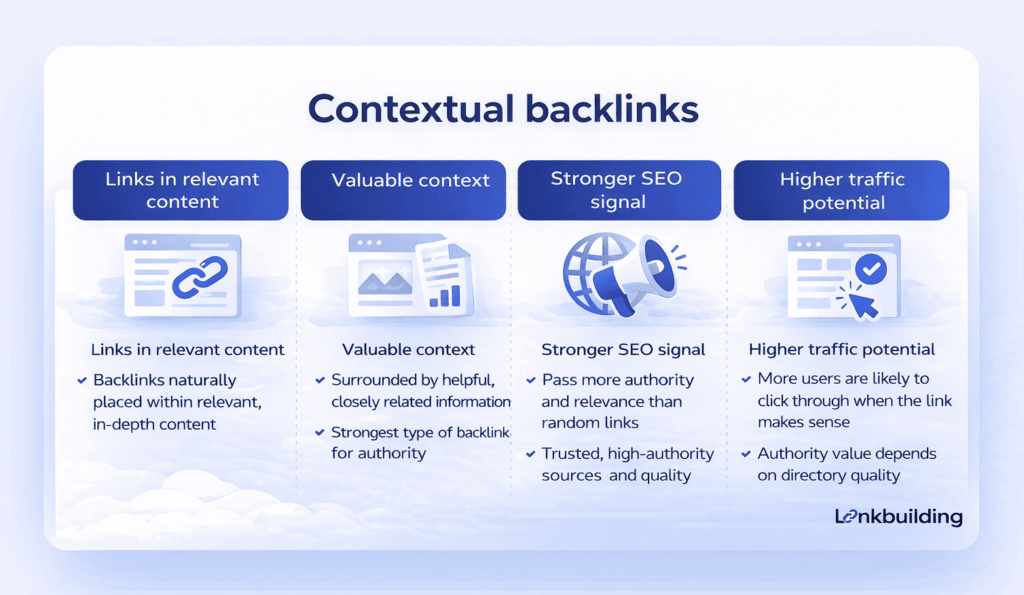
Not all backlinks carry the same weight. A link placed naturally inside relevant content is usually more valuable than a link sitting in a sidebar, footer, profile page, or low-quality directory. That is where contextual backlinks become important.
In practical SEO work, contextual backlinks are often some of the strongest links a website can earn. They are easier for search engines to interpret, more useful for readers, and usually more aligned with genuine editorial value.
This article explains what contextual backlinks are, why they matter, how they work, and what businesses should focus on if they want to earn them the right way.
What Are Contextual Backlinks?
Contextual backlinks are links placed within the main body content of a page, surrounded by relevant text that helps explain why the link is there.
For example, if an article about technical SEO links naturally to a guide on crawl budget within a paragraph discussing site efficiency, that is a contextual backlink. The link is embedded in content, supported by surrounding context, and relevant to the topic being discussed.
That is different from links placed in sidebars, author bios, footers, blog comments, or generic directories. Those links may still exist, but they usually provide less contextual meaning.
Why the context matters
Search engines do not evaluate a backlink only by where it points. They also look at the content around it.
A contextual backlink gives clearer signals about:
- the topic of the linking page
- the topic of the destination page
- the relationship between the two
- whether the link appears natural and editorial
That makes contextual backlinks especially useful in modern SEO, where relevance and intent matter more than simple link volume.
Why Contextual Backlinks Matter
Contextual backlinks matter because they usually combine the three things that make backlinks valuable: relevance, natural placement, and editorial quality.
A link inside meaningful content is often stronger than a link that exists with little explanation or no topical connection.
They strengthen topical relevance
One of the main reasons contextual backlinks matter is that they help search engines understand why the link exists.
If a page about content strategy links to an article about internal linking from within a relevant paragraph, the relationship is clear. The link is part of the topic, not separate from it.
That makes contextual backlinks especially useful for building topical authority across a content cluster.
They tend to be more natural
Many low-value backlinks exist outside the main content because they were added for convenience rather than editorial purpose. Contextual backlinks are usually harder to fake convincingly because they need to fit the surrounding content.
That does not make them automatically good, but it does mean they often reflect higher-quality placements.
They can improve user value
A contextual backlink is also more useful to readers. When the link appears in the right place, users understand why they might click it and what they are likely to find next.
Good SEO and good user experience often align here. The best contextual backlinks support both.
How Contextual Backlinks Work
Contextual backlinks work by placing your link inside relevant written content on another website.
Search engines then evaluate not just the existence of the link, but also the page it appears on, the surrounding copy, the anchor text, and the destination page.
A strong contextual backlink usually has several characteristics:
- it appears in the main content area
- the linking page is relevant to the topic
- the destination page matches the context
- the anchor text feels natural
- the source site is credible
This is why contextual backlinks are often associated with stronger SEO value. They provide meaning, not just connection.
Placement affects interpretation
A link in the middle of a useful article is often easier for search engines to interpret than a sitewide footer link or a random profile page link.
The placement suggests editorial choice. That matters because search engines try to distinguish naturally given links from links created mainly to influence rankings.
Relevance between pages matters
A contextual backlink works best when the linking page and the destination page are clearly related.
For example, a link from an article about backlinks to a guide on anchor text makes sense. A link from an unrelated lifestyle article to a technical SEO service page usually does not.
Context is not only about the words around the link. It is also about topical fit.
Important Subtopics Around Contextual Backlinks
Anchor text
Anchor text is the clickable wording of the link.
With contextual backlinks, anchor text should feel natural within the sentence. It should help explain the destination without sounding forced or overly optimized.
A healthy backlink profile usually includes branded anchors, partial-match phrases, and descriptive wording rather than repeated exact-match keywords.
Editorial backlinks vs contextual backlinks
These terms are related, but not identical.
An editorial backlink is a link placed because the publisher chose to reference your content. A contextual backlink is defined more by where and how the link appears within the content.
In practice, many of the best backlinks are both editorial and contextual. That is one reason they tend to perform well.
Link placement quality
Not every contextual backlink is automatically valuable.
A link inside the body of a low-quality article on an irrelevant site may still be weak. Contextual placement helps, but source quality and topic relevance still matter just as much.
This is where many businesses go wrong. They hear that contextual backlinks are valuable, then assume any in-content link must be good. That is not how SEO works.
Common Mistakes
Assuming all contextual backlinks are high quality
A contextual backlink on a weak site is still a weak backlink. Placement alone does not guarantee value.
What matters is the full picture: relevance, source quality, editorial standards, and destination page quality.
Over-optimizing anchor text
Because contextual backlinks sit naturally in sentences, some teams try to force exact-match keywords into every link. That usually makes the placement feel artificial.
Natural wording is often the better choice.
Chasing quantity over relevance
It is easy to buy or place large numbers of in-content links on low-quality sites. That does not mean those backlinks are helping.
A smaller number of contextual backlinks from strong, relevant sources is usually far more useful than a large number of weak placements.
Ignoring the destination page
A contextual backlink only works well when it points to a page worth visiting. If the destination page is thin, outdated, or poorly aligned with the topic, much of the potential value is lost.
Practical Guidance
If you want to earn better contextual backlinks, start by improving what you are asking people to link to.
The most linkable pages are usually:
- strong guides
- original research
- useful resource pages
- expert commentary
- statistics or benchmark content
Then focus on relevance. Look for websites, articles, and publishers where your content fits naturally into the discussion. A contextual backlink is strongest when it adds value to the page it appears on.
It also helps to think beyond outreach templates. Publishers are much more likely to place contextual backlinks when the content genuinely improves their article or supports a point they are making.
A practical way to evaluate an opportunity is to ask:
- Does the linking page match my topic?
- Does the link feel natural in that paragraph?
- Is the site credible?
- Is the destination page worth citing?
- Would this link make sense even without SEO value?
That last question is often the clearest filter.
Timing and Expectations
Contextual backlinks usually take more effort to earn than easier link types.
That is normal. Strong in-content links often depend on better assets, better outreach, and better relationships. They are rarely the fastest links to acquire, but they are often more valuable in the long run.
SEO impact also takes time. Search engines need to discover the link, interpret its context, and weigh it alongside the overall strength of your site and page.
This means contextual backlinks should be treated as part of a long-term authority-building strategy, not a quick fix.
Conclusion
Contextual backlinks are links placed naturally within the main body of relevant content. That placement matters because it gives search engines and users clearer signals about the meaning and purpose of the link.
The best contextual backlinks combine topical relevance, editorial quality, natural anchor text, and strong destination pages. That is why they are often among the most valuable links a website can earn.
The key is not to chase contextual backlinks as a label. It is to earn them in places where they genuinely belong. When that happens, they do more than strengthen a backlink profile. They support trust, relevance, and long-term SEO authority.