

Broken Link Building: What It Is, How It Works, and When It Is Worth Doing
Broken link building is a link acquisition tactic where you find broken outbound links on other websites, identify content on your own site that could replace the dead resource, and then contact the site owner or editor to suggest your page as a suitable alternative.
On the surface, the tactic sounds simple. A website has a broken link, you help fix the problem, and in return you may earn a backlink. In practice, though, broken link building is more selective and more labor-intensive than many people expect. It can work well when the replacement content is genuinely relevant and useful, but it tends to underperform when people treat it as a volume tactic rather than a quality-driven process.
That distinction matters because broken link building is often presented as an easy win. It is not. The opportunity exists because broken pages create a poor user experience, but earning the replacement link still depends on context, editorial judgment, and the quality of the page you are proposing.
For businesses, marketers, and SEO professionals, broken link building is best understood as a targeted outreach method that combines prospecting, content fit, and relationship-based communication. This article explains what broken link building is, why it matters, how it works, which supporting concepts shape results, what mistakes to avoid, and how to approach it realistically within a wider linkbuilding strategy. It follows the supplied writing and SEO guidance for an informational cluster page.
What Is Broken Link Building?
Broken link building is the process of earning backlinks by helping other websites replace dead or outdated outbound links with relevant live resources.
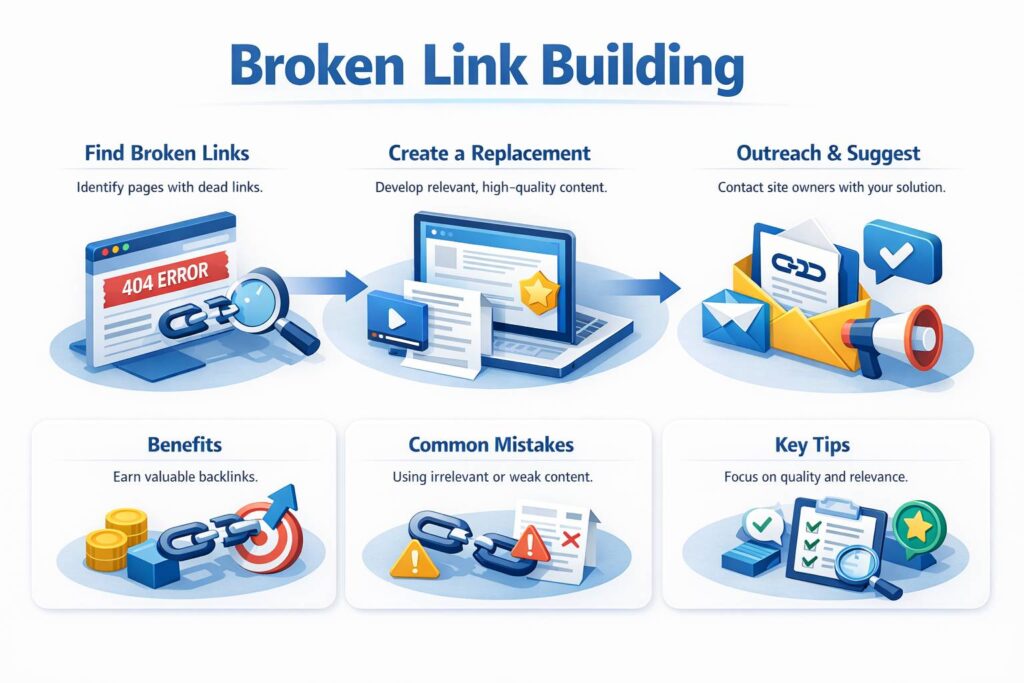
In practical terms, the workflow usually looks like this:
- find a page on another website that links to a dead resource
- review the context of the original link
- determine whether you have an existing page that serves the same purpose
- if not, create a better replacement asset
- contact the site owner or editor and suggest the update
The reason this tactic can work is that it offers a real benefit to the website being contacted. Broken links create a poor experience for readers and weaken the usefulness of the page. If you can help solve that problem with a relevant replacement, the outreach is more credible than a generic request for a backlink.
That said, the link is not earned simply because the original destination is dead. The editor still needs a reason to believe your replacement improves the page.
Why It Matters
Broken link building matters because it combines link acquisition with value creation. Unlike tactics based entirely on exposure or negotiation, this method starts with a real issue on the target site.
It solves a problem for the publisher
One of the main advantages of broken link building is that your outreach is tied to something genuinely useful. You are not only asking for attention. You are pointing out a broken user experience and offering a relevant fix.
That makes the pitch more natural than many other outreach approaches.
It can lead to contextual backlinks
When successful, broken link building typically results in a backlink placed inside existing editorial content. That can be valuable because the link is contextual, surrounded by relevant text, and embedded in a page that may already have authority and search visibility.
This can make broken link building attractive for supporting informational resources, cluster pages, or other pages with strong educational value.
It encourages higher-quality replacement assets
The tactic works best when your page is genuinely a useful substitute for the dead resource. That creates a helpful discipline: instead of promoting weak content, you need a page that actually deserves the placement.
That is one reason broken link building can fit well within a broader content and linkbuilding strategy.
It is more selective than it first appears
Broken links are common, but strong broken link opportunities are less common. The existence of a dead link does not automatically create a good prospect. The host page still needs to be relevant, credible, and worth earning a link from. The replacement page also needs to fit what the original link was doing.
So while broken link building matters, it works best as a selective tactic, not a mass tactic.
How Broken Link Building Works
Broken link building works through a combination of prospecting, content matching, and outreach.
Find relevant broken link opportunities
The first step is identifying pages on relevant websites that contain broken outbound links. In most campaigns, this means looking for resource pages, blog posts, guides, or roundups that cite external content.
But finding a broken link is only the beginning. You then need to evaluate whether the page itself is worth targeting and whether the broken reference is close enough to your own content to justify an outreach email.
A broken link on a low-quality or irrelevant page is usually not worth much effort.
Understand what the original link was meant to do
This is one of the most overlooked parts of the process. Before proposing your content as a replacement, you need to understand the function of the dead page.
Was it a research source? A definition page? A practical guide? A tool? A statistics resource?
If your replacement does not serve the same user need, the pitch will feel forced. Broken link building is not just about replacing any dead URL with any live URL. It is about replacing it with the right kind of page.
Match or create a suitable replacement
Sometimes you already have a page that fits the opportunity. In other cases, the better move is to create or improve a page specifically so that it becomes a realistic replacement.
This is where broken link building overlaps with content strategy. A stronger replacement asset makes outreach more credible and can improve success rates.
If the dead page was highly useful and your replacement is weaker, there is little reason for the editor to update the link.
Reach out with a clear, useful message
The outreach itself should be concise and professional. The goal is to point out the broken link, identify where it appears, and suggest your page only if it is genuinely relevant.
The strongest messages are practical, not pushy. They focus on helping the publisher maintain content quality, not on demanding a backlink.
Important Subtopics Within Broken Link Building
Relevance of the replacement content
This is one of the most important variables in the tactic. Your page must align closely with the original resource and the context of the surrounding article.
A weak replacement reduces the credibility of the outreach, even if the broken link itself is real.
Quality of the host page
Not every broken link opportunity is worth pursuing. A backlink from a strong, relevant page on a credible site is much more useful than a link from a page with weak content, poor maintenance, or questionable editorial quality.
That is why prospect qualification matters just as much as broken link discovery.
Outreach quality
Broken link building is still outreach. Even if the opportunity is legitimate, the email can fail if it is vague, generic, or obviously self-serving.
A useful tone matters here. You are identifying a specific issue and offering a relevant fix, not sending a mass pitch.
Content asset strength
The tactic works better when your replacement content is genuinely good. In many cases, broken link building pushes teams toward building stronger resources, because weak pages are difficult to place credibly.
This connects the tactic to the wider content architecture of the site. A strong replacement page can earn the link directly, then support related pages through internal linking, including the wider linkbuilding pillar and adjacent cluster content.
Common Mistakes
Broken link building often fails because people focus on the broken link itself and ignore everything around it.
Treating every broken link as an opportunity
Many broken links are irrelevant, low-value, or tied to pages that are not worth targeting. The presence of a dead URL does not automatically make the page a good prospect.
Suggesting weak replacements
If your page does not match the purpose of the original resource, the suggestion feels opportunistic rather than helpful. Editors can usually see that immediately.
Sending generic outreach emails
A template-heavy email that does not mention the page context or the actual broken link is easy to ignore. Broken link building usually works better when the message is specific.
Ignoring content quality
Some campaigns focus entirely on prospecting scale but underinvest in the actual replacement asset. That is a major weakness. The stronger the content, the easier it is to justify the replacement.
Expecting high conversion rates
Even helpful outreach gets ignored. Site owners may not update old articles quickly, may not care about the broken link, or may have editorial reasons not to add your resource. Low response rates are normal.
Practical Guidance
A strong broken link building campaign starts with relevance, not scale. Focus on finding dead links on pages that are genuinely connected to your niche and worth being associated with.
Then evaluate whether your current content is a credible replacement. If it is not, improve it before outreach begins. In many cases, one strong replacement page is more useful than dozens of mediocre outreach attempts.
It also helps to think about broken link building within the wider site structure. A useful cluster page can become a strong replacement resource when it answers a topic clearly and thoroughly. If that page earns backlinks, internal links can then help distribute value to related pages such as the linkbuilding pillar, outreach content, or other tactical guides. That is where the tactic becomes more strategic than simple one-off link acquisition.
In practice, broken link building tends to work best when you:
- prioritize topical fit
- qualify host pages carefully
- understand the original resource before pitching
- improve the replacement page where needed
- keep outreach helpful and precise
This usually produces fewer but stronger opportunities.
Timing and Expectations
Broken link building can take time because the process is research-heavy. You need to find prospects, assess context, review the dead page’s original purpose, and often improve or build the replacement asset before outreach begins.
Even after emails are sent, results are not immediate. Some editors respond quickly, while many do not respond at all. Others may update the broken link but choose a different replacement or remove the link entirely.
It is also important to separate placement timing from SEO impact. Earning the backlink is one step. The ranking effect depends on the quality of the host page, the relevance of the link, the strength of the destination page, and the broader SEO condition of your site.
Conclusion
Broken link building is a link acquisition tactic based on replacing dead outbound links with relevant live resources. At its best, it is effective because it combines SEO outreach with a real editorial improvement for the target site.
But it only works well when the replacement page is strong, the host page is worth targeting, and the outreach is grounded in genuine relevance. The tactic becomes much weaker when it is treated as a numbers game or when weak content is forced into places where it does not belong.
For websites investing seriously in SEO, broken link building can be a useful supporting tactic within a broader strategy built on content quality, internal linking, and topical authority. Used selectively, it helps turn helpful replacement content into meaningful backlinks. Used carelessly, it becomes just another outreach workflow with little strategic value.