

Black Hat vs White Hat Linkbuilding: What the Difference Really Means for SEO
Black hat vs white hat linkbuilding is not just a question of tactics. It is a question of how a website tries to earn authority, how much risk it is willing to accept, and whether its backlink strategy is built for short-term manipulation or long-term trust.
That distinction matters because backlinks still play an important role in SEO. But not all links are built the same way, and not all linkbuilding methods align with search engine guidelines. Google’s current spam policies explicitly describe manipulative link practices such as paid link schemes, large-scale link exchanges, and auto-generated links as link spam, and says policy-violating practices can lead to lower rankings or removal from Search results. (Google for Developers)
For businesses, marketers, and SEO professionals, the useful question is not simply whether a tactic can produce links. The better question is whether it produces links in a way that is credible, sustainable, and compatible with the kind of site you want to build over time.
This article explains what black hat and white hat linkbuilding mean, why the difference matters, how each approach works in practice, what warning signs to watch for, and how to choose a more durable strategy. It follows the supplied writing and structure guidance for an informational cluster page.
What Is Black Hat vs White Hat Linkbuilding?
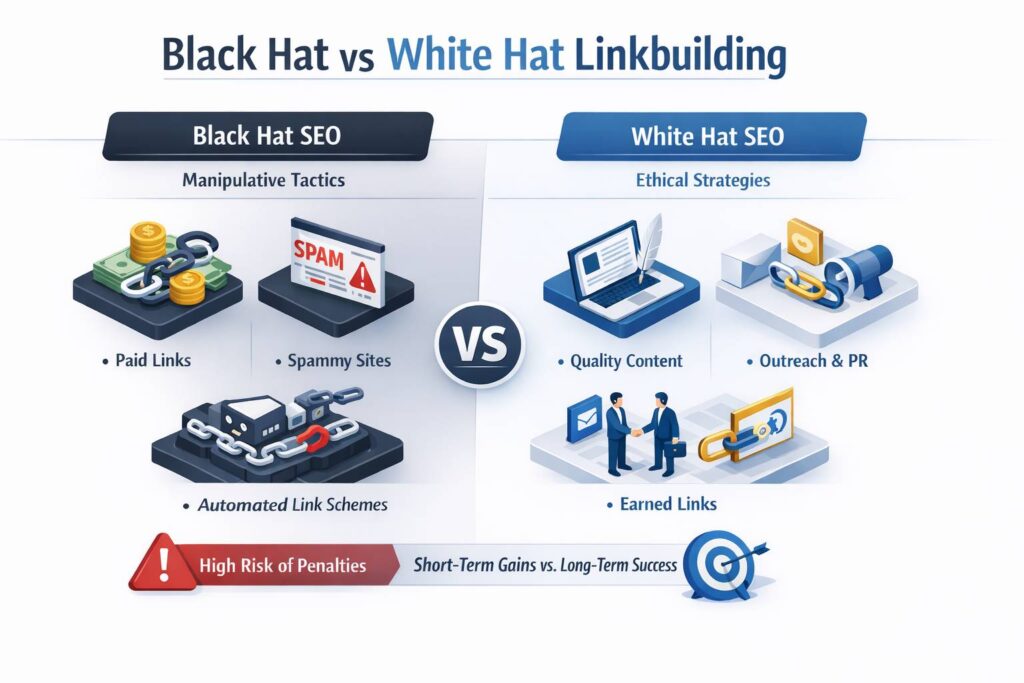
Black hat linkbuilding refers to tactics designed to manipulate search rankings through links in ways that conflict with search engine guidelines.
White hat linkbuilding refers to tactics that earn or attract links through legitimate value, relevance, editorial choice, and transparent promotion.
In practical terms, the difference is less about appearance and more about intent and method.
A white hat link is usually earned because another site genuinely wants to reference your content, brand, data, or expertise. A black hat link is usually created primarily to influence rankings, often through schemes, concealment, automation, or compensation without proper qualification.
There is also a large gray area in real-world SEO, where some tactics are not fully clean or fully overtly manipulative. But as a working framework, the core contrast is straightforward:
- white hat linkbuilding tries to earn trust
- black hat linkbuilding tries to manufacture signals
That is why the distinction matters beyond policy alone. It shapes the stability and credibility of the entire SEO strategy.
Why It Matters
Black hat vs white hat linkbuilding matters because the links a site builds affect not only rankings, but also risk, resilience, and long-term growth potential.
It affects policy risk
Google’s spam policies say links intended to manipulate rankings are considered link spam, and that sites violating spam policies may rank lower or not appear in Search at all. (Google for Developers)
That means some linkbuilding methods do more than create weak signals. They can create genuine downside.
It affects the durability of results
A link profile built on manipulative tactics may produce short-term movement, but it is less stable because it depends on signals search engines are actively trying to discount or penalize. Google also notes that when link spam systems remove the effect of spammy links, any ranking benefit those links once generated is lost. (Google for Developers)
White hat linkbuilding is slower, but it tends to build assets and authority that remain useful even as algorithms improve.
It affects brand credibility
A serious business does not only need rankings. It also needs trust. Linkbuilding methods that depend on poor-quality placements, spammy sites, or manipulative behavior can damage how a brand is perceived by partners, publishers, and users.
It affects how content strategy develops
White hat linkbuilding usually pushes a site toward stronger content, better resources, more useful assets, and smarter outreach. Black hat linkbuilding often encourages shortcut thinking instead.
That is a major strategic difference, especially in a pillar-and-cluster model where authority should support the wider site structure, not just one page.
What Is White Hat Linkbuilding?
White hat linkbuilding is the process of earning backlinks in ways that align with search engine guidance and make sense editorially.
In practice, this often includes:
- creating useful, original, or cite-worthy content
- digital PR and media outreach
- promoting research, tools, or resources
- guest contributions on relevant, credible sites when the content itself has real value
- broken link building with genuinely relevant replacement resources
- earning mentions because of expertise, products, or data
Google’s own guidance says the best way to get people to link to your site naturally is to create unique, compelling content that others want to link to. (Google for Developers)
That does not mean white hat linkbuilding is passive. Outreach and promotion can still be part of it. The difference is that the link is being earned through value and relevance, not manufactured through manipulation.
What Is Black Hat Linkbuilding?
Black hat linkbuilding refers to tactics meant to influence rankings through manipulative link creation.
Google’s spam policies explicitly call out practices such as buying or selling links for ranking purposes, excessive link exchanges, large-scale article marketing or guest posting campaigns with keyword-rich anchor text, and links created using automated services. (Google for Developers)
In practical SEO terms, black hat linkbuilding often includes:
- paid backlinks intended to pass ranking value
- private blog network style placements
- automated link blasts
- large-scale low-quality guest posting
- spammy directories and irrelevant resource pages
- comment spam or forum spam
- hidden or deceptive links
- unnatural anchor text patterns
Some of these tactics may still exist in the market, but that does not make them sound strategy. A tactic can be available and still be a poor long-term decision.
How the Difference Shows Up in Practice
The clearest difference between black hat and white hat linkbuilding is how the link ends up on the page.
White hat linkbuilding usually looks like editorial choice
A relevant site links because your content improves its page, supports a claim, adds useful depth, or deserves citation.
The page linking to you is usually topically related. The anchor text tends to feel natural. The surrounding content is written for readers, not just for search engines.
Black hat linkbuilding usually looks engineered
The placement may exist mainly because someone paid for it, inserted it, exchanged it, or mass-produced it.
The content surrounding the link may be thin or generic. The site may exist mostly to publish links. The anchor text may look overly optimized. The pattern may repeat at scale.
That does not mean every manipulative link is visually obvious. Some are designed to look editorial. But the underlying relationship and intent are different.
Important Subtopics Within Black Hat vs White Hat Linkbuilding
Paid links and proper qualification
Google says links that are advertisements, sponsorships, or other compensated arrangements should be qualified with rel="sponsored" or rel="nofollow". Unqualified paid links used to manipulate rankings fall into the category of link spam. (Google for Developers)
This is one of the clearest dividing lines between transparent promotion and manipulative linkbuilding.
Anchor text patterns
White hat campaigns usually produce more varied, natural anchor text because the links arise from real editorial decisions.
Black hat campaigns often rely on repetitive, keyword-heavy anchors because the links are being engineered for ranking purposes rather than added naturally.
Site quality and relevance
White hat links are usually placed on sites that make sense contextually. Black hat links often show up on weak or irrelevant sites because the main goal is link volume, not editorial fit.
Link intent
This is the most important subtopic of all. Ask why the link exists.
If it exists because another publisher thought it helped the page, that is closer to white hat. If it exists mainly because someone wanted to manipulate ranking signals, that is closer to black hat.
Common Mistakes
Assuming black hat only means obvious spam
Not all manipulative links look crude. Some paid placements or scaled guest posting campaigns look polished on the surface. What matters is the underlying method.
Assuming white hat means no outreach
White hat linkbuilding can absolutely include outreach. What makes it white hat is that the outreach is promoting something genuinely worth linking to, not pushing manufactured signals.
Treating short-term gains as proof of safety
A tactic producing movement today does not mean it is stable. Google’s systems are designed to detect and neutralize unnatural links over time. (Google for Developers)
Focusing only on link quantity
A smaller number of relevant, credible editorial links often has more strategic value than a large volume of weak placements.
Ignoring site architecture
Even strong links are underused if they point to isolated pages with weak internal linking. White hat linkbuilding works best when it supports a broader content structure, including cluster pages and the pillar page they reinforce.
Practical Guidance
A practical way to evaluate black hat vs white hat linkbuilding is to ask four questions:
Does the link make sense for readers?
Is the linking page and site genuinely relevant?
Would the link still belong there if ranking influence were removed from the equation?
Does the method align with current search engine guidance?
If the answer to those questions is mostly yes, the tactic is likely moving in a white hat direction. If the link exists mainly because of payment, automation, concealment, or scale-driven manipulation, it is moving toward black hat.
For most businesses, the better long-term route is to invest in:
- link-worthy assets
- strong informational content
- digital PR and outreach
- relevant editorial placements
- clear internal linking
- topic clusters that build authority over time
That approach is slower, but it tends to create a healthier backlink profile and stronger overall SEO foundations.
Timing and Expectations
Black hat tactics often attract attention because they promise speed. White hat tactics often require more patience because they depend on real content quality, relationships, and relevance.
But speed should not be confused with durability.
A manipulative tactic may create movement faster, yet carry higher risk and weaker staying power. A white hat strategy may take longer to show results, but it is more likely to compound because it strengthens assets, trust, and topical authority at the same time.
Conclusion
Black hat vs white hat linkbuilding is ultimately a difference between manufacturing authority signals and earning them.
Black hat linkbuilding relies on manipulative tactics such as paid link schemes, excessive exchanges, automation, or other methods intended to influence rankings in ways that conflict with search engine guidance. White hat linkbuilding relies on relevance, useful content, editorial choice, and transparent promotion. Google’s current documentation clearly favors the latter and warns that manipulative link practices can lead to lost ranking benefit or broader search visibility problems. (Google for Developers)
For a serious website building long-term organic visibility, the strategic choice is usually clear. White hat linkbuilding may be harder, but it builds the kind of authority a site can keep.