

What Makes a Backlink Valuable for SEO?
Backlinks still matter in SEO, but not in the simplistic way many people assume. The real question is not how many links a site has. It is whether those links are actually worth having.
That is where backlink quality becomes important. A single relevant, editorially placed backlink from a trusted site can be more useful than dozens of weak links from irrelevant or low-value pages. Businesses that ignore that difference often end up with bloated link profiles, misleading reports, and underwhelming SEO results.
This article explains what backlink quality means, why it matters, how to assess it, and what businesses should focus on if they want links that support long-term authority rather than short-term noise.
What Is Backlink Quality?
Backlink quality refers to how valuable and trustworthy a backlink is from an SEO perspective.
A high-quality backlink usually comes from a relevant, credible page, appears naturally within useful content, and points to a destination that makes sense. A low-quality backlink often lacks those qualities. It may come from an irrelevant site, sit in weak content, use forced anchor text, or exist mainly because someone created it for SEO rather than for users.
In practical terms, backlink quality is about the strength of the signal a link sends.
A good backlink does more than point to your site. It reinforces relevance, trust, and authority in a way that fits naturally within the web.
Quality is not a single metric
This is where many teams go wrong. They look for one shortcut metric, usually a third-party authority score, and treat that as the answer.
But backlink quality is not defined by a single number. It is shaped by several factors working together, including relevance, source quality, editorial context, placement, anchor text, and destination page value.
That means a link can look strong in a tool and still be strategically weak. It can also look modest in a tool while being genuinely useful because it is highly relevant and editorially justified.
Why Backlink Quality Matters
Backlink quality matters because search engines evaluate links contextually, not just quantitatively.
A site with fewer but stronger backlinks can often outperform a site with a much larger profile full of weak placements. That is because high-quality links are easier for search engines to interpret as genuine endorsements or references.
It affects authority signals
One of the main reasons backlink quality matters is authority.
When a trusted, relevant website links to your content, that can strengthen the perception that your page is useful and credible. If that link comes from a page closely related to your topic, the signal becomes even more meaningful.
This is especially important in competitive sectors where many websites already have decent technical SEO and reasonably strong content.
It influences how sustainable your SEO is
Poor-quality backlinks can create a profile that looks manipulated or shallow. Even when they do not cause an obvious problem, they often add little lasting value.
High-quality backlinks tend to age better. They are more likely to remain relevant, continue sending useful signals, and fit naturally into your wider content strategy.
It improves the return on linkbuilding
If your linkbuilding effort is focused on acquiring high volumes of mediocre links, your returns are often limited. If the effort is focused on earning fewer but stronger placements, the outcome is usually more durable.
That is why understanding backlink quality is essential for any business investing in digital PR, outreach, guest posting, or broader authority-building work.
How Backlink Quality Works
Backlink quality works through a combination of signals rather than one isolated factor.
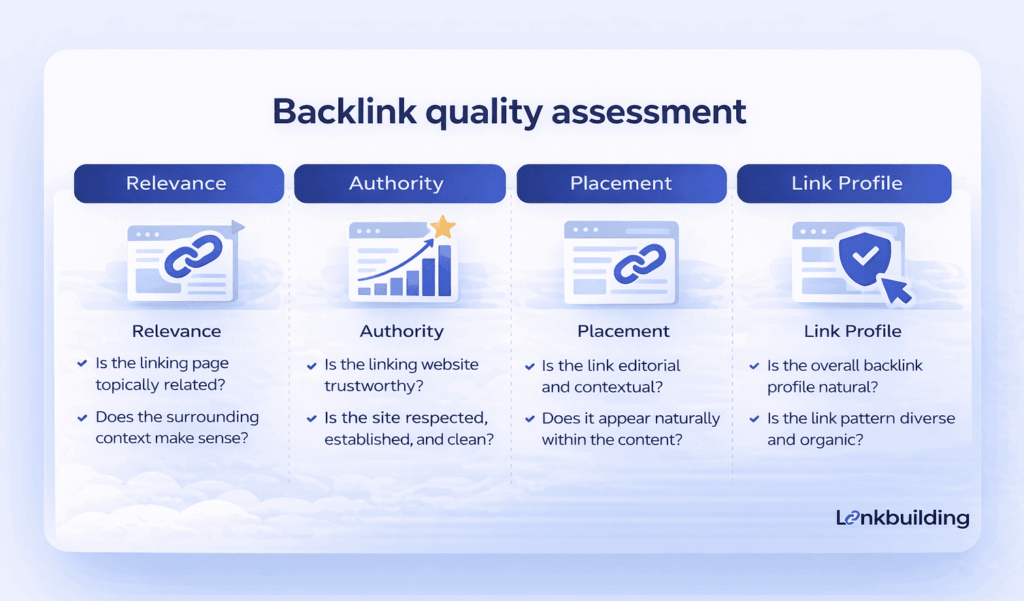
Search engines may evaluate a backlink by considering:
- the topical relevance of the linking page
- the trust and authority of the referring domain
- the editorial quality of the surrounding content
- the placement of the link on the page
- the anchor text
- the quality of the destination page
- the overall pattern of links pointing to your site
The more these elements align naturally, the stronger the backlink is likely to be.
Relevance usually comes first
A highly relevant backlink often matters more than a stronger-looking but unrelated one.
If a search marketing site links to your SEO guide, that relationship is easy to understand. If an unrelated site links to the same page without clear context, the signal is weaker even if the domain appears powerful.
That is why backlink quality is closely tied to topical fit.
Placement changes the strength of the link
A contextual link inside the main body of a useful article is usually stronger than a link in a footer, author bio, or generic resource block.
Placement matters because it helps indicate why the link exists. A natural in-content link usually reflects stronger editorial intent.
Destination page quality matters too
A strong backlink pointing to a weak page has limited value.
If the destination page is thin, outdated, or poorly aligned with search intent, the link can only do so much. High backlink quality works best when it supports content that already deserves visibility.
Important Factors That Define Backlink Quality
Source relevance
This is one of the clearest signals.
A backlink from a page that covers a closely related topic is usually more useful than one from a page with little connection to your subject.
Relevance helps search engines understand why the link was placed and whether it fits the topic naturally.
Editorial standards
High-quality backlinks often come from websites with real editorial control.
That means someone reviewed the content, decided the link added value, and included it for a legitimate reason. This is very different from links placed on sites that publish almost anything.
Contextual placement
A backlink within the main content of a page tends to carry more meaning than one placed in a sidebar or footer.
This is one reason contextual backlinks are often seen as stronger. The surrounding text provides topic signals and supports the natural logic of the link.
Anchor text
Anchor text should help describe the destination naturally.
A healthy backlink profile usually includes branded anchors, plain URLs, and descriptive phrases. When anchor text is overly optimized and repeated too aggressively, the link profile can start to look artificial.
Referring domain trust
Domain trust matters, but it should be interpreted carefully.
A link from a site with a strong reputation, real traffic, relevant content, and editorial integrity is usually a positive signal. But domain authority alone is not enough. A high-scoring site can still be irrelevant or low quality in practical terms.
Common Mistakes When Assessing Backlink Quality
Looking only at domain metrics
Third-party SEO metrics are useful for quick screening, but they are not the final answer. They do not fully capture relevance, editorial quality, or the naturalness of the placement.
Ignoring page-level context
Some teams look only at the domain and forget to examine the actual linking page. That is a mistake because backlink quality is often decided at page level, not domain level.
Overvaluing easy links
The easiest links to acquire are often the weakest. Generic directories, low-quality guest posts, and low-effort placements may add little real SEO value.
Assuming all contextual links are good
A link inside the body of an article is not automatically high quality. If the site is weak or the content is poor, the backlink can still be low value.
Practical Guidance
If you want to judge backlink quality more accurately, stop asking whether a link exists and start asking whether it makes sense.
A practical evaluation framework looks like this:
- Is the linking page topically relevant?
- Is the site credible and well maintained?
- Does the link sit naturally within useful content?
- Is the anchor text readable and appropriate?
- Does the destination page deserve the link?
- Would this link still feel valuable if SEO did not exist?
That last question is often the best filter. If a link would still make sense as a genuine reference, it is much more likely to be a high-quality backlink.
For most businesses, improving backlink quality means focusing less on scale and more on assets worth citing. Strong guides, expert commentary, original research, useful tools, and well-structured resource pages are more likely to earn high-quality links than generic promotional content.
Timing and Expectations
High backlink quality usually takes longer to build than low-quality link volume.
That is normal. Strong links often depend on better content, better relationships, and better judgment about where your brand deserves to be mentioned. They are rarely the fastest to acquire, but they are usually more useful over time.
It is also important to remember that results are not instant. Search engines need time to crawl links, assess them, and reflect their value alongside the rest of your SEO foundation.
That is why backlink quality should be treated as part of a long-term authority strategy rather than a quick-win tactic.
Conclusion
Backlink quality is what determines whether a backlink is actually helping your SEO.
A valuable backlink is not just one that exists. It is one that comes from a relevant, credible source, appears naturally in strong content, uses sensible anchor text, and points to a page worth ranking.
That is the strategic takeaway. Businesses that focus on backlink quality usually build stronger authority with less wasted effort. Businesses that focus only on volume often end up with a backlink profile that looks busy but delivers very little.
In modern SEO, quality is not a refinement. It is the point.