
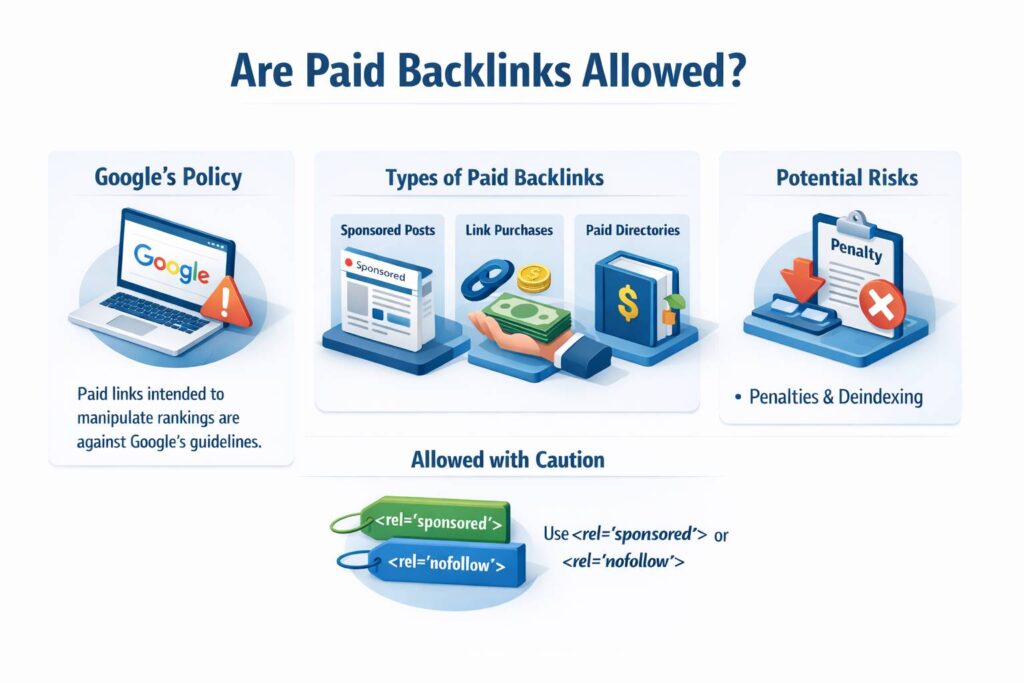

Are Paid Backlinks Allowed? What Google Says, What the Risks Are, and How to Think About Them Strategically
Paid backlinks are one of the most debated topics in SEO because they sit directly at the intersection of visibility, risk, and search engine policy. Many site owners, marketers, and agencies ask the same basic question: are paid backlinks allowed? The practical answer is more nuanced than a simple yes or no.
From Google’s perspective, links that are bought or sold for ranking purposes are considered part of link spam if they are intended to manipulate search rankings. Google also says that links created as part of advertisements, sponsorships, or other compensation arrangements should be qualified with attributes such as rel="sponsored" or rel="nofollow". (Google for Developers)
That distinction matters. A paid link can exist on the web, but that does not mean it is acceptable as a ranking tactic. If the purpose of the link is to pass ranking signals without proper qualification, it conflicts with Google’s guidance. If the link is properly disclosed and qualified, it may still be acceptable as advertising or sponsorship, but it should not be treated as a method for manipulating organic rankings. (Google for Developers)
For businesses, marketers, and SEO professionals, the real issue is not only whether paid backlinks exist, but whether they support sustainable SEO. This article explains what paid backlinks are, why they matter, how Google currently treats them, what the common risks are, and how to think about them within a broader linkbuilding strategy. It also follows the writing and structure guidance you provided for an informational cluster page.
What Are Paid Backlinks?
Paid backlinks are links placed on another website in exchange for money, products, services, discounts, or some other form of compensation.
In practical terms, this can take several forms:
- direct payment for a contextual link in an article
- payment for a guest post that includes a backlink
- sponsored content placements
- product exchanges in return for coverage and links
- affiliate-style arrangements
- paid directory or resource listings
The core issue is not only whether money changed hands in a narrow sense. Google’s documentation focuses more broadly on compensated links. If a link exists because of compensation or a commercial arrangement, Google wants that relationship qualified appropriately. (Google for Developers)
This is an important distinction because some people treat “paid backlinks” too narrowly, as though only direct cash payments count. In practice, search engines look at the underlying relationship and whether the link was created to pass ranking value.
Why Paid Backlinks Matter
Paid backlinks matter because backlinks remain an important authority signal in search, especially in competitive niches. That creates strong incentives for businesses to look for faster ways to acquire them.
They promise speed
One reason paid backlinks are attractive is that they appear to reduce the time and uncertainty involved in earning links. Instead of building a resource, pitching it, and hoping it gets cited, a business may feel it can simply pay for placement.
That speed is part of the appeal, but it is also part of the risk.
They are often misunderstood as standard practice
In some corners of the SEO industry, paid backlinks are treated as normal or inevitable. That can lead businesses to assume the tactic is broadly acceptable as long as it “works.”
But there is a difference between a tactic being common and a tactic being aligned with search engine policy.
They affect long-term risk
If a linkbuilding strategy relies heavily on paid placements intended to influence rankings, the site is accepting policy risk. Google says policy-violating practices can result in pages or sites ranking lower or being omitted from Search, whether detected algorithmically or through manual review. (Google for Developers)
They shape site quality decisions
A heavy dependence on paid backlinks can push businesses toward short-term acquisition thinking rather than stronger long-term investments in content quality, digital PR, internal linking, and genuinely link-worthy assets.
That is why the question is not only “are paid backlinks allowed?” It is also whether they lead to the kind of SEO system a serious website should want to build.
What Google Says About Paid Backlinks SEO
This is the most important part of the topic because the answer depends on current search engine guidance, not industry hearsay.
Google’s spam policies describe link spam as links intended to manipulate rankings, including buying or selling links for ranking purposes. Google also says links that are advertisements or paid placements should be qualified with rel="sponsored", and that rel="nofollow" is also an acceptable way to qualify paid links. (Google for Developers)
That leads to a practical framework:
Paid links for ranking manipulation are not allowed under Google’s spam policies
If the purpose of the paid backlink is to influence rankings without qualification, the tactic conflicts with Google’s link spam guidance. (Google for Developers)
Paid links can exist as ads or sponsorships, but they should be qualified
Google explicitly supports rel="sponsored" for paid or sponsored links and also allows rel="nofollow" in those situations. (Google for Developers)
Properly qualified paid links are not the same as passing ranking credit
This is the distinction many site owners miss. A sponsored link can be acceptable as a commercial relationship, but once it is qualified properly, it should not be treated as a conventional SEO shortcut for passing authority.
How Paid Backlinks Work in Practice
In practice, paid backlinks are usually sold as convenience.
A website owner, publisher, or intermediary offers placement in exchange for money or value. The placement may look editorial on the surface, but the underlying motivation is commercial.
Sometimes these placements happen openly as sponsored posts. Sometimes they are framed as editorial collaborations. Sometimes they are routed through agencies or link vendors. The more opaque the arrangement becomes, the harder it is to separate legitimate sponsorship from manipulative link selling.
This is why paid backlinks SEO discussions often become confused. The web contains a mix of:
- genuine sponsored content
- undisclosed paid placements
- low-quality link brokerage
- partnerships that blur editorial and commercial intent
From Google’s standpoint, the important part is whether the link is compensated and whether it is being used to manipulate rankings. (Google for Developers)
Important Subtopics Within Paid Backlinks SEO
rel=”sponsored”and rel=”nofollow”
Google supports rel="sponsored" to identify links created as part of advertisements, sponsorships, or compensation agreements. Google also states that if you were paid in some way for a link, you should qualify it with sponsored or nofollow. (Google for Developers)
This is one of the clearest pieces of official guidance on the subject.
Link spam and manual risk
Google’s spam policies say spammy tactics can lead to lower rankings or removal from results, and Google uses both automated systems and human review. (Google for Developers)
That means the risk is not theoretical. A site building rankings on unqualified paid backlinks is operating against published policy.
Editorial links versus purchased placements
A strong editorial backlink is earned because another publisher genuinely chose to cite your content. A purchased placement may resemble an editorial link visually, but the relationship behind it is different.
That difference matters both for policy and for long-term trust.
Broader SEO sustainability
A strategy built around linkable assets, digital PR, content marketing, and relevant outreach tends to be slower, but it aligns better with search quality expectations. It also creates stronger assets that can support the wider site through internal linking and topical authority, which fits the broader pillar-and-cluster model described in your writing brief.
Common Mistakes
Assuming “everyone does it” means it is safe
Industry prevalence is not the same as platform approval. A tactic can be common and still conflict with official policy.
Confusing sponsorship with SEO value
A paid mention may still have branding or referral value, but that does not make it a safe or valid way to pass organic ranking signals unless handled according to Google’s guidance. (Google for Developers)
Ignoring qualification requirements
If a link is compensated and left unqualified in order to influence rankings, that is exactly the kind of scenario Google’s guidance is trying to address. (Google for Developers)
Relying on paid links instead of building link-worthy assets
A backlink strategy becomes fragile when it depends primarily on purchased placements instead of content quality, credibility, and real editorial relevance.
Treating all paid placements as equal
Some paid placements are transparent sponsorships. Others are undisclosed link sales on poor-quality sites. Lumping them together hides the real issue: risk grows quickly when quality and disclosure disappear.
Practical Guidance
A practical way to think about paid backlinks SEO is this:
If the link exists because of compensation, assume it needs qualification. If the goal is manipulating rankings through an unqualified paid link, it conflicts with Google’s stated policies. (Google for Developers)
For most serious websites, the better long-term approach is to separate advertising from organic SEO.
Use sponsorships when they make marketing sense. Use editorial outreach, strong content, digital PR, research assets, and internal linking when the goal is organic authority growth. That creates a cleaner strategy and reduces the pressure to rely on tactics that may create policy risk later.
This also fits better with a cluster-based site architecture. A strong pillar page on linkbuilding can be supported by cluster pages like this one, while genuine backlinks earned through useful resources and relevant promotion help reinforce the topic more sustainably than purchased placements.
Timing and Expectations
Paid backlinks can produce placements quickly. That is part of why they attract attention.
But speed should not be confused with stability. A fast link that carries policy risk may look efficient in the short term while creating weaker foundations over time. By contrast, earned links usually take longer, but they tend to align better with lasting SEO performance.
It is also worth remembering that properly qualified sponsored links may still have value for awareness, partnerships, and referral traffic. They just should not be treated as a loophole for manipulating organic rankings.
Conclusion
So, are paid backlinks allowed?
If by “paid backlinks” you mean buying links to manipulate rankings, Google’s answer is effectively no under its spam policies. If by “paid backlinks” you mean advertisements, sponsorships, or other compensated links that are properly qualified with rel="sponsored" or rel="nofollow", those can exist, but they should not be treated as ordinary ranking signals. (Google for Developers)
That is the real strategic takeaway. The question is not only whether you can pay for a link. It is whether the link fits a durable SEO model. For businesses investing in long-term organic visibility, the stronger path is usually to build assets worth citing, earn links through relevance and usefulness, and use paid placements transparently as marketing, not as a substitute for real authority.