

How to Use Anchor Text Strategically Without Over-Optimizing
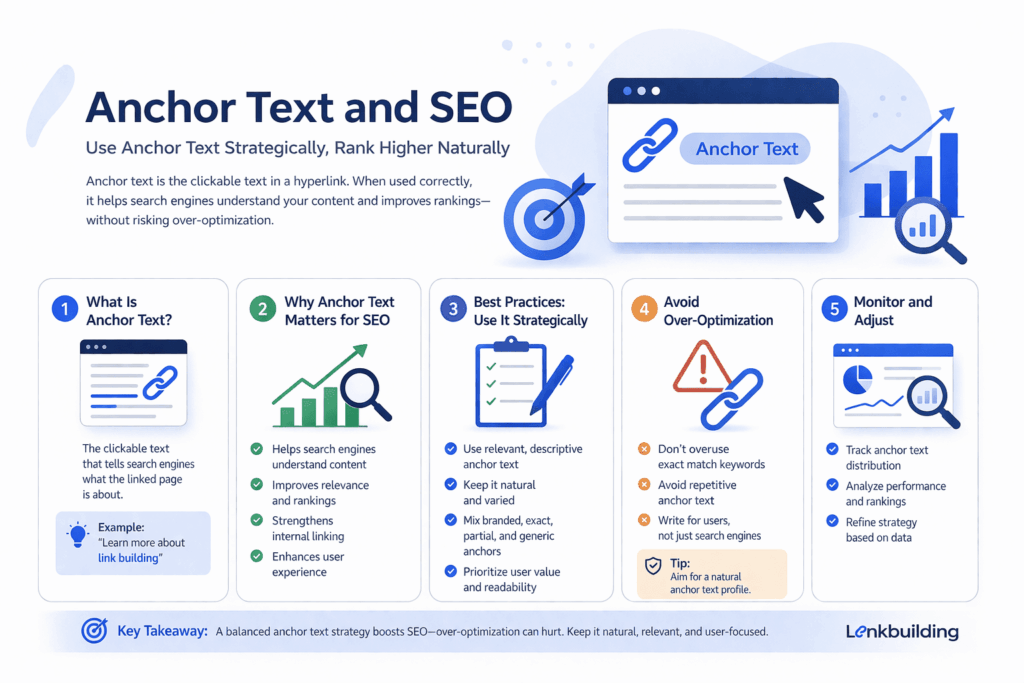
Anchor text seems simple on the surface. It is just the clickable text in a link. But in SEO, it carries much more weight than that definition suggests. Anchor text helps search engines understand what a linked page is about, how pages relate to each other, and whether a linking pattern looks natural or manipulated.
That is why anchor text SEO matters. It sits at the intersection of internal linking, backlink quality, topical relevance, and site architecture. Used well, it improves clarity and strengthens content relationships. Used badly, it creates weak user experience, unnatural link signals, and avoidable SEO risk.
This article explains what anchor text SEO is, why it matters, how it works, and how businesses should approach it in a practical, sustainable way.
What Is Anchor Text SEO?
Anchor text SEO is the practice of using clickable link text in a way that helps users and search engines understand the destination page clearly and naturally.
For example, if a page links to a guide about backlink quality using the words “backlink quality guide,” that phrase is the anchor text. It gives context before the user clicks and helps search engines interpret the relationship between the two pages.
In simple terms, anchor text tells both users and search engines what to expect from the link.
That does not mean anchor text should be stuffed with keywords. Good anchor text SEO is about clarity, relevance, and natural language, not forced optimization.
Anchor text in practical terms
Anchor text appears in two main SEO contexts:
- internal links between pages on your own site
- backlinks from other websites pointing to your site
Both matter, but they work differently.
With internal links, you control the anchor text directly. That makes anchor text an important tool for building topic clusters and strengthening site structure. With backlinks, you have less control, which is why a natural variety of anchors is usually healthier than a rigid keyword pattern.
Why Anchor Text SEO Matters
Anchor text matters because links without context are less useful.
A strong link tells the user where they are going and helps search engines understand how the linked page fits into a broader topic. That makes anchor text important for both usability and SEO.
It helps search engines interpret relevance
Anchor text can reinforce what the destination page is about. If multiple relevant pages link to a guide using descriptive anchors related to the topic, that creates stronger contextual signals than generic text like “click here.”
This is especially useful in cluster-based SEO, where internal links help define the relationship between pillar pages and supporting content.
It improves internal linking strategy
Anchor text SEO is one of the most practical parts of internal linking. It helps you guide users through related pages while showing search engines which content pieces support each other.
A page about linkbuilding, for example, might link to related articles on types of backlinks, backlink quality, or contextual backlinks using natural descriptive phrases rather than vague anchors.
It affects backlink quality patterns
With external links, anchor text can influence how natural a backlink profile looks. A healthy link profile usually includes a mix of branded anchors, plain URLs, descriptive phrases, and occasional keyword-related anchors.
When too many backlinks use the same exact-match keyword, the pattern can look artificial. That is one reason anchor text SEO needs restraint as well as precision.
How Anchor Text SEO Works
Anchor text SEO works by providing context around a link.
Search engines use that context, together with the linking page, surrounding content, and destination page, to better understand the relationship between pages. Users also rely on anchor text to decide whether the link is worth clicking.
That means anchor text does two jobs at once: it informs users and supports topic relevance.
Relevance matters more than exact matching
A common misconception is that anchor text should always match the target keyword exactly. That is rarely the best approach.
In most cases, relevant and natural anchor text is more useful than repetitive exact-match wording. Search engines are able to understand semantic relationships, so anchor text does not need to repeat the same phrase every time to be effective.
For example, if your target page is about anchor text SEO, useful anchors might include:
- anchor text best practices
- how to use anchor text
- internal linking anchor strategy
- guide to anchor text SEO
This creates stronger natural variation while still reinforcing topical relevance.
Internal and external anchor text behave differently
Internal anchor text can be more strategically consistent because you control it. You can use internal links to strengthen topic clusters, guide readers, and support priority pages.
External anchor text should look more organic. Since backlinks come from different websites, a natural backlink profile tends to include more variation and more branded anchors.
That distinction matters. What works in internal linking should not automatically be copied into backlink acquisition.
Important Types of Anchor Text
Exact-match anchor text
This uses the precise keyword of the target page.
For example, linking with the phrase “anchor text SEO” to a page targeting that keyword would be exact match. Used sparingly, exact-match anchors can be useful. Overused, they can look forced.
Partial-match anchor text
This includes the target keyword or topic in a broader phrase.
Examples might include “guide to anchor text SEO” or “best practices for anchor text.” This is often the safest and most flexible option because it keeps relevance while sounding natural.
Branded anchor text
This uses a brand name as the anchor.
Branded anchors are common in natural backlink profiles and often help keep link patterns balanced.
Generic anchor text
This includes phrases like “read more,” “learn more,” or “click here.”
These anchors are not ideal when used excessively, because they provide little context. But they are not always wrong. In some design or UX situations, they may still be workable if the surrounding context is clear.
Naked URL anchors
This is when the full URL appears as the clickable text.
These are common in some backlink contexts and can be part of a natural profile, though they are less useful for clarity in editorial content.
Common Anchor Text Mistakes
Overusing exact-match keywords
This is the classic anchor text mistake.
If every internal link or backlink uses the exact same keyword-rich phrase, the pattern starts to look unnatural. It also makes the content less pleasant to read.
Using vague anchors too often
Anchors like “here” or “this article” add very little value when used repeatedly. They do not help users understand the destination clearly, and they weaken internal linking context.
Forcing keywords into unnatural sentences
Anchor text should fit naturally into the sentence. If the wording feels awkward just to include a keyword, the link is probably over-optimized.
Ignoring destination relevance
Even strong anchor text cannot fix a mismatch between the link text and the page it points to. The destination must deliver what the anchor suggests.
Practical Guidance for Better Anchor Text SEO
The best way to approach anchor text SEO is to think about clarity first and optimization second.
Ask a simple question: if a user only reads the linked words, do they have a reasonable idea of what they will get after clicking?
That mindset usually leads to better decisions.
A practical approach includes:
- using descriptive anchors where they genuinely help
- varying anchor phrasing naturally
- using exact-match anchors sparingly
- keeping internal anchors aligned with real topic relationships
- checking that the destination page matches the anchor promise
For internal linking, anchor text should support your site architecture. Use it to connect pillar pages, cluster articles, and relevant supporting content in a way that reflects real topical relationships.
For backlinks, focus less on controlling exact anchor text and more on earning relevant editorial links from strong sources. A natural anchor mix is usually healthier than aggressive optimization.
Timing and Expectations
Anchor text changes can influence SEO, especially for internal linking, but they are rarely a standalone growth lever.
Search engines need time to recrawl pages, reprocess internal relationships, and interpret the broader linking context. The impact also depends on the quality of the linked pages, the overall structure of the site, and the competitiveness of the topic.
That means anchor text SEO should be treated as an important refinement within a larger system, not as a shortcut to rankings.
In practice, better anchor text often improves clarity first. The SEO benefit tends to follow when the structure, relevance, and page quality are already strong.
Conclusion
Anchor text SEO is not about forcing keywords into every link. It is about using link text strategically so that users and search engines understand where the link goes and why it matters.
Good anchor text improves clarity, strengthens internal linking, supports topic relevance, and helps maintain a healthier backlink profile. Poor anchor text does the opposite. It reduces readability, weakens context, and can create over-optimized patterns that add little real value.
The most effective approach is straightforward: keep anchor text relevant, natural, and aligned with the page being linked to. When that discipline is applied consistently, anchor text becomes a practical SEO asset rather than a minor technical detail.