

A Practical Guide to Authority, Relevance, and Long-Term SEO Growth
Linkbuilding remains one of the most important parts of SEO, and one of the easiest to misunderstand.
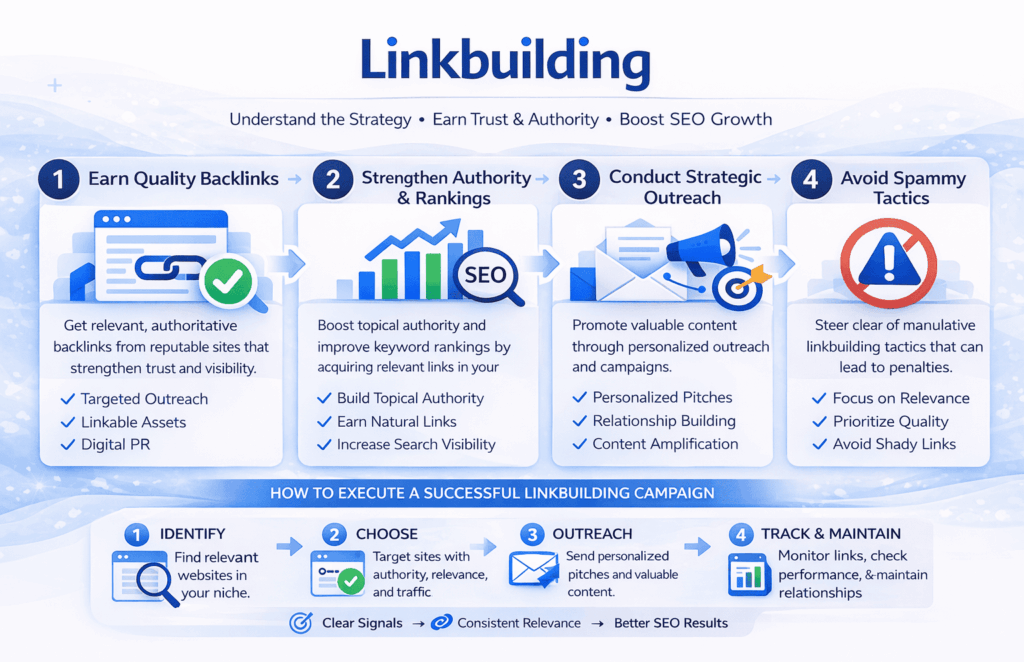
Some businesses still treat it as a numbers game. Others avoid it because they associate it with spam, bulk outreach, or manipulative tactics that do more harm than good. Both views miss the real point. Good linkbuilding is not about collecting backlinks for the sake of volume. It is about earning relevant, credible links that strengthen trust, reinforce authority, and support the visibility of the right pages.
For websites built on a pillar-and-cluster model, linkbuilding matters even more. Strong content and clean site architecture create the foundation, but external links often help search engines judge which pages deserve stronger visibility in competitive results. That means linkbuilding does not sit outside content strategy. It works alongside content quality, internal linking, search intent, and topical authority.
This pillar page explains what linkbuilding is, why it matters, how it works, the main subtopics that shape it, the mistakes that weaken it, and how to build a process that supports long-term growth rather than short-term risk.
What Is Linkbuilding?
Linkbuilding is the process of earning or acquiring hyperlinks from other websites to your own.
In SEO terms, these links act as external references. When relevant, trusted websites link to your content, they help search engines understand that your page may be worth surfacing as a credible resource. Not every backlink improves rankings, and not every link has the same value, but the general principle still holds: strong external references can support stronger search performance.
In practical terms, linkbuilding is broader than outreach alone. It can include digital PR, original research, expert commentary, linkable asset creation, guest contributions, reclaiming unlinked brand mentions, and partnerships that lead to editorial citations. The shared goal is not simply to place links. It is to build external credibility around pages that matter.
A useful definition is this: linkbuilding is the strategic process of earning relevant backlinks that strengthen the authority, visibility, and trust of your site.
That final point matters. Effective linkbuilding is selective. The goal is not to build links to every page equally. It is to support the pages that deserve authority and fit your broader SEO strategy.
Why Linkbuilding Matters
Search engines use many signals to rank pages. Content quality, technical health, internal linking, structure, and intent alignment all matter. But in competitive markets, backlinks often help distinguish content that is merely relevant from content that is also authoritative.
It strengthens domain and page authority
When credible websites reference your content, that helps reinforce that your site is not isolated. It suggests that others in your market, industry, or editorial space see your content as worth citing. That trust is not mechanical. It depends on where the link comes from, how relevant it is, and whether it makes editorial sense. But when those conditions are strong, the effect can be meaningful.
It supports rankings for competitive queries
In low-competition niches, strong on-page optimization and helpful content may be enough. In tougher search results, many pages are already well written and reasonably well optimized. In those situations, backlinks often become part of the difference between moderate visibility and strong rankings.
It improves discoverability
Links do not only help algorithms. They also help people find your content. A mention in a respected article, industry resource page, newsletter, or blog can drive relevant traffic directly. That traffic may lead to additional engagement, sharing, and secondary links over time.
It reinforces topical authority
A site built on a pillar-and-cluster structure depends on clarity and depth. External links can strengthen that structure when they point to pages that anchor the topic or deliver the best resource on a focused subtopic. Linkbuilding, internal linking, and content architecture should work together rather than exist as separate efforts.
It supports commercial growth indirectly
Not every backlink leads directly to leads or sales, but linkbuilding often strengthens the pages that sit upstream from those outcomes. A strong backlink profile can improve the visibility of educational content, comparison content, or industry resources that bring qualified users into the site and support later conversions.
How Linkbuilding Works
Linkbuilding works when your site creates pages worth referencing and makes those pages visible to the people most likely to cite them.
Start with link-worthy assets
Before asking how to build links, ask why anyone should link to the page at all.
Some pages naturally attract links more easily than others. These often include original research, detailed guides, statistics pages, visual explainers, comparison resources, free tools, calculators, templates, and strong opinion-led expert content. Commercial pages can earn links, but informational assets usually perform better as the front line of a linkbuilding strategy.
This is where many campaigns fail. They start with outreach before the asset is strong enough to earn genuine editorial interest.
Match the asset to the right audience
Not every asset belongs in the same promotion workflow. A research-driven page may be suitable for journalists or publishers. A tactical guide may work better for blogs, communities, or industry newsletters. A practical template may attract links from resource pages or educational sites.
Good linkbuilding is not just about having a strong page. It is about aligning that page with people who would realistically reference it.
Build relevance, not just quantity
One highly relevant link from a trusted site in your niche is usually worth more than many low-quality links from unrelated pages. Linkbuilding should be judged by fit, credibility, and context.
A relevant industry site, respected publisher, specialist blog, or carefully curated resource page often provides more real SEO value than a larger number of weak mentions that exist only to increase counts.
Use multiple acquisition paths
Outreach is only one route. Links can also come from digital PR campaigns, expert commentary, partnerships, guest contributions, reactive media requests, original data, brand mentions, and useful resources that attract links passively over time.
The strongest linkbuilding strategies are usually diversified. They do not depend entirely on one method or one type of contact list.
Important Subtopics Within Linkbuilding
Because this is a pillar topic, linkbuilding connects to several supporting subtopics that deserve their own focused pages in a cluster.
Link Quality
Not all backlinks are equal. Link quality depends on relevance, trust, editorial context, page placement, and whether the referring page is itself useful and credible.
A strong backlink usually has several characteristics:
it comes from a relevant site, appears naturally in the content, supports the reader, and exists because the destination page genuinely adds value.
A weak backlink often lacks these traits. It may come from a thin page, an irrelevant site, a low-quality directory, or an obviously manufactured placement. Good linkbuilding depends far more on quality than volume.
Anchor Text
Anchor text helps search engines and users understand what a linked page is about. But it should develop naturally.
One of the most common mistakes in poor linkbuilding campaigns is overusing exact-match anchor text. That pattern often looks engineered rather than editorial. Strong backlink profiles usually contain a mix of branded anchors, partial matches, topical phrases, URLs, and generic language where appropriate.
Anchor text should reflect how real people would link, not how an SEO spreadsheet would prefer them to.
Digital PR
Digital PR is one of the strongest modern linkbuilding approaches because it focuses on earning coverage through useful stories, original information, timing, and expertise.
This may include publishing new data, offering expert commentary on current topics, responding quickly to trends, or creating assets that journalists and editors can cite. Digital PR is powerful because it can build both backlinks and brand visibility at the same time.
Outreach Strategy
Outreach still matters, but quality matters more than scale.
Strong outreach is not about sending thousands of generic emails. It is about identifying a relevant editor, site owner, or writer, understanding what they publish, and showing why your asset is useful for their audience. A relevant pitch sent to a good fit is far more effective than a mass campaign built around weak targeting.
Linkable Assets
A sustainable linkbuilding strategy usually depends on developing assets that deserve links in the first place.
Examples include:
- original studies
- benchmark reports
- templates
- calculators
- glossaries
- frameworks
- deep guides
- tools
- curated resource pages
These assets do not guarantee links, but they make link acquisition more realistic and scalable.
Internal Linking Support
External links become more valuable when the site’s internal structure distributes relevance intelligently. If a strong page earns backlinks but sits inside a weak internal architecture, some of the broader strategic value is lost.
That is why linkbuilding should always be paired with strong internal linking. A linked pillar page should support cluster pages. A linked cluster page should be integrated into the broader topic system. External authority and internal structure should reinforce each other.
Common Linkbuilding Approaches
The best method depends on the business, the audience, and the type of assets you can create, but several approaches consistently matter.
Resource linkbuilding
This approach focuses on building or improving content that people use as references. It works well for guides, definitions, industry explainers, checklists, and tools. When executed well, the page becomes something other sites naturally want to cite.
Data-led campaigns
Original data is one of the strongest linkbuilding assets because it gives writers, publishers, and researchers something new to reference. That could be survey results, benchmark studies, industry patterns, trend analysis, or proprietary observations.
Brand mention reclamation
Sometimes your brand is already being discussed without being linked. Reclaiming unlinked mentions can be one of the more efficient ways to earn backlinks because the relevance already exists.
Broken link building
This involves identifying broken outbound links on relevant sites and suggesting your resource as a replacement when it genuinely fits. It still works in some contexts, but only when the replacement is genuinely helpful and the outreach is selective.
Guest contributions
Guest posting can still be valuable when it is used for relevance and authority rather than volume. The publication should matter, the content should be original and strong, and the contribution should make sense even without the link.
Common Mistakes
Many linkbuilding problems come from treating it as a shortcut instead of a strategic process.
Chasing volume over relevance
This remains the most common mistake. Large volumes of low-quality links rarely create the same value as a smaller number of credible, relevant links. In some cases, they can weaken trust rather than strengthen it.
Building links to the wrong pages
Some sites invest in linkbuilding without deciding which pages actually deserve external authority. Links should support strategically important pages: pillar resources, strong cluster assets, data-led content, or pages that play a meaningful role in visibility and conversion paths.
Ignoring content quality
Outreach cannot rescue a weak asset. If the page is generic, shallow, or easily replaceable, it will be harder to earn links and easier to fall back on manipulative tactics.
Over-optimizing anchor text
Overuse of exact-match keywords in backlinks can create patterns that feel artificial. Good linkbuilding should look editorial, not manufactured.
Treating linkbuilding as separate from brand
The strongest backlinks often come when a site is visible, useful, and credible in its field. Businesses that separate SEO from broader brand authority often miss better opportunities. Linkbuilding is usually stronger when it supports thought leadership, useful content, and real visibility.
Expecting quick results
Linkbuilding often compounds rather than spikes. A good asset may earn a few strong links, gain visibility, and then attract more references later. Businesses that expect immediate results often drift toward poor tactics out of frustration.
Practical Guidance
A practical linkbuilding strategy starts with prioritization and honesty.
First, identify the pages that deserve stronger authority. These may be pillar pages, commercial-support pages with strong informational value, research content, or cluster pages that serve as standout answers to focused queries.
Second, review whether those pages are genuinely link-worthy. If they are not clearly useful or differentiated, improve them first. It is often better to create one strong asset than promote five average ones.
Third, define who should realistically link to the page. Think in terms of editorial fit, not raw prospect count. Which sites cover the topic? Which writers might reference the asset? Which publishers or resource pages serve the same audience?
Fourth, support the linked page with internal architecture. Make sure it is integrated into your cluster model and can pass value through the rest of the site where appropriate.
A simple working process often looks like this:
- choose priority pages
- improve them into link-worthy assets
- identify relevant prospect types
- use outreach, digital PR, and distribution selectively
- review results by quality, not just volume
- refine based on what earns strong links most consistently
This keeps linkbuilding grounded in strategy rather than activity for its own sake.
Timing and Expectations
Linkbuilding is usually a medium- to long-term investment.
Some campaigns can earn links quickly, especially when the asset is timely or the brand already has visibility. More often, the impact builds in stages. The asset earns a few links, becomes more visible, attracts more attention, and then supports rankings more meaningfully over time.
That timeline is normal.
It is also important to remember that backlinks are not a substitute for overall quality. If the content is weak, the search intent is wrong, or the internal linking is poor, backlinks alone will not solve those deeper issues. Linkbuilding works best when it strengthens pages that are already strategically sound.
Conclusion
Linkbuilding is not a shortcut. It is a long-term authority-building discipline inside SEO.
At its best, it helps strong content earn the external trust signals it needs to compete. It supports visibility, reinforces relevance, and strengthens the pages that matter most to your topic cluster and business goals. For a site built on a pillar-and-cluster model, it also helps connect your content system to the wider web in a meaningful way.
The key is to approach linkbuilding with discipline. Focus on relevance, editorial value, quality, and the assets that genuinely deserve to be cited. Build pages worth linking to. Use outreach and digital PR as amplifiers, not replacements for substance.
That is what sustainable linkbuilding looks like: not a race for backlinks, but a deliberate strategy for earning the right kind of authority over time.