

Why Keyword Research Matters
Why keyword research matters is a foundational question in SEO because it gets to the reason content strategy succeeds or fails. Many websites publish articles, service pages, and guides consistently, yet still struggle to earn meaningful organic visibility. The problem is often not effort. It is direction. Without keyword research, content decisions are usually based on assumptions, internal terminology, or broad guesses about what the audience wants.
That creates avoidable problems. Teams publish pages around topics with weak search demand, target the wrong intent, or create multiple pages that compete with one another. Over time, that weakens site structure, dilutes internal linking, and makes it harder to build topical authority.
Keyword research matters because it turns SEO from guesswork into a more disciplined process. It helps a website understand what people are searching for, how they describe their needs, and which topics deserve focused content investment. For a website using a pillar-and-cluster model, that matters even more. Good keyword research helps define which topics belong on the main pillar page, which ones deserve cluster articles, and how those pages should support one another through natural internal links.
This article explains why keyword research matters, how it supports rankings and site performance, what people often misunderstand about it, and how to use it strategically in a topical content structure. It follows the informational cluster-page brief and writing requirements you provided.
What Is Keyword Research?
Before explaining why keyword research matters, it helps to define it clearly.
Keyword research is the process of identifying the search terms, topics, and questions people use in search engines, then evaluating which of those opportunities your website should target. In practice, it is not just about gathering keywords from a tool. It is about understanding demand, search intent, and the relationship between queries and page types.
A keyword usually represents more than a phrase. It reflects a need. Someone searching for “why keyword research” wants to understand the value behind the practice. Someone searching for “keyword research tools” may be comparing software. Someone searching for “how to do keyword research” is looking for a process. The terms are related, but the intent behind them is different.
That distinction is why keyword research matters so much. It shapes not only which topics you target, but also how you structure the page, how broad or narrow the content should be, and how it should connect to surrounding pages in the site architecture.
Why Keyword Research Matters in SEO
Keyword research matters because SEO depends on relevance. A page can be well designed, technically sound, and professionally written, but it will still struggle if it targets the wrong topic, the wrong phrasing, or the wrong intent.
It connects content to real search demand
One of the clearest reasons keyword research matters is that it connects your website to what people actually search for.
Businesses often describe their services in ways that make sense internally but do not reflect how users think or search. Keyword research helps close that gap. It shows the language, questions, and topic variations your audience already uses. That allows your content to align with real demand rather than assumptions.
This does not mean every keyword with volume should become a target page. It means content decisions should start from evidence of demand instead of preference alone.
It improves intent alignment
A large part of SEO performance comes from matching the right page to the right query. Keyword research helps identify whether a user wants an overview, a definition, a comparison, a product page, or a deeper guide.
That matters because search engines already evaluate which format best serves the query. If the search results show educational articles, then a short commercial page is unlikely to perform well. If the results show product or service pages, a general blog post may not be the best fit.
Keyword research matters because it helps you choose the correct angle before content is produced.
It supports stronger rankings through relevance
Rankings improve when pages answer the searcher’s need clearly and thoroughly. Keyword research supports that by clarifying which subtopics, terms, and supporting concepts should appear on the page.
It does not work by stuffing keywords into copy. The real value is directional. It helps shape page focus, heading structure, semantic coverage, and topical depth. A page built on sound keyword research is more likely to feel relevant to both search engines and users because it is structured around the right problem.
It helps build topical authority
Topical authority depends on depth and structure. A site rarely becomes authoritative by publishing isolated articles around loosely related terms. It becomes more authoritative when the main topic is supported by logical subtopics, each with a clear role.
Keyword research matters because it helps identify those relationships. A pillar page on Keyword Research can link naturally to supporting pages on:
- what keyword research is
- why keyword research matters
- long-tail keywords
- keyword search volume
- competitor keyword analysis
- search intent
- keyword mapping
That kind of structure helps search engines interpret the site as a serious resource rather than a collection of disconnected pages.
It reduces wasted content effort
Content production takes time, budget, and editorial focus. Publishing the wrong topics creates hidden costs. Some pages never had meaningful demand. Others target queries the site cannot realistically compete for yet. Some overlap so heavily with existing content that they create cannibalisation instead of growth.
Keyword research matters because it improves prioritisation. It helps you decide which topics are worth creating, which need a different angle, and which should be updated or consolidated rather than published as new pages.
How Keyword Research Supports SEO Performance
Keyword research matters not only because it informs topic selection, but because it influences multiple parts of the SEO system.
It shapes page strategy
Every strong page should have a clear role. Some pages are broad pillar assets. Others are focused cluster pages designed to answer a narrower question. Keyword research helps define that role.
A broad keyword with informational intent may justify a comprehensive pillar page. A more specific query like “why keyword research” works better as a focused cluster page supporting the broader parent topic. That distinction strengthens the content hierarchy and reduces overlap.
It improves internal linking logic
Internal linking works best when pages have clearly defined relationships. Keyword research helps create those relationships by revealing how topics connect.
For example, someone reading about why keyword research matters may naturally want to explore what keyword research is, how keyword research works, or how to evaluate search intent. Those are meaningful next steps, not forced links. Good research makes that internal linking more natural because the topic structure is already clear.
It informs content depth
A page that is too shallow may fail to satisfy the query. A page that tries to cover every related concept at once may lose focus. Keyword research helps find the right depth.
For a focused article like this one, the goal is not to explain every aspect of keyword research in full detail. The goal is to explain why it matters while still referencing related concepts where useful. That keeps the page aligned with its informational intent while supporting the wider cluster.
Important Reasons Why Keyword Research Matters
Several practical reasons explain why keyword research remains one of the most important SEO activities.
It improves audience understanding
Keyword research gives direct insight into what the audience wants to know. That makes it useful beyond rankings alone. It can inform messaging, content prioritisation, page naming, and even product communication.
A business may think its audience cares most about industry language, while search behaviour shows they are asking broader or simpler questions. That insight can improve clarity across the site.
It helps identify realistic opportunities
Not every keyword is worth targeting. Some are too competitive for the site’s current authority. Others are not closely aligned with business goals. Keyword research matters because it helps separate attractive-looking opportunities from genuinely useful ones.
That is especially important for growing sites. A realistic keyword strategy often starts with focused queries, stronger intent alignment, and better cluster development rather than trying to win the broadest terms immediately.
It supports better content quality
Pages tend to be stronger when they are built with a clear understanding of the topic and its surrounding language. Keyword research helps content move beyond vague summaries by revealing the subtopics, questions, and semantic angles users expect to see addressed.
Used properly, this leads to better content quality. Not because more keywords are inserted, but because the page is more complete, more relevant, and more intentionally structured.
It improves measurement and iteration
Keyword research also gives SEO teams a clearer basis for performance review. If you know which topic a page was meant to own, which intent it was built for, and which related queries it should support, it becomes much easier to evaluate whether the page is succeeding.
That supports smarter updates. Instead of revising pages randomly, you can improve targeting, strengthen coverage, adjust internal links, or refine the structure based on how the page performs against its intended keyword set.
Common Mistakes When People Underestimate Keyword Research
Many websites use keyword research, but still fail to get the full benefit because they misunderstand what it is for.
Treating it as only a volume exercise
One common mistake is judging keywords almost entirely by search volume. Volume is useful context, but it does not tell you whether the query matches your expertise, whether the intent is right, or whether the page can realistically compete.
Keyword research matters because it is interpretive, not just numerical.
Assuming good writing alone is enough
Strong writing matters, but it does not replace strategic targeting. A well-written page can still miss the mark if it answers a question no one is asking, uses language users do not search for, or ignores the type of result people expect.
Separating keyword research from site structure
Keyword research becomes much more valuable when it shapes site architecture, internal linking, and content clusters. When it is treated as a list handed to writers without structural context, much of the strategic value is lost.
Creating too many overlapping pages
Without disciplined keyword research and mapping, websites often publish several pages around near-identical topics. That creates internal competition and weakens clarity. Good research helps define which page owns the main topic and which pages exist to support it.
Practical Guidance for Using Keyword Research Well
The best way to approach keyword research is to treat it as part of strategic content planning rather than a standalone SEO task.
Start by defining the topics your site should credibly cover. Then evaluate how users search around those topics, what intent appears in the search results, and which pages deserve broad versus narrow treatment.
In a pillar-and-cluster structure, this usually means identifying the main parent page first, then mapping supporting cluster pages around distinct subtopics. For example, the broader Keyword Research pillar can cover the full discipline, while related articles address focused questions such as what keyword research is, why keyword research matters, or how to evaluate keyword opportunities.
A practical process usually involves:
- defining the core topic and its role in the wider SEO strategy
- identifying related queries and variations
- reviewing live search results to confirm intent
- grouping terms by topic and page type
- mapping each group to a clear URL
- building internal links that reinforce topic relationships
This approach is more effective than treating every keyword as an isolated content prompt.
Timing and Expectations
Keyword research can improve strategic clarity quickly, but the SEO gains it supports usually take longer.
For an established site, stronger keyword targeting can sometimes improve performance within weeks or months, especially if it leads to better page alignment, refreshed content, or consolidation of overlapping URLs. For newer sites, the value often shows first in planning quality. The content is more focused, the architecture is more coherent, and the site is better positioned to build authority over time.
It is also important to stay realistic. Keyword research helps you identify the right opportunities, but it does not create rankings by itself. Performance still depends on execution, content quality, technical health, internal linking, and competition.
Conclusion
Why keyword research matters comes down to one central point: it helps a website create the right content for the right searches in the right structure.
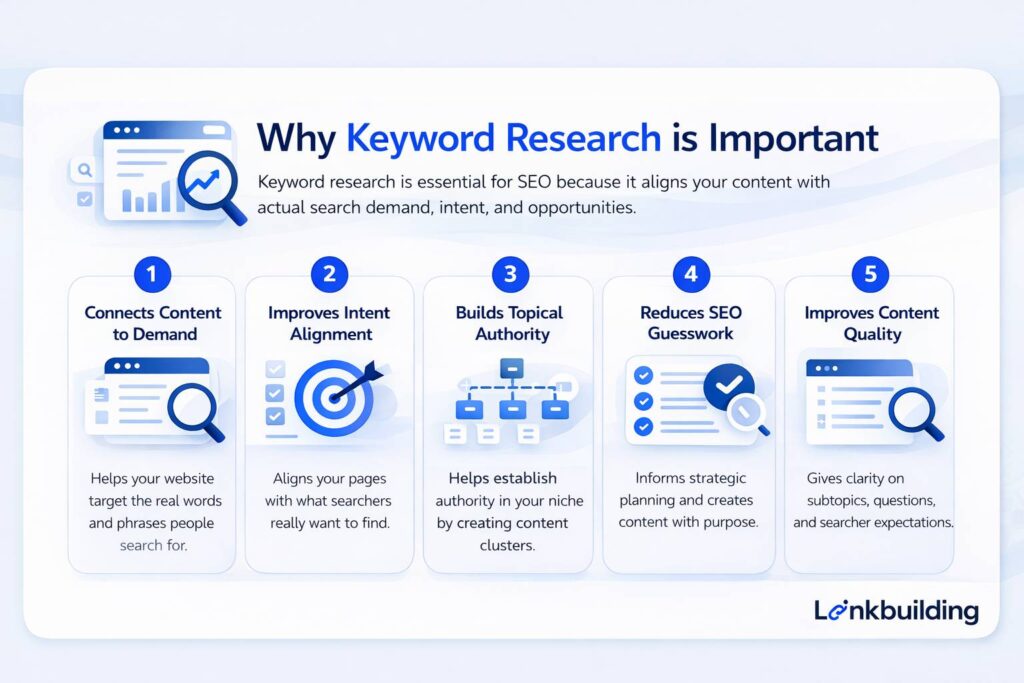
It matters because it connects content strategy to real demand, improves intent alignment, strengthens relevance, and supports topical authority. It also reduces wasted effort by helping teams prioritise opportunities that fit both the audience and the site’s broader SEO goals.
For a website building a pillar-and-cluster model, keyword research is especially important because it defines how the main topic and supporting pages should work together. In that sense, keyword research is not just a helpful SEO task. It is one of the core disciplines that makes the whole content strategy more coherent, more efficient, and more likely to perform over time.