

What Is Keyword Research and Why Is It Important?
What is keyword research, and why does it matter so much in SEO? At a basic level, keyword research is the process of identifying the words, phrases, questions, and topics people type into search engines, then deciding which of those searches your website should target. In practice, it is much more than a list of terms from a tool. It is a way to understand demand, interpret search intent, and shape content around what users actually want to find.
For businesses, marketers, and SEO professionals, keyword research is one of the clearest ways to reduce guesswork. Without it, content planning often becomes reactive. Pages get published because a topic feels relevant internally, not because there is evidence that users search for it in a meaningful way. That usually leads to weak prioritisation, overlapping content, and missed opportunities.
This article explains what keyword research is, how it works, why it matters, and what people often misunderstand about it. As a cluster page, it focuses specifically on answering the core informational query while naturally supporting a broader pillar structure around Keyword Research. It follows the writing and structure requirements in your brief.
What Is Keyword Research?
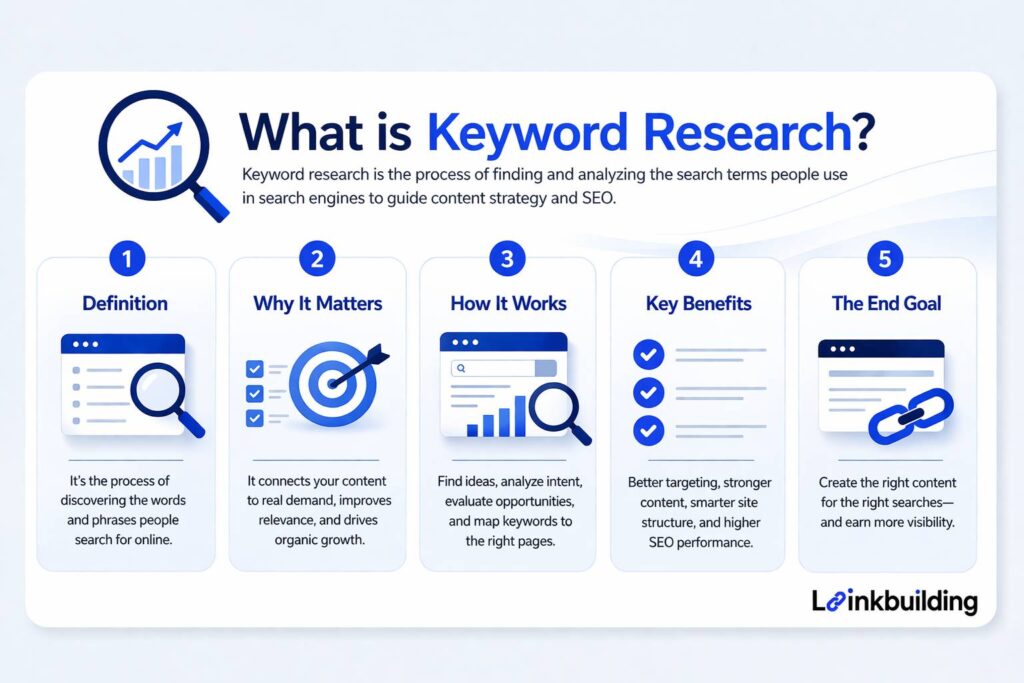
Keyword research is the process of finding and evaluating search queries that people use in Google and other search engines, then using that information to guide content strategy, page targeting, and site structure.
That definition is simple, but the practical meaning is broader.
A keyword is not just a term with search volume. It is usually a signal of need. Someone searching “what is keyword research” wants a clear explanation. Someone searching “keyword research tools” is likely comparing options. Someone searching “keyword research for ecommerce” has a narrower use case. The wording changes, but more importantly, the intent changes.
That is why keyword research should not be understood as a spreadsheet exercise alone. It is a way to answer several strategic questions at once:
- What topics does the audience care about?
- How do they describe those topics?
- What kind of content are they expecting?
- Which opportunities are realistic for this site?
- Where should each topic sit within the site architecture?
In other words, keyword research is not only about finding terms. It is about understanding search behaviour well enough to create the right page for the right query.
Why Keyword Research Matters
Keyword research matters because SEO depends on relevance. If a page does not align with how users search and what they expect to find, it will struggle to perform even if the writing is strong and the technical SEO is sound.
It aligns content with real search demand
Many websites publish useful information, but usefulness alone does not guarantee discoverability. If the page is built around language that real users do not search for, it may never attract organic visibility.
Keyword research helps solve that problem by connecting content planning to actual search behaviour. It reveals how people phrase questions, which subtopics appear repeatedly, and what kind of demand exists around a subject.
It improves intent matching
A large part of SEO performance comes from matching the right page format to the right query. Some searches require a broad educational guide. Others need a focused how-to article, a comparison page, or a product page.
Keyword research helps identify those differences early. That reduces the risk of creating a page that targets the right words but the wrong intent.
It supports stronger site structure
Keyword research is also important because it influences how pages relate to each other. In a pillar-and-cluster model, the broad topic often belongs on a pillar page, while narrower questions belong on focused supporting articles.
For example, a pillar page on Keyword Research can link naturally to supporting content on long-tail keywords, keyword search volume, competitor analysis, and search intent. A cluster page like this one answers the specific question “what is keyword research” without trying to replace the full pillar page.
It reduces wasted content effort
Content production takes time and budget. Keyword research helps make that investment more disciplined. Instead of publishing pages based on intuition alone, teams can make decisions based on relevance, demand, and strategic fit.
That does not eliminate uncertainty, but it improves the quality of the decisions behind what gets published.
How Keyword Research Works
Keyword research usually starts with a topic and expands into a process of discovery, evaluation, and mapping.
Start with a core topic
Most keyword research begins with a broad subject that matters to the website and its audience. That topic might be keyword research, technical SEO, internal linking, or local SEO.
From there, you identify the different ways people search around that topic. Those variations may include definitions, questions, comparisons, problems, and long-tail versions of the same theme.
In this case, “what is keyword research” is a definition-style informational query connected to the broader parent topic of Keyword Research.
Find related terms and questions
Once the topic is clear, the next step is to identify search terms related to it. This often includes:
- close variations
- question-based searches
- longer, more specific queries
- semantically related phrases
- beginner and advanced versions of the same topic
This matters because users rarely search in only one way. A strong page should reflect the language and context that surround the topic, even if it focuses on one main keyword.
Evaluate search intent
Keyword research is not only about what people type. It is also about why they type it.
For “what is keyword research,” the intent is clearly informational. The user wants a definition, explanation, and practical context. They are not necessarily trying to buy software or hire a service at that moment.
That insight shapes the page. The correct response is a clear educational article, not a sales page and not an overly technical manual.
Assess whether the topic is worth targeting
After identifying the keyword and its intent, the next step is deciding whether it deserves a dedicated page and how it should fit into the wider strategy.
That usually means asking:
- Is the topic relevant to the site?
- Is there meaningful search demand?
- Does it fit the current content structure?
- Would a separate page help clarify the topic for users?
- Can the page support related internal links?
For a cluster strategy, a focused page on “what is keyword research” makes sense because it addresses a common informational entry point and can lead readers toward deeper related content.
Important Subtopics Related to Keyword Research
To explain what keyword research is properly, it helps to understand the main concepts connected to it.
Search intent
Search intent is the reason behind a query. It is one of the most important parts of keyword research because the same topic can appear in different forms depending on what the user wants.
A definition-style search usually needs a clear explanation. A tools query often needs comparison content. A service query may need commercial information. Good keyword research distinguishes between those cases instead of treating them as interchangeable.
Search volume
Search volume estimates how often a keyword is searched. It can help with prioritisation, but it should not be treated as the only decision factor.
A keyword with lower search volume can still be valuable if the intent is clear and the page fits the site well. Search volume is useful context, not a full strategy.
Long-tail keywords
Long-tail keywords are more specific phrases, usually with clearer intent and often lower competition. They are important because they help websites target narrower needs more precisely.
A broad term like “keyword research” may belong on a pillar page. A specific phrase like “what is keyword research” is better suited to a focused cluster page like this one.
Keyword mapping
Keyword mapping is the process of assigning keywords to the right pages. This helps prevent overlap and makes it easier to structure content around clear page roles.
Without mapping, websites often create multiple articles around very similar terms, which weakens their overall architecture.
Common Mistakes People Make When Defining Keyword Research
A lot of confusion around keyword research comes from oversimplifying it.
Treating it as only a list of keywords
One common mistake is thinking keyword research ends once a tool exports a list of phrases. That list is only raw material. The strategic value comes from interpreting the data, understanding intent, and deciding how it should shape content.
Focusing only on search volume
Search volume is useful, but it can distort decision-making when used without context. High-volume terms are not automatically the best targets. Some are too broad, too competitive, or too weakly aligned with business goals.
Ignoring the page type behind the query
Some queries deserve a broad guide. Others deserve a narrow article or a commercial page. When websites ignore that distinction, they often create content that targets the right term but the wrong format.
Separating keyword research from site architecture
Keyword research works best when it informs how the site is structured. If it is treated as separate from internal linking, content hierarchy, and topical coverage, the result is usually fragmented content rather than a coherent cluster.
Practical Guidance for Using Keyword Research Correctly
The best way to use keyword research is to treat it as part of strategic planning, not just content production.
Start with the topics your site should cover based on expertise, business goals, and audience needs. Then look at how those topics appear in search. Review the language people use, the kinds of pages that rank, and the relationships between broad and narrow queries.
From there, decide which terms deserve pillar-level treatment and which should become cluster pages. In a strong topical structure, the broader Keyword Research pillar can explain the full discipline, while supporting pages cover more focused queries such as what keyword research is, how keyword research works, or how to find long-tail opportunities.
This also improves internal linking. A page like this one can naturally point readers toward broader guides on Keyword Research or deeper articles on search intent, search volume, and competitor analysis.
Timing and Expectations
Keyword research can improve planning immediately, but the SEO results that follow usually take longer.
Understanding the right topics and structuring content properly can save time from the start. Rankings, traffic gains, and authority growth still depend on execution, content quality, technical health, and competition.
That is worth keeping in mind with informational queries. A clear definition page can be valuable, but it works best when it sits inside a wider, well-linked content structure rather than in isolation.
Conclusion
So, what is keyword research? It is the process of discovering how people search, interpreting what those searches mean, and using that insight to decide what content a website should create.
At its best, keyword research does much more than produce a list of target phrases. It helps shape page purpose, content structure, internal linking, and topical authority. That is why it remains one of the most important foundations of SEO.
For a site using a pillar-and-cluster model, keyword research is especially valuable because it helps define the relationship between broad topics and supporting pages. A focused cluster page like this answers the core definition clearly, while also supporting a wider strategy built around the parent topic of Keyword Research.