
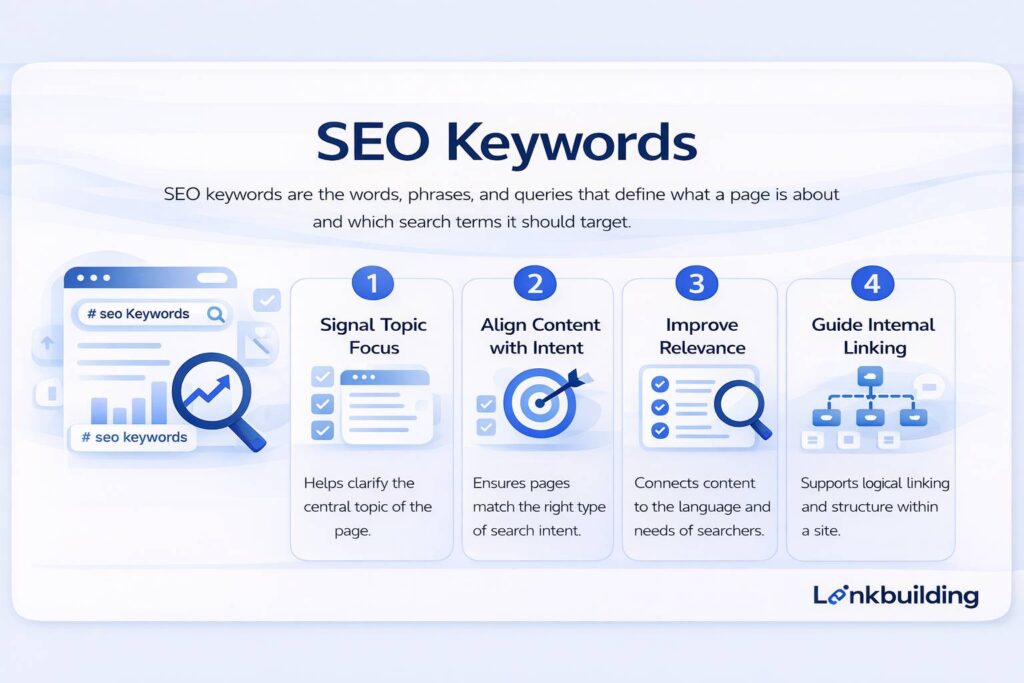

SEO Keywords
SEO keywords are one of the most familiar concepts in search marketing, but they are also one of the most misunderstood. Many people still think of them as isolated phrases that need to be inserted into a page a certain number of times. That view is outdated and usually unhelpful. In practice, SEO keywords are signals of topic, intent, and relevance. They help shape how content is planned, structured, and positioned within a wider SEO strategy.
For business owners, marketers, and SEO professionals, the real value of SEO keywords is not just that they can drive traffic. It is that they help connect a website’s pages to the language people actually use when searching. Without that connection, even strong content can struggle because it is framed around internal assumptions rather than real search behaviour.
This matters even more in a pillar-and-cluster model. A site building topical authority needs clear page roles. Broad topics belong on pillar pages, while narrower keyword themes often belong on cluster pages that support the broader structure. A focused page about SEO keywords should therefore explain what they are, why they matter, how to use them properly, and how they fit into a modern content strategy. This article follows the informational cluster-page brief and the writing guidelines you provided.
What Are SEO Keywords?
SEO keywords are the words, phrases, and search queries that help define what a page is about and which searches it is intended to match.
That definition is simple, but the practical meaning is more nuanced. A keyword is not just text placed on a page. It represents a topic and usually a specific user need. When someone searches for “SEO keywords,” they are not looking only for a phrase. They are looking for an explanation of how keywords work in SEO, how they should be used, and how they influence content and rankings.
In modern SEO, keywords should be understood as part of a broader system that includes:
- search intent
- topical relevance
- semantic coverage
- content structure
- internal linking
- page purpose
That is why SEO keywords are not just a writing consideration. They are also a planning and strategy consideration. They help determine what content gets created, how pages are differentiated, and how related pages connect to each other inside the site.
Why SEO Keywords Matter
SEO keywords matter because search engines need signals to understand what a page is about and when it deserves to appear in results. Users also need pages that reflect the language and topics they are actually searching for.
They connect pages to search demand
A website may know its products, services, or industry extremely well, but that does not guarantee it uses the same language as its audience. SEO keywords help bridge that gap.
They show how people search, what topics they associate together, and which wording reflects real demand. That helps businesses move away from internal jargon and create pages that align more closely with how users think and search.
They improve relevance
A page that targets the right topic clearly is more likely to feel relevant to both users and search engines. That does not mean repeating a phrase excessively. It means using the main keyword and related terms naturally within content that fully addresses the topic.
If a page is about SEO keywords, readers should expect a clear explanation of what they are, how they work, how to choose them, and how they fit into on-page SEO and content strategy. Relevance comes from clarity and completeness, not just repetition.
They support page structure and content planning
SEO keywords are also useful because they help define page roles. Some keywords indicate a broad informational topic that deserves a pillar page. Others point to narrower supporting pages.
For example, a broad pillar page on Keyword Research may link to more focused cluster articles on what keyword research is, why keyword research matters, long-tail keywords, keyword search volume, and SEO keywords. That structure helps the website cover the topic in depth without forcing one page to do everything.
They contribute to internal linking and topical authority
When a site understands its keyword landscape, it can build more coherent internal links. Related pages can support one another naturally because they are organised around connected keyword themes rather than scattered content ideas.
That improves usability and helps reinforce topical relationships across the site.
How SEO Keywords Work
SEO keywords work by helping shape the relationship between a page, a topic, and the search queries that page is best suited to answer.
Keywords signal topic focus
A page needs a clear subject. Keywords help establish that subject. They usually appear in places such as the page title, headings, body copy, URL, and anchor text where relevant.
But their job is not just placement. Their real job is focus. If the target keyword is “SEO keywords,” the page should stay centred on that subject rather than drifting into a broad general guide on all of SEO.
Keywords help align pages with intent
Not every keyword reflects the same intent. Some are informational. Some are commercial. Some are transactional. Some are navigational.
That difference affects the kind of page that should be created. Informational keywords usually need explanatory content. Commercial keywords often need comparisons or solution-focused pages. Transactional keywords need clear next steps or product relevance.
This is why keyword choice cannot be separated from intent analysis. A keyword is useful only when it is matched to the right content format.
Keywords shape semantic coverage
Modern SEO does not rely on exact-match repetition alone. Search engines interpret topics more broadly. That means a strong page should include semantically related language and supporting subtopics where relevant.
For a page on SEO keywords, that might include terms and concepts such as search queries, keyword targeting, search intent, keyword mapping, long-tail keywords, on-page SEO, and keyword relevance. These help the page feel complete and natural rather than narrow and mechanical.
Important Types of SEO Keywords
Understanding SEO keywords properly means understanding that they come in different forms and serve different purposes.
Primary keywords
A primary keyword is the main term a page is built around. It defines the central topic and helps guide the structure of the page.
For this article, the primary keyword is SEO keywords. The page should stay closely aligned with that topic throughout.
Secondary and related keywords
Secondary keywords are supporting terms that add context, depth, and semantic relevance. They are not separate targets that require their own sections every time, but they help expand the page naturally.
These might include phrases related to keyword targeting, long-tail keywords, keyword relevance, and keyword intent.
Short-tail keywords
Short-tail keywords are broad phrases, often with high search volume and broader intent. They can be valuable, but they are also more competitive and sometimes less precise.
Because they are broad, they often suit pillar pages or highly authoritative sites better than narrow pages.
Long-tail keywords
Long-tail keywords are more specific phrases, usually with clearer intent. They often make strong cluster-page topics because they answer narrower user needs more directly.
A page about SEO keywords may reference long-tail keyword strategy naturally, while a separate article could go deeper into that specific concept.
Branded and non-branded keywords
Some keywords include brand names, while others are generic topic searches. Non-branded keywords are especially important for discovery because they help users find the site before they know the brand.
For informational SEO content, non-branded keywords often play a central role in visibility building.
Common Mistakes With SEO Keywords
SEO keywords are simple in theory, but they are often used poorly in practice.
Treating keywords as a stuffing exercise
One of the oldest mistakes in SEO is assuming that repeating the exact phrase more often will improve rankings. This usually makes content worse, not better.
Overuse can damage readability, weaken trust, and signal low-quality optimisation. Good keyword use should feel natural and proportional to the topic.
Targeting keywords without considering intent
A keyword may look valuable in a tool, but if the page format does not match what users expect, performance will suffer.
A page targeting an informational keyword should explain and clarify. If it behaves like a sales page instead, it is unlikely to satisfy the search.
Creating too many similar pages
Websites sometimes create multiple pages around slight keyword variations that should really be handled together. That often leads to cannibalisation, thin content, and weaker internal structure.
A better approach is usually to group related queries by intent and build one strong page where appropriate.
Focusing only on volume
Search volume matters, but it should not dominate every decision. Some lower-volume keywords are more aligned, easier to rank for, or more useful strategically.
A strong keyword strategy balances relevance, competition, intent, and site structure.
Ignoring related language
Pages that focus too narrowly on one repeated phrase often miss the broader context of the topic. Search engines and users both respond better to content that reflects the full subject naturally.
Practical Guidance for Using SEO Keywords Well
The best way to use SEO keywords is to treat them as strategic inputs, not just writing prompts.
Start by identifying the main topic of the page and the intent behind the target query. Then decide what type of page should serve that keyword and how it fits into the wider site structure. Once that is clear, use the keyword naturally in important areas such as the title, heading structure, opening copy, and supporting sections where relevant.
A practical approach usually involves:
- choosing a clear primary keyword for the page
- confirming the search intent behind it
- grouping related keywords by topic and meaning
- deciding whether the keyword deserves a dedicated page or fits within an existing one
- writing content that covers the topic fully and naturally
- linking to related pages where it improves context and usability
This approach works especially well within a pillar-and-cluster structure. A broader Keyword Research pillar can explain the full process, while a page like this one clarifies the role of SEO keywords within that system. Related pages on search intent, keyword mapping, and long-tail keywords can then deepen the cluster without duplication.
Timing and Expectations
Using SEO keywords correctly can improve page clarity immediately, but the ranking benefits usually take time.
Search engines still need to crawl, interpret, and compare the page within the wider search landscape. Strong keyword use can improve relevance, but it works best when supported by content quality, internal linking, technical health, and topical depth.
It is also worth keeping expectations realistic. Choosing the right SEO keywords does not guarantee rankings on its own. It improves the foundation. The results come from how well those keywords are translated into genuinely useful pages.
Conclusion
SEO keywords are not just phrases inserted into content. They are signals that help connect topics, pages, and search intent within a broader SEO strategy.
When used properly, SEO keywords improve relevance, strengthen content planning, support internal linking, and help define clear page roles across a site. They matter not because they can be repeated, but because they help shape how a website responds to real search behaviour.
For a site building topical authority, that makes SEO keywords far more than a technical detail. They are one of the core tools used to organise content around the right topics, create stronger cluster relationships, and build pages that earn visibility through clarity and relevance over time.