

What Are Long Tail Keywords and Why Are They Important?
Long tail keywords are one of the most practical concepts in SEO because they help turn broad search demand into focused content opportunities. They are often described simply as longer search phrases, but that definition only tells part of the story. In practice, long tail keywords matter because they usually reveal clearer intent, more specific needs, and more realistic ranking opportunities than broad head terms.
For business owners, marketers, and SEO professionals, that makes them especially valuable. A website does not always need to compete for the broadest, most competitive keywords to grow meaningful organic traffic. In many cases, it performs better by targeting narrower queries that align closely with what the searcher actually wants. That is where long tail keywords become strategically useful.
This is particularly important in a pillar-and-cluster content model. Broad pages help establish topical relevance, but cluster pages often perform best when they address more specific search behaviour. Long tail keywords frequently provide the structure for those supporting pages. They help define subtopics, clarify search intent, and create stronger internal linking paths back to the main pillar topic.
This article explains what long tail keywords are, why they matter, how they work, what people often misunderstand about them, and how to use them in a realistic SEO strategy. It follows the informational cluster-page brief and the writing requirements you provided.
What Are Long Tail Keywords?
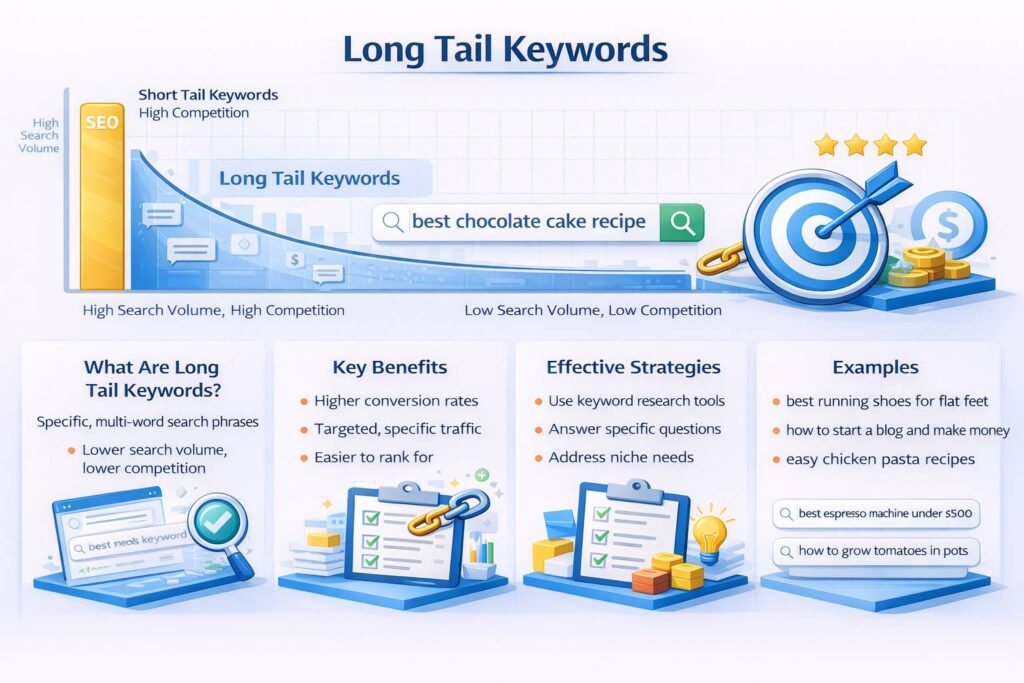
Long tail keywords are more specific search queries that usually have narrower intent than broad, high-volume terms.
The phrase “long tail” does not only refer to word count. Many long tail keywords are longer than head terms, but the real distinction is specificity. A broad keyword like “SEO” is general and can mean many things. A long tail keyword such as “best SEO tools for local businesses” reflects a much clearer need.
That difference matters because specificity changes how a page should be written and what kind of result the user expects. Someone searching a broad term may still be exploring. Someone searching a long tail phrase often has a more defined question, problem, or objective.
In practical SEO terms, long tail keywords often:
- reflect clearer intent
- narrow the topic more precisely
- reduce ambiguity
- support more focused pages
- create stronger alignment between query and content
That is why long tail keywords are so useful in content planning. They help move a strategy from broad topic coverage into actual page-level targeting.
Why Long Tail Keywords Matter
Long tail keywords matter because relevance is often easier to build around a specific need than around a broad topic.
They reflect clearer search intent
One of the biggest advantages of long tail keywords is that intent is usually easier to interpret. A broad term may contain mixed intent, meaning different users want very different things from the same search. A more specific keyword usually reduces that ambiguity.
For example, a search for “keywords” is too broad to guide a page properly. A search for “long tail keywords for ecommerce product pages” gives much clearer direction. It indicates topic, context, and likely expectation.
That clarity makes it easier to create a page that actually satisfies the query.
They create more realistic ranking opportunities
Broad head terms are often highly competitive, especially in established industries. Long tail keywords usually offer a more practical route to visibility because they are more focused and sometimes less heavily contested.
That does not mean every long tail keyword is easy. Competition still depends on the topic, the search results, and the authority of the sites already ranking. But in general, long tail keywords allow websites to compete with greater precision rather than trying to win the broadest terms immediately.
They support stronger content relevance
A page built around a well-chosen long tail keyword often feels more useful because it is designed for a specific searcher need. The content can be more direct, more complete, and better structured around the actual problem.
This is especially useful for cluster content. A broad pillar page might introduce keyword research as a whole, while long tail keywords can define supporting articles about search intent, keyword types, or long-tail strategy itself.
They can attract higher-quality traffic
Traffic quality matters more than raw traffic volume. A narrower search term often attracts users who are closer to taking action, making a decision, or engaging deeply with the topic.
Even when a long tail keyword has lower search volume, it may still produce better outcomes if the traffic is more relevant and the page better matches the user’s need.
How Long Tail Keywords Work
Long tail keywords work by helping websites target narrower search behaviour with more focused pages.
They narrow a broad topic into a specific query
Most SEO topics start broad. Keyword research, link building, technical SEO, and on-page SEO are all large subject areas. Long tail keywords help break those into more precise search opportunities.
That process matters because users do not always search for the broad category name. They often search for a variation that reflects their particular question, experience level, business type, or objective.
A broad topic creates the thematic space. Long tail keywords create the actual page targets inside that space.
They improve page-to-query matching
When the keyword is more specific, the page can be more specific too. This improves the match between the search query and the content.
A strong page built around a long tail keyword usually has:
- a clearer page purpose
- tighter topical focus
- more direct headings
- less unnecessary content
- stronger intent alignment
That does not mean the page should be thin. It means the page should be focused.
They help define cluster content
In a pillar-and-cluster structure, pillar pages cover the broad theme while cluster pages handle narrower supporting queries. Long tail keywords are often what make those cluster pages possible.
For example, a broader pillar page on Keyword Research might support cluster pages such as:
- what is keyword research
- why keyword research matters
- SEO keywords
- types of keywords
- long tail keywords
Each of those phrases reflects a more specific angle within the broader topic. Together, they improve coverage and make internal linking more meaningful.
Important Characteristics of Long Tail Keywords
Long tail keywords are easier to use strategically when you understand what makes them different from broader terms.
Specificity
The defining characteristic of long tail keywords is specificity. They narrow the query into something more precise than a generic head term.
That specificity might come from:
- a question format
- a use case
- a location
- a comparison angle
- a user segment
- a problem-based need
The more specific the phrase, the easier it often becomes to understand what type of page should serve it.
Lower individual search volume
Many long tail keywords have lower search volume than broad terms. That is normal and not a weakness by itself.
SEO strategy should not treat low volume as a reason to dismiss a keyword automatically. A lower-volume keyword can still be valuable if it is strongly aligned with the business, clearly intent-driven, and realistically winnable.
Stronger intent clarity
Broad terms often attract users with different goals. Long tail keywords usually reduce that ambiguity, which makes content planning easier and can improve relevance.
A clear query leads to a clearer page.
Better fit for niche and growing sites
Websites that are still building authority often benefit from targeting long tail keywords because broad head terms may be too competitive or too diffuse. Long tail opportunities allow those sites to create useful, focused pages that serve specific needs well.
That can build a stronger foundation over time than chasing only the biggest phrases.
Long Tail Keywords vs Short-Tail Keywords
Understanding long tail keywords becomes easier when comparing them directly with short-tail or head keywords.
Short-tail keywords are broader
Short-tail keywords are usually broad phrases with wider meaning and larger potential search volume. They are often useful for pillar pages or highly authoritative sites, but they can be difficult to rank for and may reflect mixed intent.
Long tail keywords are narrower
Long tail keywords are more precise. They usually point to a more defined user need and allow the content to be structured around that need directly.
This does not make long tail keywords automatically better in every case. Broad and narrow terms serve different roles. The main difference is that long tail keywords are usually better suited to focused pages, supporting topics, and more targeted intent coverage.
Common Mistakes With Long Tail Keywords
Long tail keywords are widely recommended in SEO, but they are often misunderstood or used too mechanically.
Assuming long means valuable
Not every long phrase is worth targeting. Some are too obscure, poorly aligned, or unsupported by meaningful demand. A keyword is not useful simply because it is longer. It needs relevance, intent clarity, and a realistic content role.
Treating each long tail keyword as a separate page
This is a common mistake. Closely related long tail queries often belong on the same page if they share the same intent and search result pattern.
Creating separate pages for every slight variation usually leads to thin content and cannibalisation. Keyword clustering is important here. Similar queries should often be grouped and covered together.
Ignoring the search results
A long tail keyword may look attractive in a tool, but the live search results still matter. You need to see what types of pages are ranking, how specific they are, and whether the keyword really represents a distinct opportunity.
Focusing only on low competition
Lower competition can be attractive, but it is not the whole strategy. A long tail keyword still needs to support business goals, fit the wider topic cluster, and lead to content that is genuinely useful.
Using long tail keywords without a wider structure
Long tail pages work best when they support a broader content architecture. A site made only of disconnected narrow pages may rank for isolated queries, but it often struggles to build strong topical authority. Long tail keywords are most effective when they reinforce a larger topic framework.
Practical Guidance for Using Long Tail Keywords Well
The best way to use long tail keywords is to treat them as focused entry points into a broader topic strategy.
Start with the main topic you want the site to own. Then identify the narrower questions, use cases, and search patterns within that topic. Review the search results to understand intent, then decide whether the long tail phrase deserves its own page or should be grouped into an existing one.
A practical process usually looks like this:
- define the broad topic area
- identify specific search variations within that topic
- review the search results for intent and page format
- group related long tail phrases by similarity
- map them to the most appropriate cluster or supporting pages
- connect those pages back to the broader pillar through internal links
This works especially well in a pillar-and-cluster model. A broad page can establish the main theme, while long tail keyword pages capture narrower informational needs that support the overall topic section.
Long tail keywords are also useful when prioritising content. If a site is still building authority, narrower, high-relevance opportunities often make more strategic sense than competing immediately for the broadest head terms.
Timing and Expectations
Long tail keywords can improve targeting quickly, but results still depend on execution and competition.
Because they are more focused, long tail pages can sometimes gain traction faster than broader content, especially when the site serves the query well and the search landscape is not overly competitive. Still, that is not guaranteed. Search engines still evaluate content quality, relevance, internal linking, technical health, and overall site authority.
The most realistic expectation is that long tail keywords improve strategic precision. They help you choose clearer opportunities, create better-aligned pages, and build a more coherent cluster structure. Rankings and traffic growth then follow from how well that strategy is executed over time.
Conclusion
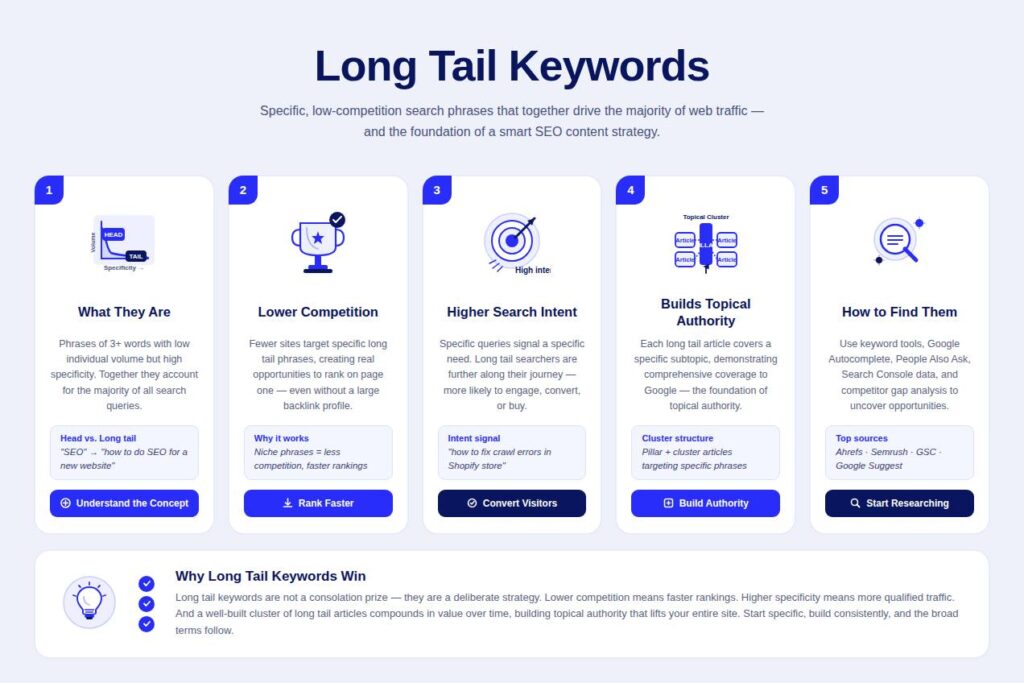
Long tail keywords are more than long search phrases. They are specific search opportunities that help websites match content more closely to user intent.
They matter because they create clearer targeting, support more focused pages, and often offer more practical ranking opportunities than broad head terms. They are especially useful in a cluster-based SEO strategy, where supporting pages need distinct roles and strong internal relationships to the broader topic.
Used well, long tail keywords help a website move from general visibility goals to pages that answer precise questions and attract more relevant traffic. That makes them one of the most useful tools in content-led SEO, not because they are narrower, but because they allow strategy to become more precise, more realistic, and more useful to the searcher.