

Keyword Strategy
Keyword strategy is the process of deciding which search topics a website should target, how those topics should be prioritised, and how they should be mapped across the site. It sits at the center of effective SEO because publishing content without a strategy usually leads to overlap, weak targeting, and wasted effort. A website may create useful pages, but if those pages are not built around the right opportunities or structured in the right way, performance will remain inconsistent.
For business owners, marketers, and SEO professionals, this is where keyword strategy becomes more valuable than keyword collection. A list of search terms is not a strategy. A strategy explains which queries matter, why they matter, what intent they represent, which pages should target them, and how those pages should work together inside a broader content structure.
That is especially important in a pillar-and-cluster model. A site building topical authority needs more than individual articles around related themes. It needs clear page roles, strong internal relationships, and a content plan that reflects both search demand and site architecture. Keyword strategy provides that framework. This article follows the informational cluster-page brief and the writing guidance you provided.
What Is Keyword Strategy?
Keyword strategy is the structured process of selecting, prioritising, grouping, and assigning keywords to the right pages based on search intent, business value, and site structure.
In practical terms, keyword strategy answers questions such as:
- Which topics should this website target?
- Which keywords deserve their own pages?
- Which related terms should be grouped together?
- Which pages should be pillar pages and which should be cluster pages?
- How should internal links connect those pages?
- Which opportunities are realistic now, and which should wait?
That is why keyword strategy is broader than keyword research. Keyword research discovers search opportunities. Keyword strategy turns those opportunities into a coherent plan.
For example, a website building an SEO content cluster may identify topics such as Keyword Research, search intent, long tail keywords, keyword types, and keyword strategy itself. Research reveals that those topics have search demand. Strategy determines how they should be prioritised, how each page should be framed, and how they should connect to one another.
Why Keyword Strategy Matters
Keyword strategy matters because SEO performance depends on more than choosing relevant search terms. It depends on how those terms are translated into site structure and page decisions.
It prevents random content production
Without keyword strategy, content planning becomes reactive. Teams publish articles one at a time based on isolated keyword ideas, competitor activity, or internal assumptions. That often creates content that feels related on the surface but lacks real structure.
A strategy provides direction. It helps the site move from publishing content opportunistically to building content deliberately.
It improves page clarity
Each page should have a defined role. A strong strategy makes that role clear. It determines which keyword is primary, which related terms belong on the page, and which nearby subtopics should be handled elsewhere.
That reduces confusion for both users and search engines. A page that tries to target too many overlapping ideas often becomes unfocused. A page built with a clear keyword strategy is easier to structure and easier to understand.
It supports topical authority
Search engines increasingly reward sites that cover a topic area with depth and coherence. Keyword strategy is essential here because it determines how broad themes and supporting subtopics fit together.
A broad Keyword Research pillar page can support cluster content on what keyword research is, why keyword research matters, SEO keywords, types of keywords, long tail keywords, search intent SEO, and how to determine search intent. Those pages do not exist independently. They work together as part of a structured topic system. That strategic relationship is exactly what your broader keyword research guide supports.
It reduces cannibalisation and wasted effort
One of the most common SEO problems is multiple pages competing for the same or very similar queries. This happens when keywords are collected but not mapped properly.
Keyword strategy reduces that risk by clarifying which page owns which topic and which related terms should be grouped together. It also helps identify where a content update or consolidation is better than publishing another article.
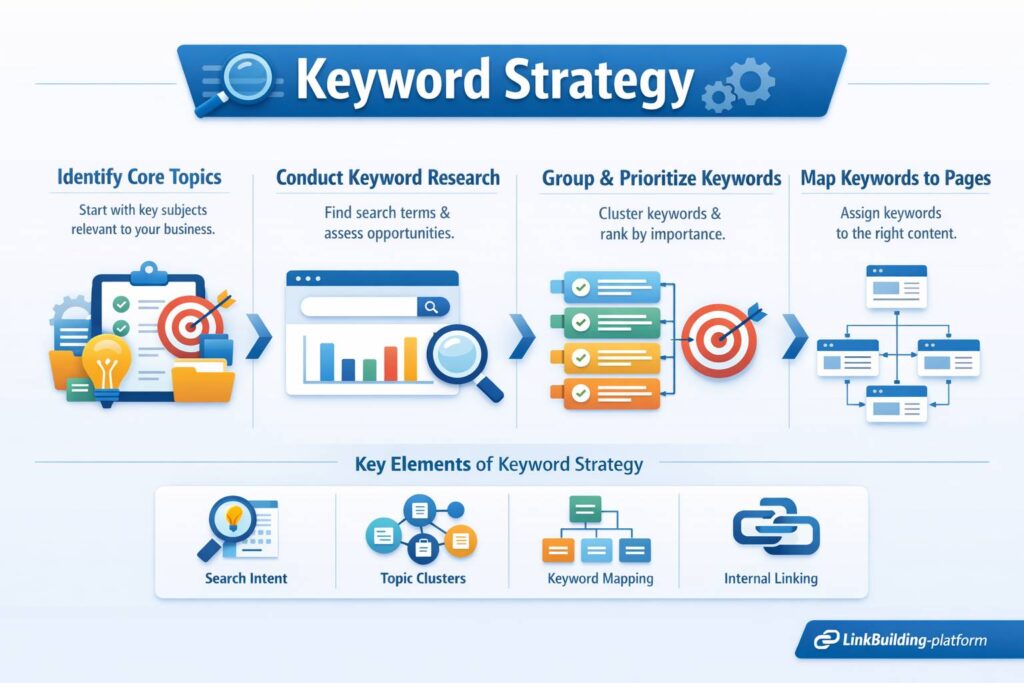
How Keyword Strategy Works
Keyword strategy works by turning keyword data into page-level decisions that support the broader goals of the site.
Start with business goals and core topics
A useful strategy begins with the site’s priorities, not with an export from a keyword tool. You need to identify the subjects the site should credibly own based on expertise, services, products, and audience demand.
These broad subjects form the foundation of the strategy. They usually become pillar topics or central category themes.
Layer keyword research onto those topics
Once the core topics are clear, keyword research expands them into specific search opportunities. This includes:
- broad head terms
- long-tail variations
- question-based searches
- commercial and comparison queries
- semantically related phrases
At this stage, the goal is not to build pages yet. It is to understand the keyword landscape around each topic.
Analyse search intent
A keyword strategy is only effective when intent is built into it. Every keyword needs context. The same topic can produce informational, commercial, and transactional queries that deserve different page types.
This is why reviewing live search results matters. The SERP often tells you whether the query needs a guide, a comparison page, a service page, or something else.
Group keywords into clusters
Not every keyword needs its own page. Closely related terms with the same intent often belong together. Keyword clustering helps identify those relationships.
This improves content depth and reduces the risk of thin or overlapping pages. It also makes the site architecture cleaner because each page serves a clearer purpose.
Map keywords to page roles
This is where keyword strategy becomes operational. The grouped keywords are assigned to existing or planned pages based on:
- topic breadth
- search intent
- business relevance
- competitiveness
- internal structure
A strong map should clarify which page owns the main topic, which pages support it, and how users should move between them through internal links.
Important Elements of a Strong Keyword Strategy
A sound keyword strategy depends on several supporting concepts working together.
Search intent alignment
Search intent is one of the most important elements because it shapes page type. A keyword may look promising, but if the wrong format is chosen, the page will struggle.
This is why strategy should never be based on volume alone. Intent determines whether the page should educate, compare, convert, or navigate.
Topic hierarchy
Topic hierarchy helps separate pillar pages from cluster pages. Broad themes usually belong at the top of the structure. Narrower questions and subtopics support them below.
This hierarchy is what makes internal linking more meaningful. Each page plays a role within a larger section of the site rather than existing in isolation.
Keyword prioritisation
Not every keyword opportunity deserves the same level of investment. Some terms are more valuable because they better match business goals, fit current authority levels, or support stronger cluster growth.
A strategy should prioritise keywords based on a mix of relevance, realistic opportunity, and structural value.
Keyword mapping
Keyword mapping is one of the clearest outputs of a keyword strategy. It assigns target topics and supporting phrases to specific URLs.
This helps prevent duplication and makes it much easier to manage content growth over time.
Internal linking logic
Keyword strategy should influence internal linking from the start. A page targeting a core concept should link naturally to supporting pages, and supporting pages should reinforce the broader topic section.
This strengthens both usability and topical clarity.
Common Keyword Strategy Mistakes
Keyword strategy often fails not because there is no data, but because the data is used without structure.
Treating keyword research as the strategy
A keyword spreadsheet is not a strategy. It becomes a strategy only when the keywords are prioritised, grouped, mapped, and connected to page roles.
Chasing volume without context
High-volume terms can look appealing, but they are not always the best targets. Some are too broad, too competitive, or too weakly aligned with the site’s goals. Strategy requires context, not just scale.
Publishing one page per phrase
This is a common mistake in content-led SEO. Slight keyword variations often belong together on one stronger page. Splitting them too aggressively creates thin content and internal competition.
Ignoring site architecture
A strategy that does not account for pillar pages, cluster pages, and internal links will usually become fragmented. The site may have content, but not real thematic structure.
Failing to revisit the plan
Keyword strategy is not static. Search results change, competitors publish new content, and site authority evolves. A strategy should be reviewed and adjusted over time rather than treated as final.
Practical Guidance for Building a Better Keyword Strategy
A practical keyword strategy starts with restraint. Do not try to target everything at once. Focus first on the topics the site can credibly own and the opportunities that align most closely with business value and search intent.
From there, build outward in a structured way.
A useful process usually looks like this:
- define the core topics that matter most to the site
- expand those topics into related keyword sets
- review the search results for intent and page format
- cluster related terms by meaning and SERP similarity
- assign those clusters to the right page types
- prioritise pages based on relevance, opportunity, and structural importance
- connect them through internal links that reflect the topic hierarchy
- review performance and refine the strategy over time
This process works especially well in a pillar-and-cluster model. A broad Keyword Research pillar can serve as the central topic page, while focused supporting pages cover specific subtopics such as search intent, long tail keywords, and keyword strategy. That structure is more useful than publishing disconnected articles because each page supports the wider topic system.
Timing and Expectations
Keyword strategy can improve clarity immediately, but the SEO outcomes take longer. The first benefit is better decision-making. The site publishes with more focus, avoids unnecessary overlap, and creates stronger links between related pages.
Ranking and traffic improvements follow over time as content is published, crawled, evaluated, and strengthened through internal linking and topical depth.
For established sites, revising keyword strategy can sometimes unlock gains relatively quickly, especially when it leads to consolidation, improved page targeting, or clearer cluster development. For newer sites, the value is often more foundational at first. The structure is stronger, even before the rankings fully catch up.
Conclusion
Keyword strategy is the framework that turns keyword opportunities into a coherent SEO system.
It matters because effective SEO is not built from isolated phrases. It is built from structured topic choices, clear page roles, aligned intent, and a site architecture that helps content work together. A strong keyword strategy makes those decisions visible and deliberate.
For a website building topical authority, this is especially important. The difference between scattered content and a strong content cluster often comes down to strategy. When keyword strategy is handled well, the site becomes easier to expand, easier to optimise, and more likely to earn visibility through relevance, structure, and long-term focus.