

Keyword Search Volume
Keyword search volume is one of the most familiar metrics in SEO, but it is also one of the most misunderstood. Many marketers treat it as the main signal for choosing topics, prioritising content, and judging keyword value. That approach usually leads to weak decisions. Search volume matters, but it only becomes useful when viewed alongside search intent, competitiveness, business relevance, and page role.
For business owners, marketers, and SEO professionals, keyword search volume is best understood as a directional metric. It helps estimate how often a term is searched, but it does not tell you everything you need to know about whether that keyword deserves its own page or whether your site should target it. A high-volume keyword can still be a poor fit. A lower-volume keyword can still be strategically strong.
This is especially important in a pillar-and-cluster model. Broad, high-volume terms may suit pillar pages, while lower-volume, more specific terms may be better for cluster pages that support topical depth and intent alignment. This article follows the informational cluster-page brief and the writing standards you provided.
What Is Keyword Search Volume?
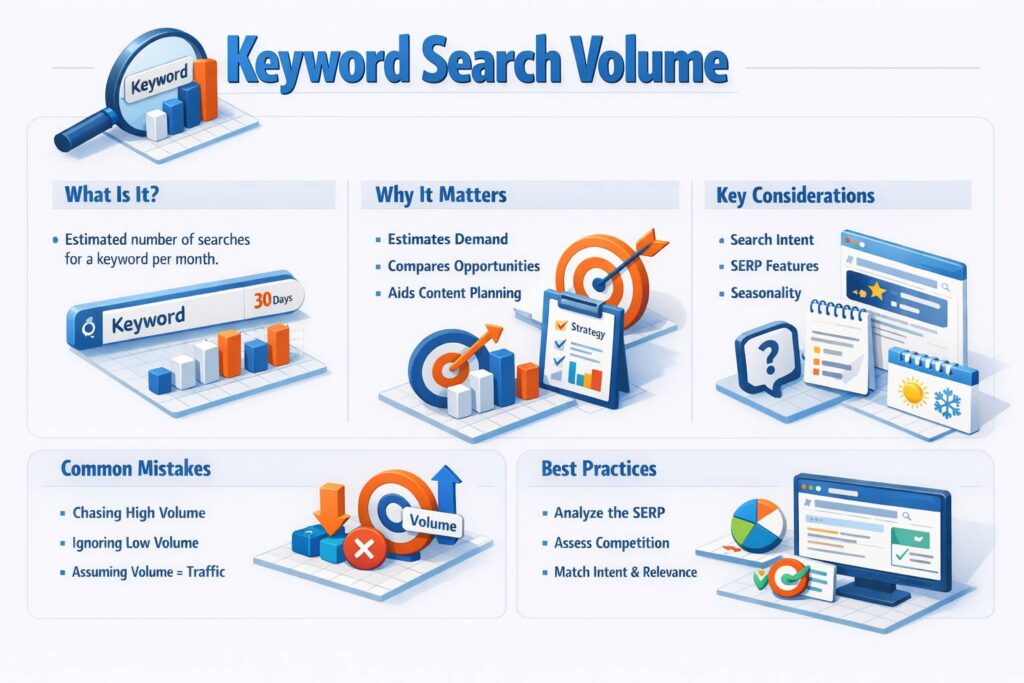
Keyword search volume is an estimate of how many times a keyword is searched within a given period, usually monthly.
In practice, it is often shown in keyword research tools as an average monthly number. That estimate helps marketers compare relative demand between different topics and phrases. But it is important to understand what the number actually represents.
Keyword search volume is not:
- a guarantee of traffic
- a prediction of clicks
- a signal that a keyword is worth targeting by itself
It is simply a measure of estimated search frequency.
For example, a keyword may show strong search volume but attract low click-through rates because the results page is crowded with ads, AI summaries, or SERP features. Another keyword may have lower search volume but clearer intent and better traffic quality. That is why keyword search volume should be treated as context, not as the full decision.
Why Keyword Search Volume Matters
Keyword search volume matters because it helps estimate potential demand. Without that signal, content planning becomes much more speculative.
It helps compare opportunities
One of the clearest uses of keyword search volume is comparing topics. If two keywords are similarly relevant and realistic, search volume can help indicate which one may have broader demand.
This is useful in planning because it helps prioritise content creation more intelligently.
It gives context to topic size
Search volume can also help show whether a keyword is a broad head term or a narrower supporting query. This matters when deciding whether a term belongs on a pillar page, a cluster page, or within an existing article.
A broad topic with substantial demand may justify a main resource page. A lower-volume subtopic may work better as supporting cluster content.
It supports realistic forecasting
While keyword search volume should not be treated as a traffic forecast, it can still help estimate the relative size of a topic area. This is useful for planning content investment, resource allocation, and topic prioritisation.
It helps identify hidden value in low-volume terms
A useful lesson in SEO is that low volume does not mean low value. Sometimes a keyword with modest search volume has much clearer intent, stronger relevance, and a better fit for the site’s content structure.
That is why understanding keyword search volume properly often leads to better decisions, not just bigger targets.
How Keyword Search Volume Works
Keyword search volume works as an estimated measure, not an exact count. That distinction is important.
It is usually averaged over time
Most tools show keyword search volume as a monthly average rather than a real-time number. That means the figure smooths out fluctuations and may not reflect seasonal spikes or sudden changes in interest.
It varies by tool and methodology
Different keyword tools often show different search volume estimates. That is normal. Each tool may use different data sources, modelling approaches, and rounding methods.
This is one reason volume should be treated directionally rather than as a precise fact.
It does not equal traffic
A keyword with 10,000 searches per month does not mean a page ranking for it will receive 10,000 visits. Actual clicks depend on:
- ranking position
- SERP features
- search intent
- competition
- click-through behaviour
Search volume is demand at the query level, not guaranteed traffic at the page level.
It needs intent and SERP context
Search volume only becomes meaningful when paired with intent analysis and live SERP review. A keyword might show attractive volume, but if the intent is wrong for your page type or the results are dominated by stronger formats, the opportunity may still be weak.
Important Factors That Affect Keyword Search Volume
Keyword search volume is useful, but several surrounding factors shape how much it should influence your strategy.
Search intent
A keyword with strong volume but unclear or mixed intent can be harder to target effectively than a lower-volume query with a very clear informational or commercial purpose.
Intent often matters more than volume.
SERP features
Some queries generate featured snippets, AI-generated summaries, People Also Ask boxes, shopping results, or local packs. These features can reduce clicks to organic listings even when search volume is high.
Seasonality
Some keywords rise and fall throughout the year. This matters because average monthly volume can hide strong seasonal patterns.
A topic may look modest on average but become highly valuable during certain periods.
Topic relevance
Search volume is only useful when the keyword is relevant to your audience, offer, and content goals. A high-volume term that sits outside your real area of authority may generate weak traffic and poor engagement.
Competition
Search volume should always be considered alongside competition. A large-demand keyword may be valuable in theory, but not realistic if the search results are dominated by highly authoritative sites and very strong pages.
Keyword Search Volume in a Cluster Strategy
Keyword search volume becomes much more useful when viewed inside a broader topical structure rather than as an isolated metric.
A site building a Keyword Research section, for example, may use search volume to distinguish:
- broader pillar topics
- supporting cluster pages
- narrow subtopics that belong within existing pages
That means high-volume terms do not automatically deserve their own URLs. Some belong at the center of the cluster. Others support the broader structure through more focused pages. Lower-volume cluster topics can still be strategically important because they help deepen coverage, support internal linking, and strengthen topical authority.
This is consistent with the wider cluster logic reflected in your uploaded Keyword Research guide.
Common Mistakes With Keyword Search Volume
Keyword search volume is useful, but it often causes poor decisions when overemphasised.
Treating volume as the main decision factor
A common mistake is assuming the highest-volume keyword is automatically the best target. In reality, the best target often depends more on intent, page fit, and realistic competition.
Ignoring lower-volume opportunities
Lower-volume keywords are often dismissed too quickly. But many of them have stronger specificity, better conversion potential, or a better place within a cluster-based SEO strategy.
Confusing search volume with traffic potential
Search volume does not equal visits. Even strong rankings may attract fewer clicks than expected if the SERP is crowded or the query produces limited organic engagement.
Using volume without checking the SERP
A keyword may look attractive in a tool, but the live results may reveal strong competitors, mixed intent, or page types that do not match your plan. Volume without SERP analysis is incomplete.
Building one page for every volume-bearing keyword
Not every keyword with measurable demand deserves a dedicated page. Closely related keywords often belong on one stronger page rather than multiple overlapping articles.
Practical Guidance for Using Keyword Search Volume Well
The best way to use keyword search volume is as one input in a broader decision-making process.
Start by evaluating whether the keyword is relevant to the site and fits the wider topic cluster. Then review the intent and the live SERP. After that, use search volume to compare opportunities and understand relative topic size, not to make the entire decision by itself.
A practical process usually looks like this:
- identify the topic and likely page role
- check the keyword’s relevance to the business and cluster
- review the search intent and current results
- compare search volume against similar terms
- assess competition and SERP features
- decide whether the keyword deserves its own page or fits within an existing one
- prioritise based on strategic fit, not just demand
This approach helps search volume stay useful without allowing it to distort the strategy.
Timing and Expectations
Keyword search volume can improve planning quickly because it helps estimate the relative size of opportunities early in the research process.
Its real value appears over time when combined with better targeting and cleaner content structure. Pages built around realistic keywords with clear intent and meaningful relevance usually perform better than pages chosen only because the volume looked attractive.
It is also worth staying realistic. Search volume is a planning metric, not a performance promise. Rankings, clicks, and business outcomes still depend on execution, competition, and how well the page satisfies the query.
Conclusion
Keyword search volume is an important SEO metric, but it is only useful when interpreted in context.
It matters because it helps estimate demand, compare opportunities, and understand topic scale. But it does not tell you everything. Search intent, competition, topic relevance, and page role all matter just as much, and often more.
For a site building topical authority, that makes keyword search volume a supporting metric rather than a deciding one. Used properly, it helps shape smarter content priorities and stronger cluster structure. Used poorly, it can lead to broad, unrealistic targets and weak editorial choices. The goal is not to chase the biggest number. The goal is to choose the right opportunities for the right pages.