

Keyword Research with Google
Keyword research with Google remains one of the most practical approaches in SEO because Google itself reveals how people search, what topics connect, and what type of content the search engine already rewards. Many marketers assume serious keyword research requires expensive software from the start. In reality, Google can provide a large amount of useful insight before a paid tool is ever involved.
For business owners, marketers, and SEO professionals, that makes Google especially valuable in early-stage research, content planning, and cluster development. It helps uncover search language, related questions, topic breadth, intent patterns, and content opportunities. That does not mean Google replaces every dedicated SEO platform. It means Google can be one of the most useful research environments available when used properly.
This is especially important in a pillar-and-cluster model. A website building topical authority needs more than isolated keyword ideas. It needs broad topic themes, supporting subtopics, and clear internal relationships between pages. Keyword research with Google can help define that structure by showing how users phrase searches and how Google groups topics across the results. This article follows the informational cluster-page brief and the writing standards you provided.
What Is Keyword Research with Google?
Keyword research with Google is the process of using Google’s own search features and result pages to discover, evaluate, and organise keyword opportunities.
In practical terms, this means using sources such as:
- Google autocomplete
- related searches
- People Also Ask
- live search results
- trend signals where relevant
The goal is not just to find phrases. It is to understand how Google interprets a topic and how users search around it.
For example, if you start with a broad topic like keyword research, Google may reveal supporting terms around search intent, long-tail keywords, keyword mapping, keyword tools, and choosing keywords. Those connected terms can help define the surrounding content cluster and improve how a website covers the broader subject.
This is why keyword research with Google is not just a budget alternative. It is a meaningful part of SEO strategy because it shows both search behaviour and search engine interpretation at the same time.
Why Keyword Research with Google Matters
Keyword research with Google matters because it gives direct insight into the search environment where rankings actually happen.
It reflects real search language
One of the biggest benefits of using Google for keyword research is that it shows how people phrase searches in real life. That matters because internal business language is often different from the language users actually type into search.
Google helps close that gap. It surfaces phrasing, modifiers, and question patterns that can improve page targeting and content clarity.
It reveals search intent more clearly
Many keyword tools provide metrics, but Google shows the actual results users receive. That makes it one of the best places to understand intent.
If a query returns guides and educational pages, the intent is likely informational. If the results show product or service pages, the intent may be commercial or transactional. This helps determine what type of page should be created before content production begins.
It supports cluster planning
A strong topical cluster needs supporting subtopics, not just one main page. Google can help identify those surrounding opportunities by revealing related questions, adjacent themes, and deeper search paths.
That is especially useful when building around a broader parent topic like Keyword Research, which naturally connects to pages on search intent, long-tail keywords, keyword mapping, keyword research tools, and keyword research with Google itself. That wider structure is aligned with the pillar framework in your uploaded guide.
It is accessible and practical
Google is available to everyone. That makes it useful for early-stage planning, validation, and ongoing refinement even when paid software is limited or unavailable.
How Keyword Research with Google Works
Keyword research with Google works by using the search engine itself as both a discovery tool and an interpretation tool.
Start with a seed topic
Begin with a core topic or phrase related to the page you want to build. This should be broad enough to reveal surrounding opportunities but focused enough to stay relevant to the subject area.
For example, a seed topic like keyword research can expand into more specific informational queries and supporting pages.
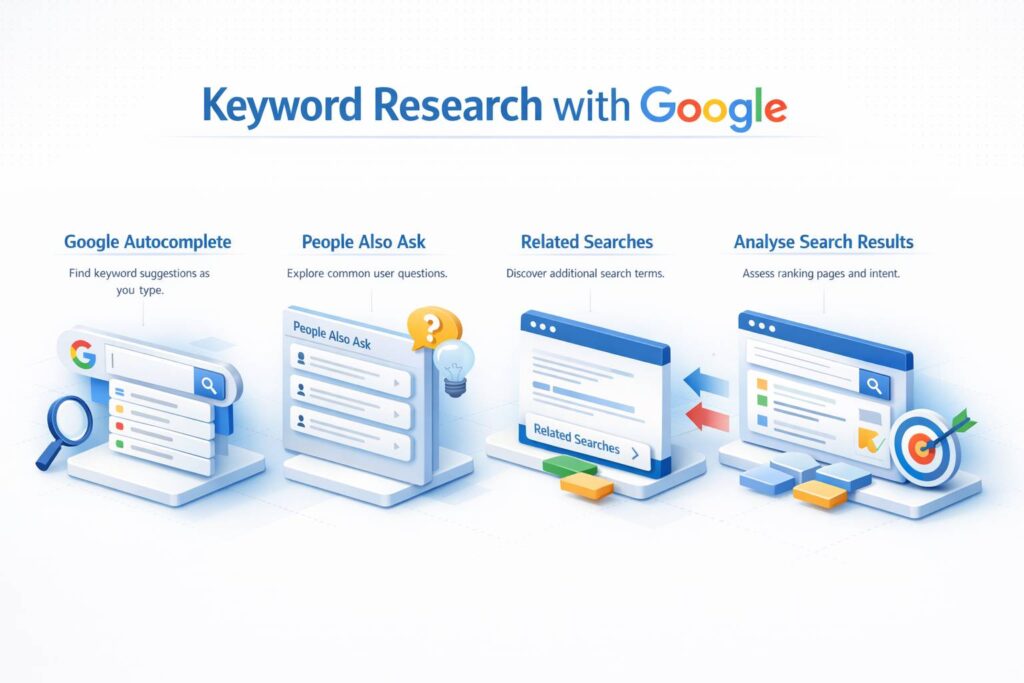
Use autocomplete for variations
Google autocomplete is one of the simplest and most useful research features. As you type, it suggests commonly searched phrases related to the topic.
These suggestions can help uncover:
- long-tail variations
- beginner questions
- comparison phrases
- problem-based searches
- supporting subtopics
Autocomplete is especially useful for expanding a topic into cluster ideas.
Review People Also Ask
The People Also Ask box often reveals closely related questions that users commonly explore around a topic. This can be useful for understanding user intent, subtopic depth, and supporting article opportunities.
It is also a strong way to find informational cluster content because it reflects the kinds of questions Google sees as adjacent to the original query.
Check related searches
Related searches at the bottom of the SERP can help identify adjacent terms and alternative phrasings. These often provide useful clues about topic breadth and searcher language.
Analyse the actual search results
This is one of the most important parts of keyword research with Google. The live search results tell you:
- what type of page ranks
- how broad the coverage should be
- what search intent dominates
- how strong the current competition appears to be
This helps move from keyword discovery into page planning.
Important Google Features for Keyword Research
Google offers several built-in signals that are especially useful during keyword research.
Google autocomplete
Autocomplete is useful for discovering common phrasing and long-tail variations. It helps reveal how users expand a base term into more specific needs.
People Also Ask
This feature is useful for question discovery and cluster planning. It can show what supporting questions belong near the main topic and where informational intent is strongest.
Related searches
Related searches help uncover nearby subtopics and alternate phrasing. These can often be useful for semantic coverage or supporting content ideas.
The SERP itself
The most important Google feature may simply be the search results page. It shows the ranking page types, topic coverage, and intent pattern directly. No tool can replace that fully.
Important Subtopics Within Keyword Research with Google
A strong page on keyword research with Google should also cover the concepts that make this process more effective.
Search intent analysis
Google is one of the best places to determine search intent because it shows the current ranking pattern. A keyword is more useful when you understand what kind of page Google already rewards for it.
Topic expansion
Using Google well means looking beyond one keyword. A broad topic often expands into supporting themes, related questions, and more specific cluster opportunities.
Keyword clustering
Google features often surface sets of related queries that should be grouped together rather than split into separate pages. This helps reduce duplication and improve page depth.
Content planning
Google-based research is most useful when it turns into page decisions. The end goal is not to collect search suggestions. The goal is to decide what pages to create, how to structure them, and how they should connect.
Common Mistakes in Keyword Research with Google
Keyword research with Google is simple to start, but it is still easy to misuse.
Stopping at autocomplete
Autocomplete is useful, but it is only one step. Good research also requires checking the actual results, related questions, and page formats.
Ignoring search intent
A phrase may look appealing, but the results may reveal a different intent than expected. Without checking the SERP, pages can easily target the wrong format.
Treating every suggestion as a separate page
Google often surfaces many close variations around one theme. These do not always deserve individual pages. Many should be grouped into one stronger article.
Using Google without structure
Google can generate many ideas quickly. Without a structured process, that can lead to scattered content planning. The research still needs to be filtered through topic relevance, page role, and site architecture.
Practical Guidance for Doing Keyword Research with Google
The best way to approach keyword research with Google is to use it as a structured discovery and validation system.
Start with the main topic you want the page or cluster to cover. Use autocomplete to expand the term, People Also Ask to uncover related questions, related searches to identify adjacent phrasing, and the live SERP to confirm intent and page format. Then group the findings into logical topic clusters and assign them to the right pages.
A practical workflow usually looks like this:
- choose a seed topic
- review autocomplete suggestions
- examine People Also Ask questions
- check related searches
- analyse the top-ranking pages
- group related terms by intent and topic
- map them to pillar or cluster pages
This approach works especially well within a pillar-and-cluster model because it helps define both the main topic and the supporting pages needed around it.
Timing and Expectations
Keyword research with Google can improve topic discovery quickly because the search engine provides immediate signals about phrasing, intent, and content patterns.
Its value often appears early in planning. It helps shape better content decisions before production begins. Over time, the benefits show up in stronger page targeting, clearer site structure, and more useful internal linking.
Google-based research is especially strong for discovery and intent analysis. It becomes even more effective when paired with thoughtful clustering and strategic page mapping.
Conclusion
Keyword research with Google is one of the most practical ways to understand how people search and how Google interprets a topic.
It matters because it reveals real search language, clarifies search intent, uncovers related questions, and helps build stronger topic clusters. Used properly, it can support a full content planning process, especially for informational SEO and pillar-and-cluster structures.
For a website building topical authority, that makes Google more than just the place where rankings happen. It is also one of the most useful research environments for deciding what content should exist, how it should be framed, and how it should connect to the wider topic structure.