
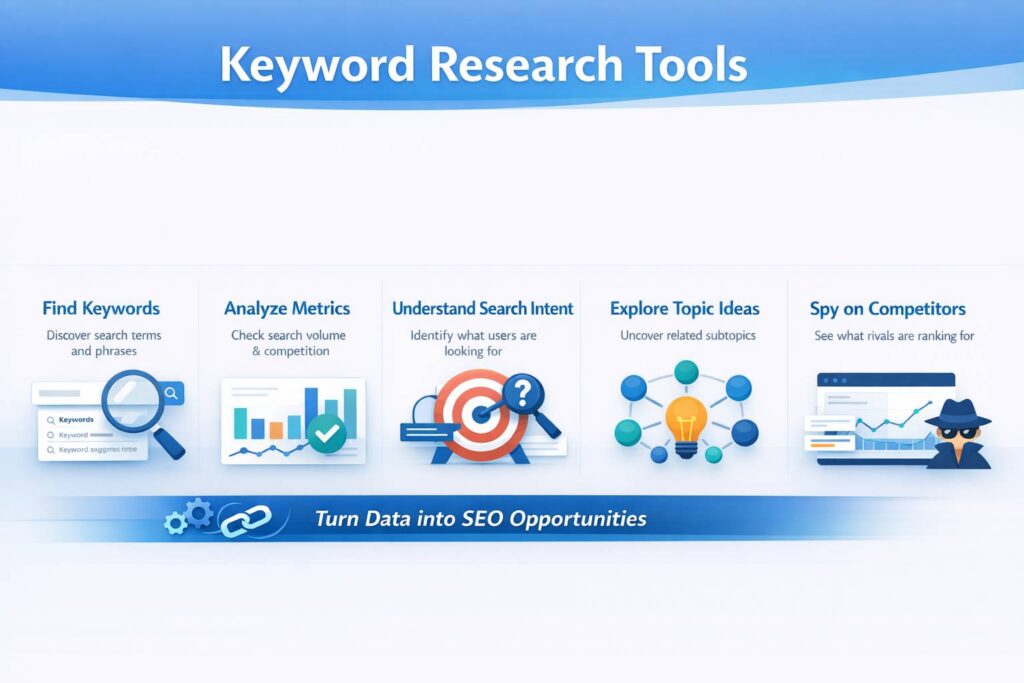

Keyword Research Tools
Keyword research tools are essential in modern SEO because they help turn broad topic ideas into real search opportunities. Without them, teams often rely too heavily on instinct, internal terminology, or assumptions about what users want. That usually leads to weak targeting, scattered content planning, and pages that fail to match real search behaviour.
For business owners, marketers, and SEO professionals, the value of keyword research tools is not simply that they produce lists of keywords. Their real value is that they help you evaluate demand, discover related topics, compare opportunities, understand search intent, and make better strategic decisions about what your website should publish.
That matters even more in a pillar-and-cluster model. A site building topical authority needs more than random content ideas. It needs a structured topic plan, supporting subtopics, clear internal linking, and realistic prioritisation. Keyword research tools help provide that structure by showing how search opportunities connect and which pages deserve investment. This article follows the informational cluster-page brief and the content standards you provided.
What Are Keyword Research Tools?
Keyword research tools are platforms, software, and search-based resources used to discover, evaluate, and organise keywords for SEO.
In practical terms, they help answer questions such as:
- What are people searching for?
- How often is a keyword searched?
- What related topics exist around a main term?
- How competitive is a query likely to be?
- What search intent does the keyword suggest?
- Which keywords belong together on one page?
A good keyword research tool does not replace strategic thinking. It supports it. The tool provides inputs such as search volume, keyword variations, related questions, trend patterns, and competitive clues. The strategist still has to decide which opportunities matter, which deserve their own pages, and how they fit into the wider site architecture.
That distinction matters. Tools help you see the search landscape, but they do not build the strategy for you.
Why Keyword Research Tools Matter
Keyword research tools matter because SEO depends on evidence-based decisions. Choosing topics without data can work occasionally, but it usually produces inconsistent results over time.
They connect content planning to real search demand
One of the clearest benefits of keyword research tools is that they show how users actually search. That helps websites move away from internal assumptions and toward real audience language.
A business may know its products or services well, but that does not mean it knows the exact phrasing customers use in search. Keyword research tools help bridge that gap.
They support better prioritisation
Not every keyword is worth targeting. Some are too broad. Some are too competitive. Some are too disconnected from business goals. Good tools help compare opportunities so you can focus on what is realistic and strategically useful.
That improves editorial discipline. Instead of creating pages around whatever sounds relevant, teams can prioritise topics that support both demand and structure.
They reveal topic depth and cluster opportunities
A broad theme often includes many related subtopics. Keyword research tools help uncover those layers.
For example, a site building a Keyword Research section may use tools to identify supporting opportunities around search intent, long-tail keywords, keyword strategy, keyword mapping, and choosing keywords. Those connections are central to building the structured cluster model described in your broader keyword research guide.
They improve page targeting
A page performs better when its topical focus is clear. Keyword research tools help identify which terms belong on the page, which related phrases should support it, and which nearby concepts deserve their own pages instead.
This reduces overlap and makes content more coherent.
How Keyword Research Tools Work
Keyword research tools work by gathering and organising signals related to search behaviour. The exact data sources and methodologies vary, but most tools help surface patterns rather than exact truth.
They start with a seed topic or keyword
Most tools begin with a core keyword, topic, or phrase. From there, they return related search terms, variations, and supporting questions.
This is often the first step in expanding a topic into a usable keyword set.
They provide keyword metrics
Most tools offer some combination of:
- search volume estimates
- keyword difficulty or competition indicators
- related keywords
- question-based queries
- trend patterns
- SERP previews or ranking data
These metrics help compare opportunities, but they need interpretation. A strong keyword strategy does not depend on one metric alone.
They help identify search intent patterns
Many tools indirectly support search intent analysis by showing related modifiers, search result previews, or clustering signals. Some make this more explicit than others.
Still, no tool fully replaces reviewing the live search results. Search intent should be validated through the SERP, not assumed from the software alone.
They support clustering and mapping
The most useful keyword research tools help group related terms and show how they connect across topics. This is valuable because not every variation deserves its own page.
By seeing related searches together, it becomes easier to build stronger pages and avoid fragmentation.
Important Types of Keyword Research Tools
Keyword research tools come in several forms, and each plays a different role in strategy.
Full SEO platforms
These tools usually combine keyword data, ranking analysis, competitor research, and site-level SEO features. They are useful when you need a broader strategic view rather than just a list of keywords.
They often help with:
- keyword discovery
- competitor analysis
- SERP analysis
- keyword grouping
- ranking tracking
Search engine native tools and data sources
Some of the most useful keyword inputs come directly from search engines themselves. These can include autocomplete suggestions, related searches, and broader trend signals.
These sources are often valuable because they reflect real user behaviour more directly, even when they offer less structured reporting than full SEO platforms.
Question and topic discovery tools
Some tools are especially useful for uncovering question-based searches, content angles, and supporting informational queries. These can help expand a core topic into cluster content and improve semantic coverage.
Competitor-focused tools
Some keyword research tools are strongest when used to understand what competitors rank for, where they have topic coverage gaps, and which search opportunities overlap with your own priorities.
These are especially useful when deciding whether a topic is already saturated or whether there is room to produce something more useful.
Important Subtopics Within Keyword Research Tools
A strong article on keyword research tools should also explain the supporting concepts that shape how those tools are used well.
Search volume and demand estimates
One of the most common features of keyword research tools is search volume data. This can help indicate demand, but it should not be treated as a precise number or the only decision factor.
Volume is useful for context. It becomes valuable only when balanced with intent, competitiveness, and page role.
Keyword difficulty and competition
Many tools estimate how difficult it may be to rank for a keyword. This can be helpful, but it should not replace manual judgment.
Difficulty scores can point you in the right direction, but the actual search results often reveal more about whether the opportunity is realistic.
Related terms and semantic coverage
Keyword research tools are often strongest when they reveal the surrounding language of a topic. This helps pages become more complete and more aligned with how users search.
That is especially useful for cluster content, where semantically related queries can help define supporting page angles.
Competitor analysis
Many tools allow you to review what other sites rank for. Used properly, this can reveal content gaps, topic priorities, and realistic opportunities.
The goal is not to copy competitor pages. It is to understand the landscape well enough to make better decisions.
Common Mistakes With Keyword Research Tools
Keyword research tools are useful, but they are often misused.
Treating the tool as the strategy
A tool can surface keywords, but it cannot decide your priorities for you. The strategy still depends on topic relevance, intent, site architecture, and business goals.
Overvaluing search volume
One of the most common mistakes is using search volume as the main filter for every decision. High-volume terms are not always the best targets. Some are too broad, too competitive, or too weakly aligned with the site’s goals.
Ignoring search intent
Even the best keyword tool cannot tell the full story unless the search results are reviewed as well. A keyword may look promising in software, but if the SERP suggests a different page type than the one you planned, the opportunity may be weaker than it appears.
Creating one page for every keyword variation
Tools often return many close variations of the same theme. Treating each one as a separate content idea creates thin pages and cannibalisation. Similar terms usually need clustering, not duplication.
Relying only on one tool
No single tool captures the whole search landscape perfectly. Different tools highlight different opportunities. In practice, combining tool outputs with live SERP review usually leads to better decisions.
Practical Guidance for Using Keyword Research Tools Well
The best way to use keyword research tools is to treat them as decision-support systems, not content generators.
Start with a clear topic area. Then use the tools to expand that topic into related opportunities, compare likely demand, review competitiveness, and identify which subtopics belong together. After that, validate the findings against the live search results and map them into the wider content structure.
A practical process usually looks like this:
- define the core topic
- use a tool to find related keywords and questions
- review search volume and competition signals
- check the live search results for intent and page format
- group related terms into clusters
- assign clusters to the right pages
- refine the plan as the site grows
This process works especially well within a pillar-and-cluster model. A broad page can own the central topic, while keyword research tools help identify and support the surrounding cluster pages that deepen topical coverage.
Timing and Expectations
Keyword research tools can improve planning immediately, but the SEO outcomes they support still take time. Their first value is strategic clarity. They help you make better choices about topics, page roles, and site structure before content is created.
For established sites, better use of tools can sometimes lead to quicker gains, especially when they reveal gaps, reduce overlap, or improve targeting on existing pages. For newer sites, the value is often more foundational. The site becomes better organised and easier to scale.
Still, tools alone do not produce rankings. Results depend on how well the insights are turned into useful pages, strong internal links, and a coherent topic structure.
Conclusion
Keyword research tools are essential because they help websites make smarter SEO decisions based on real search behaviour instead of assumption alone.
They matter not because they generate large keyword lists, but because they help reveal demand, intent, related topics, and realistic opportunities. Used well, they support stronger topic planning, clearer page targeting, better clustering, and more purposeful site architecture.
For a website building topical authority, that makes keyword research tools much more than optional software. They are practical instruments for turning broad topic ideas into structured content systems that are easier to publish, easier to optimise, and more likely to perform over time.