

Keyword Mapping
Keyword mapping is one of the most important structural disciplines in SEO because it determines which page should target which topic, query set, and search intent. Many websites do keyword research, collect useful opportunities, and publish content consistently, yet still struggle to build organic momentum. The issue is often not a lack of content. It is a lack of clarity. When multiple pages target the same intent, or when important keywords have no clear page assigned to them, the site becomes harder for both users and search engines to understand.
For business owners, marketers, and SEO professionals, keyword mapping turns research into execution. It bridges the gap between keyword discovery and site architecture. Instead of treating keywords as a loose collection of ideas, keyword mapping assigns them to specific URLs based on relevance, intent, and page role. That makes content planning more strategic, reduces overlap, and supports stronger internal linking.
This matters even more in a pillar-and-cluster model. A site building topical authority needs broad pillar pages, focused cluster pages, and clear relationships between them. Keyword mapping helps define those relationships. It shows which page owns the main topic, which pages support it, and how surrounding content should connect. This article follows the informational cluster-page brief and the content standards you provided.
What Is Keyword Mapping?
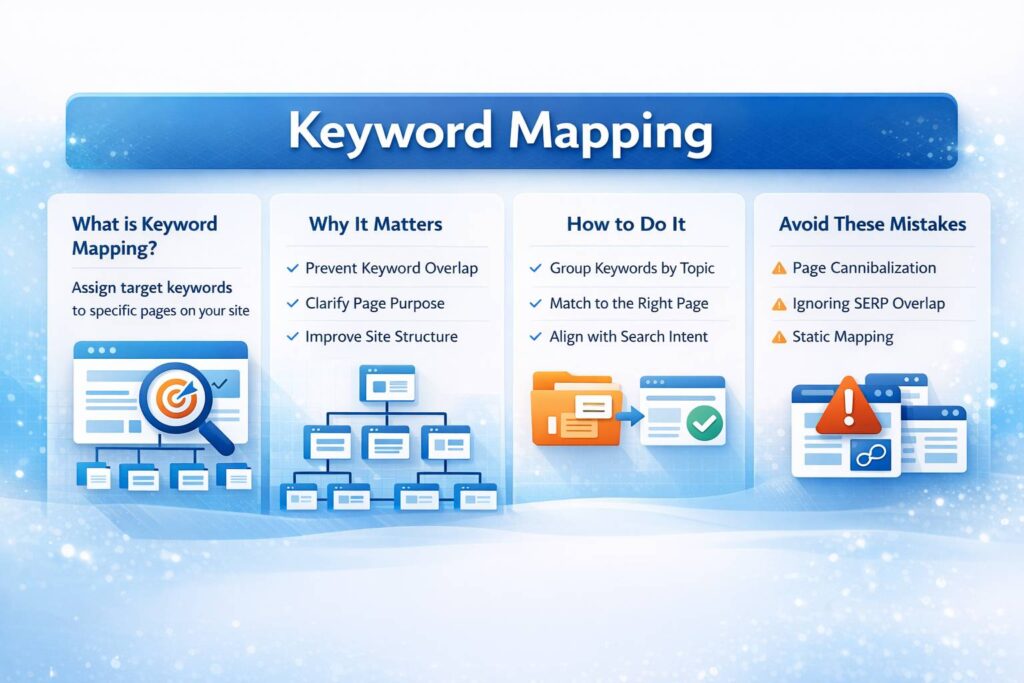
Keyword mapping is the process of assigning target keywords and related search themes to specific pages on a website.
In practical terms, it answers a simple but essential question: which page should rank for which keyword set?
That sounds straightforward, but good keyword mapping is more than matching one phrase to one URL. It involves understanding search intent, grouping related terms, preventing overlap, and deciding where each page fits within the wider content structure.
For example, a site building a Keyword Research topic cluster might have:
- a pillar page targeting Keyword Research
- a cluster page targeting what keyword research is
- a cluster page targeting search intent SEO
- a cluster page targeting long tail keywords
- a cluster page targeting keyword mapping
Each page has a distinct role, but each also supports the larger topic. Keyword mapping is what keeps those pages from competing with one another unnecessarily.
Without mapping, teams often create pages reactively. They publish a new article whenever they find a promising term, without checking whether another page already serves that need. Over time, this creates duplication, cannibalisation, and weak architecture.
Why Keyword Mapping Matters
Keyword mapping matters because SEO performance depends on structure as much as it depends on content quality.
It gives each page a clear role
A page performs better when its purpose is obvious. Keyword mapping helps define that purpose by clarifying which topic the page owns and which related terms belong with it.
That improves focus. The page becomes easier to structure, easier to optimise, and easier to connect to other relevant pages.
It reduces keyword cannibalisation
One of the most common SEO problems is several pages competing for the same query or intent. This can happen when content is produced by different teams over time, when slight keyword variations are treated as separate pages, or when there is no central map guiding decisions.
Keyword mapping reduces that risk by showing which page should own the topic and which pages should support it instead of competing with it.
It supports stronger site architecture
A website building topical authority needs more than pages on related subjects. It needs a structure that makes those relationships visible.
Keyword mapping helps create that structure. It clarifies how broad pages relate to narrower supporting pages, and it improves internal linking because the topic hierarchy is already defined.
This is especially useful in a pillar-and-cluster model, where the broader Keyword Research guide can support focused articles on search intent, long-tail opportunities, keyword strategy, and keyword mapping itself. That structural relationship is reinforced in the broader keyword research guide you provided.
It improves content planning and prioritisation
Keyword mapping is not only useful for existing pages. It is also a planning tool. It reveals:
- which important topics already have a page
- which topics are missing entirely
- which pages may need consolidation
- which areas of the cluster need stronger support
That makes editorial planning more strategic and reduces wasted production effort.
How Keyword Mapping Works
Keyword mapping works by translating keyword research into page-level decisions.
Start with the existing site structure
The first step is understanding what pages already exist and what each page is intended to do. Before assigning keywords, you need to know:
- which pages are pillars
- which pages are cluster articles
- which pages are commercial or service pages
- where topic overlap may already exist
This matters because mapping should not happen in a vacuum. It should reflect the actual structure of the site.
Group keywords by topic and intent
Not every keyword deserves a unique page. Related phrases with the same search intent often belong together.
This is where clustering matters. A strong keyword map usually groups terms based on:
- shared topic meaning
- similar search intent
- overlapping search results
- page format expectations
For example, several close variations around keyword mapping in SEO may belong on one page rather than multiple separate URLs.
Match keyword groups to the right page type
Once the keyword clusters are clear, the next step is assigning them to the correct page type.
A broad informational topic may belong on a pillar page. A narrower explanatory query may belong on a cluster article. A comparison phrase may need a commercial-style page. A service-led search may belong on a landing page.
Keyword mapping works best when it reflects both keyword meaning and content role.
Assign a primary focus and supporting terms
A mapped page usually needs one primary keyword theme and a set of related supporting terms.
That keeps optimisation focused without becoming overly narrow. The page can cover the topic naturally, include semantically related language, and still maintain a clear central purpose.
Important Elements of Good Keyword Mapping
A useful keyword map depends on more than a spreadsheet of keywords and URLs.
Search intent alignment
Intent is one of the most important parts of keyword mapping because it determines whether a page is the right fit for the query.
If a keyword has informational intent, it should usually be mapped to an educational page. If the results show commercial investigation or transactional behaviour, the page type may need to change.
Mapping based on phrases alone often leads to poor results. Mapping based on intent leads to stronger relevance.
Topic hierarchy
Good keyword mapping reflects the hierarchy of the site.
Broad pages usually sit higher in the structure and support the overall theme. Narrower pages answer specific questions or cover supporting subtopics. This hierarchy makes internal linking more logical and reduces duplication.
Page differentiation
Each mapped page should have a distinct reason to exist. If two pages target nearly the same topic, one of them may be unnecessary or may need a clearer angle.
Keyword mapping helps create separation between pages so the site covers the topic thoroughly without blurring page roles.
Internal linking pathways
Mapping should influence how pages connect. If a page targets a supporting subtopic, it should usually link back to the broader pillar topic where appropriate, and vice versa.
That improves usability and reinforces topical relationships for search engines.
Common Keyword Mapping Mistakes
Keyword mapping is simple in theory, but it often breaks down in execution.
Mapping one keyword to every page variation
A common mistake is assuming every phrase deserves its own page. This often creates thin content and unnecessary overlap.
Slightly different keywords do not always represent different intents. In many cases, closely related terms belong together on one strong page.
Ignoring the current search results
A keyword may look distinct in a tool, but the search results may show the same set of ranking pages as another term. That is a strong sign the terms should likely be clustered together rather than split apart.
Ignoring the SERP often leads to poor mapping decisions.
Treating mapping as static
Keyword maps should be revisited over time. Search behaviour changes, rankings shift, and websites grow. A page that once made sense may later overlap with new content or need a revised role.
A map is a working document, not a permanent one-time exercise.
Failing to connect mapping to internal linking
Keyword mapping is most useful when it affects how the pages relate to one another. If the site maps keywords but does not use that structure to guide internal links, a lot of the strategic value is lost.
Mapping without business relevance
A keyword may be interesting, but it still needs to support the site’s broader goals. Good keyword mapping balances search demand with relevance, not just volume.
Practical Guidance for Keyword Mapping
The best way to approach keyword mapping is to treat it as part of a broader planning system rather than a last-minute optimisation task.
Start by auditing the current pages in the topic area. Then group the relevant keywords by intent and theme. Review the live search results to confirm which terms belong together. From there, assign each cluster to the page that is best positioned to own it, or identify where a new page is genuinely needed.
A practical process usually looks like this:
- list the current pages in the topic section
- collect relevant keyword groups for that section
- review intent and SERP overlap for each group
- cluster related terms together
- assign each cluster to a specific URL
- identify overlaps, gaps, and consolidation needs
- strengthen internal links based on the new map
- review the map regularly as the site grows
This process works especially well in a pillar-and-cluster model. A broader page can target the main theme, while focused cluster pages support narrower questions and concepts. Keyword mapping ensures those pages complement each other instead of competing.
Timing and Expectations
Keyword mapping can improve strategic clarity immediately, but the ranking benefits usually take time.
The first gains are often operational. Teams publish with more focus, avoid duplication, and make better decisions about which pages to create or revise. SEO gains then follow as the content structure becomes clearer, internal linking improves, and search engines can interpret page roles more confidently.
For established sites, better keyword mapping can sometimes lead to relatively quick improvements if it helps resolve cannibalisation or strengthen underperforming pages. For newer sites, the value is often foundational at first. The site is better organised and easier to scale correctly over time.
Conclusion
Keyword mapping is the process that turns keyword research into a clear site structure.
It matters because keywords alone do not create strong SEO. Pages need defined roles, distinct topics, and purposeful relationships. Keyword mapping provides that framework by showing which page should target which theme and how those pages should work together inside the wider content cluster.
For a site building topical authority, that makes keyword mapping more than a technical task. It is a structural discipline that supports page clarity, reduces overlap, strengthens internal linking, and helps the entire content system become more coherent over time.