

How to Determine Search Intent
Determine search intent correctly and your SEO strategy becomes much more effective. Miss it, and even a well-written page can struggle to rank or convert. That is because search intent explains what the user is actually trying to achieve when they type a query into Google. The keyword gives you the subject. Intent tells you the purpose behind it.
For business owners, marketers, and SEO professionals, this matters because content performance is rarely driven by keyword placement alone. Pages succeed when they match what searchers expect to find. A keyword with informational intent needs a different page format from a keyword with commercial or transactional intent. If the format is wrong, the page can feel irrelevant even when the topic is technically correct.
In a pillar-and-cluster model, this becomes even more important. Determining search intent helps define whether a topic belongs on a broad pillar page, a focused cluster article, or a commercial landing page. It also improves internal linking because each page can serve a clearer role within the wider topic structure. This article follows the informational cluster-page brief and the content standards you provided.
What Is Search Intent?
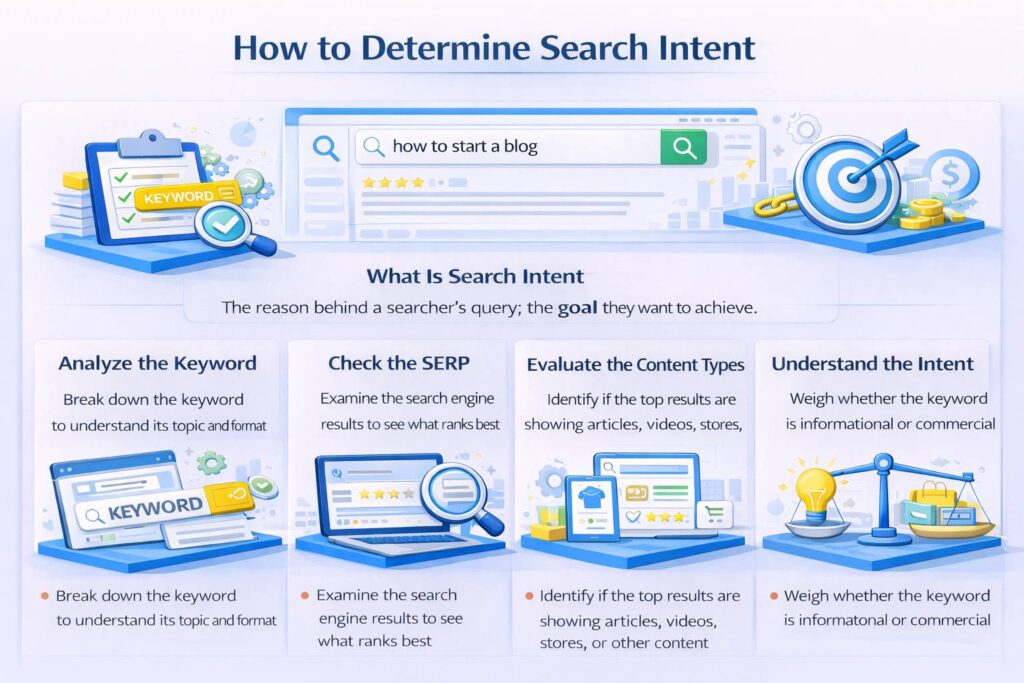
Search intent is the reason behind a search query. It describes what the user wants to accomplish, not just what words they used.
When you determine search intent, you are trying to answer a simple question: what kind of result is most likely to satisfy this search?
For example, someone searching for “what is keyword research” usually wants an explanation. Someone searching for “best keyword research tools” is likely comparing options. Someone searching for “buy SEO software” is much closer to action. The words are different, but more importantly, the expectation is different.
That is why intent matters so much in SEO. Search engines do not just rank pages that mention a keyword. They rank pages that appear to serve the purpose behind the query.
In practical terms, determining search intent helps you decide:
- what type of page to create
- how broad or narrow the content should be
- which subtopics to include
- which related pages to link to
- where the page belongs in the overall site structure
Why It Matters to Determine Search Intent
Determine search intent well, and you improve much more than rankings. You improve the quality of the entire content strategy.
It improves page relevance
Relevance is not only about covering the topic. It is about presenting that topic in the right format. A page can be accurate and still underperform if it answers the wrong question or answers the right question in the wrong way.
If users want a concise guide and the page behaves like a product pitch, intent is mismatched. If users want to compare services and the page only provides a dictionary-style definition, the page will likely feel incomplete.
It supports better rankings
Search engines try to match queries with the most useful result type. When your page aligns with that expected format, it has a better chance of competing.
This is why determining search intent should happen before the page is written, not after. It is part of choosing the page correctly, not just optimizing it later.
It improves user experience
Users arrive with an expectation. When the page meets that expectation quickly and clearly, engagement usually improves. When the page misses the mark, users often return to the search results.
Determining search intent helps reduce that friction because it keeps the page aligned with the reason the search happened in the first place.
It strengthens site structure
A site building topical authority needs page roles to be clear. Determining search intent helps separate broad informational pages from narrower cluster articles and commercial assets.
For example, a broader Keyword Research pillar page can support cluster articles on search intent, long tail keywords, and how to determine search intent. Each page answers a different need while still contributing to the wider topic section. That relationship is central to the pillar-and-cluster approach described in your content brief.
How to Determine Search Intent
Determining search intent is not guesswork. It is a structured process built around the keyword, the results page, and the expectations revealed by current rankings.
Start with the query itself
The first clue comes from the wording of the search.
Some terms naturally suggest informational intent. Queries containing words such as what, how, why, guide, tips, or examples often signal that the user wants to learn something.
Other terms suggest comparison or evaluation. Queries containing best, top, review, comparison, or vs often signal commercial investigation.
Terms like buy, pricing, hire, near me, or discount may indicate transactional or local intent.
This first step is useful, but it is not enough on its own. Wording can help, but real intent should always be confirmed by looking at the search results.
Review the live search results
The search engine results page is one of the strongest intent signals available. It shows what Google currently believes satisfies the query.
When reviewing the results, look for patterns such as:
- guides and blog posts
- product pages
- service pages
- comparison pages
- local listings
- videos
- featured snippets
If the top results are mostly educational articles, the query is likely informational. If they are comparison lists or review pages, the intent is probably commercial. If they are product or service pages, the intent may be transactional.
For the query “determine search intent,” the expected pattern is informational. Users want to understand the process, not buy a product immediately.
Identify the dominant page format
Once you examine the results, the next step is to identify the dominant format. This is what helps translate intent into a page decision.
Common formats include:
- definition articles
- how-to guides
- comparison pages
- category pages
- local landing pages
- product or service pages
Do not assume your preferred format is the right one. Let the SERP reveal what is already working. Search engines are effectively telling you how they interpret the query.
Look at SERP features for extra clues
SERP features often reinforce intent. They can show whether users want quick answers, videos, products, or local results.
For example:
- featured snippets often suggest definitional or explanatory intent
- video carousels can suggest tutorial or demonstration intent
- shopping results often suggest purchase intent
- map packs usually suggest local intent
- “People also ask” can reveal related informational questions
These features do not replace content judgment, but they add useful context.
Consider where the user is in the journey
Intent is often tied to stage of awareness.
A user searching “what is search intent” is early in the learning process. A user searching “best SEO tools for intent analysis” is evaluating options. A user searching “SEO consultant near me” is likely much closer to action.
Determine search intent by asking where the user appears to be in that journey and what kind of page would best help them move forward.
Important Types of Search Intent
To determine search intent well, it helps to understand the common categories used in SEO.
Informational intent
Informational intent means the user wants to learn, understand, or explore a topic.
These searches often lead to:
- guides
- definitions
- tutorials
- explanatory blog posts
This page targets informational intent.
Commercial intent
Commercial intent appears when a user is comparing options before making a decision.
These searches often lead to:
- best-of articles
- reviews
- comparisons
- tool roundups
The user is not always ready to buy immediately, but they are evaluating.
Transactional intent
Transactional intent means the user is ready to take action.
These searches often lead to:
- product pages
- service pages
- pricing pages
- conversion-focused landing pages
The goal here is not just information. It is completion of an action.
Navigational intent
Navigational intent means the user already knows the destination and wants to reach a specific site, brand, or page.
This type matters less for general educational content, but it is still useful when interpreting branded or direct destination searches.
Important Subtopics That Help Determine Search Intent
Determining search intent is easier when you connect it to a few supporting SEO concepts.
Keyword research
Search intent is a core part of keyword research. A keyword list without intent analysis is incomplete because it tells you what people search, but not what they expect.
This is why keyword research should include manual SERP review, not just tool exports and volume metrics.
Content format
Search intent directly influences content format. The same topic may need different formats depending on the query.
A query about understanding a concept usually needs a guide. A query about choosing a product often needs comparison content. A query about acting needs a page built for conversion.
Keyword clustering
Sometimes multiple related keywords share the same intent and should be covered together on one page. Determining search intent helps prevent unnecessary fragmentation.
If several terms produce nearly identical search results, they often belong in the same cluster rather than on separate URLs.
Internal linking
Intent also shapes how pages should link together. An informational article can link naturally to related educational pages and, where appropriate, to deeper commercial pages that make sense as a next step.
This makes internal linking more strategic and more useful to the reader.
Common Mistakes When You Determine Search Intent
Many SEO problems come from misunderstanding or oversimplifying intent.
Assuming intent from the keyword alone
A phrase may look informational, but the results page may show something different. That is why checking the SERP matters. The wording gives clues, but the rankings provide confirmation.
Ignoring the dominant format
Even when teams identify the topic correctly, they sometimes choose the wrong page type. A keyword may deserve a guide, but the team builds a landing page. Or the results may favor comparisons, but the team publishes a broad overview.
That weakens alignment.
Mixing multiple intents on one page
A page that tries to educate, compare, sell, and navigate all at once often becomes unfocused. Each page should mainly serve one dominant intent, especially in a cluster-based SEO structure.
Treating intent as permanent
Search results can change over time. Intent patterns may shift as competitors publish new content or as Google updates how it interprets a query. Important pages should be reviewed periodically rather than assumed to be correct forever.
Practical Guidance for Determining Search Intent Correctly
The best way to determine search intent is to use a repeatable process.
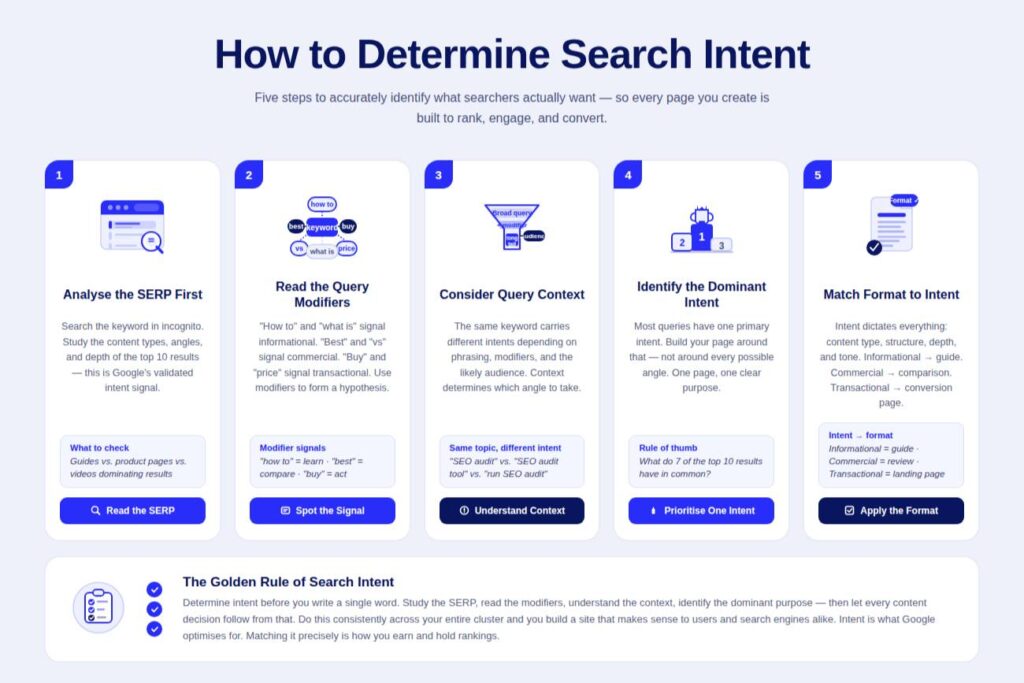
Start with the target keyword. Review the wording for early clues, then examine the top results. Identify the dominant page types, note any SERP features, and ask what the user is most likely trying to achieve.
A practical workflow usually looks like this:
- choose the target keyword
- review the top-ranking pages
- identify the dominant content format
- note SERP features and related questions
- decide the most likely user goal
- create the page that best serves that goal
- connect it to related pages in the content cluster
This approach works especially well in a pillar-and-cluster structure. A main Keyword Research pillar can introduce the wider concept, while supporting pages answer narrower questions such as what keyword research is, why keyword research matters, search intent SEO, and how to determine search intent.
That gives each page a distinct role while strengthening the overall topical section.
Timing and Expectations
Determining search intent can improve strategy immediately because it clarifies the right page type before resources are spent on production.
If a page already exists and underperforms because of intent mismatch, updating the page structure and format can sometimes create noticeable gains within weeks or months. For new pages, the benefit is more foundational. The page starts with stronger alignment from the beginning.
Still, intent alone does not guarantee rankings. It improves your direction, but performance also depends on quality, internal linking, technical health, and site authority.
Conclusion
To determine search intent is to understand what the searcher truly wants and build the page around that need.
That is why it matters so much in SEO. Keywords tell you the subject. Intent tells you the purpose. When those two are aligned correctly, pages become more relevant, more useful, and more likely to perform well in search.
For a site building topical authority, this is not a minor refinement. It is one of the core decisions that shapes page format, site structure, and internal linking across the entire content cluster. Used properly, search intent analysis helps turn keyword targeting into content that genuinely matches the searcher’s expectations and supports long-term SEO growth.