
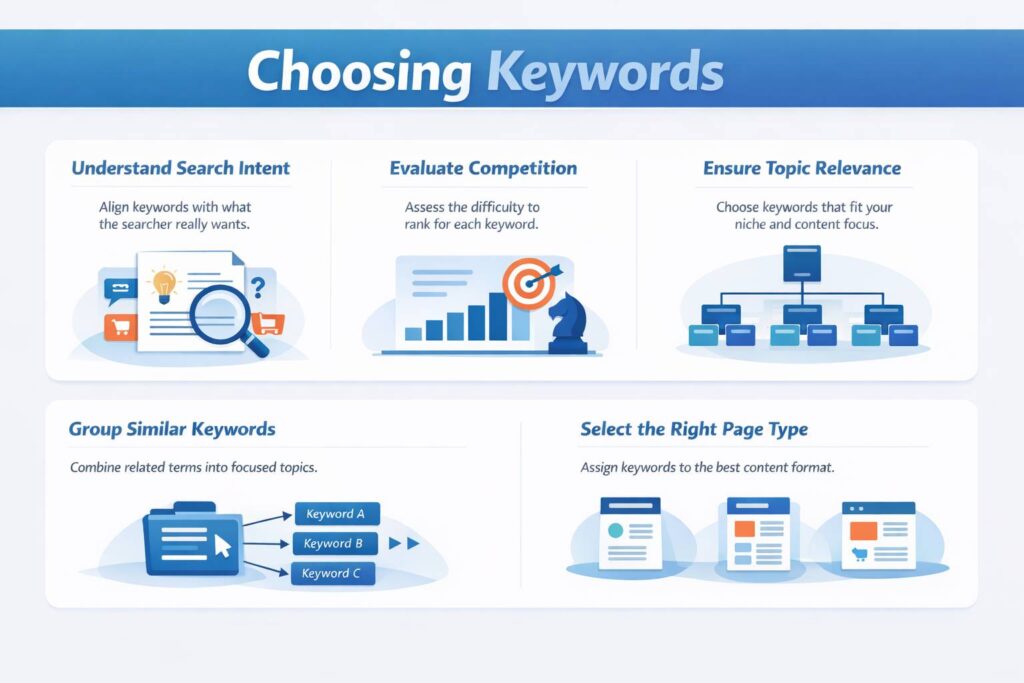

Choosing Keywords
Choosing keywords is one of the most important decisions in SEO because it shapes what a website publishes, which pages it creates, and how effectively it can compete in search. Many content strategies fail long before the article is written. The problem is not always weak writing or poor optimisation. Very often, the problem starts with choosing keywords that are too broad, too competitive, too vague, or too disconnected from what the audience actually wants.
For business owners, marketers, and SEO professionals, that makes keyword selection a strategic task rather than a routine step. To choose keywords well, you need to understand demand, search intent, competitiveness, business relevance, and how each term fits into your wider site structure. A good keyword is not just one with search volume. It is one that supports the right page, matches the right intent, and gives the site a realistic opportunity to earn visibility.
This is especially important in a pillar-and-cluster model. A website building topical authority needs broad pages for major themes and focused supporting pages for narrower searches. Choosing keywords correctly helps define that structure. It shows which topics deserve pillar pages, which deserve cluster articles, and how those pages should connect through internal linking. This article follows the informational cluster-page brief and the writing standards in your uploaded guidance.
What Is Choosing Keywords?
Choosing keywords is the process of selecting the search terms a page or website should target based on relevance, intent, opportunity, and strategic fit.
In practice, this means more than pulling a list from a keyword tool and choosing the terms with the highest search volume. A strong keyword choice should answer several questions at once:
- Is this query relevant to the business or topic area?
- What does the searcher actually want?
- Does this keyword deserve its own page?
- Is the competition realistic for this website?
- Does the keyword fit the wider content cluster?
That is why choosing keywords should be seen as part of SEO planning, not just part of on-page optimisation. The keyword you choose affects the angle of the page, the depth of coverage, the internal links it needs, and how well it fits into the larger site architecture.
For example, a site building a Keyword Research topic cluster might need to choose keywords for pages such as long tail keywords, search intent SEO, keyword mapping, and choosing keywords itself. Those terms are related, but they serve different page roles. The point is not to target everything at once. The point is to assign the right keyword to the right page.
Why Choosing Keywords Matters
Choosing keywords matters because SEO is not simply about publishing content. It is about publishing the right content for the right searches.
It determines page relevance
A page can be well written and still underperform if the keyword choice is weak. If the term is too broad, the page may struggle to compete. If the term is too narrow or too obscure, the page may never attract meaningful traffic. If the intent is wrong, the page may not satisfy the searcher even when it ranks.
Choosing keywords correctly improves the relevance of the page from the start.
It shapes content strategy
Keyword choice influences what topics the site covers and how those topics are broken down. Broad terms often support pillar pages. More specific queries often support cluster pages. Without careful keyword selection, websites tend to publish content in a scattered way, with too much overlap or too little structure.
It affects competitiveness
Some keywords are highly competitive and dominated by strong sites. Others offer more realistic opportunities, especially for sites that are still building authority. Choosing keywords well helps balance ambition with realism.
This does not mean only choosing easy terms. It means choosing terms that make sense for the current authority, goals, and topic depth of the site.
It supports topical authority
A website builds topical authority when its pages work together. Choosing keywords is one of the first steps in creating that structure. It helps clarify which page owns the broad topic and which pages support it with narrower intent or subtopic coverage.
That relationship is central to the wider keyword research framework reflected in your pillar-page brief.
How to Choose Keywords
To choose keywords effectively, you need a process rather than a guess.
Start with topic relevance
The first filter is relevance. Before looking at metrics, ask whether the keyword genuinely fits the business, the audience, and the topic cluster you are building.
A keyword may have strong search demand, but if it sits outside the site’s expertise or purpose, it can create weak traffic and a fragmented content strategy. Good keyword choices usually sit at the intersection of audience need and site authority.
Understand the search intent
Search intent should be one of the main factors in choosing keywords. A keyword is only useful when the page can satisfy the reason behind the search.
If the keyword has informational intent, the page should explain, teach, or clarify. If the query has commercial intent, the page may need comparison or evaluation. If the query is transactional, a service or product page may be the better fit.
This is why choosing keywords and determining intent should happen together, not separately.
Check the live search results
Keyword tools are useful, but the search results often reveal more than the tool itself. Review the current SERP and ask:
- What type of page is ranking?
- How broad or narrow is the coverage?
- Are the results beginner-focused or advanced?
- Do multiple results follow the same format?
If the top results are all guides, then a guide is probably the right page type. If they are comparison pages, then an educational article may not be the best fit. This step helps confirm whether the keyword is appropriate for the page you want to build.
Evaluate competitiveness
Not every good keyword is realistic right now. You need to assess whether the site has a plausible chance of competing.
This does not require avoiding difficult terms entirely. It requires understanding the trade-off. Some broad keywords are worth targeting through long-term pillar pages. Others may be better approached through narrower related topics first.
A useful evaluation usually includes:
Authority of current ranking pages
If the results are dominated by major brands and very strong pages, it may be harder to compete directly.
Quality of existing content
Sometimes a query looks competitive, but the ranking pages are weak, outdated, or poorly structured. That can create a real opportunity.
Fit within your cluster
A highly competitive term may still be worth targeting if it is central to the topic cluster and supported by strong surrounding pages.
Group related keywords before assigning them
A common mistake is treating every keyword variation as a separate page target. In reality, many related phrases share the same intent and should be grouped together.
This is where clustering matters. Before finalising the keyword choice, look at whether several close variations can live on one page without creating confusion. That keeps the content stronger and avoids cannibalisation.
Important Factors to Consider When Choosing Keywords
Choosing keywords well usually depends on a few core considerations working together.
Search intent
Intent is often more important than search volume. A lower-volume keyword with strong, clear intent can be more valuable than a broad term with mixed results and vague expectations.
Topic fit
The keyword should align with the site’s wider subject area. If it does not support the broader cluster, it may weaken the structure rather than strengthen it.
Search volume
Search volume is useful, but it should be treated as context rather than as the only decision factor. High-volume terms are not automatically the best opportunities.
Business value
Not every informational page converts directly, but it should still support a wider strategic goal. It might attract relevant visitors, build trust, or help connect readers to other pages in the funnel.
Page role
A good keyword choice fits a specific page role. It should be clear whether the term belongs on a pillar page, a cluster article, a comparison page, or a commercial landing page.
Common Mistakes When Choosing Keywords
Choosing keywords often goes wrong because the process is too simplistic.
Chasing only search volume
High volume is attractive, but it can distort priorities. A high-volume keyword may be too broad, too competitive, or poorly aligned with the site’s actual goals.
Ignoring search intent
A keyword may look relevant, but if the page type does not match the intent, performance will suffer. Choosing keywords without checking intent is one of the most common SEO mistakes.
Choosing keywords that are too broad
Broad keywords can be useful for pillar pages, but many websites choose them too early or too often. This usually leads to weak rankings and unfocused content.
Creating separate pages for minor variations
Slight keyword variations often belong on one page rather than several. Splitting them apart creates thin content and internal competition.
Choosing keywords without thinking about site structure
A keyword may be good on its own, but if it overlaps heavily with an existing page or does not fit the cluster clearly, it may not be the right choice.
Practical Guidance for Choosing Keywords Better
The best way to choose keywords is to think in terms of topics, intent, and page roles rather than isolated terms.
Start with the core subject area you want the site to cover. Then build out the related keyword opportunities within that area. Review the intent and search results, group similar terms, and decide which keywords deserve their own pages versus which belong within broader content.
A practical process usually looks like this:
- define the topic area
- collect related keyword opportunities
- review the search intent and SERP pattern
- cluster similar terms together
- assess competitiveness and business relevance
- assign the best keyword to the right page type
- connect that page to related pages through internal links
In a pillar-and-cluster model, this helps create a cleaner and more scalable structure. A broad Keyword Research pillar can support cluster pages on search intent, long tail keywords, keyword mapping, keyword strategy, and choosing keywords. Each page has its own focus, but all contribute to a stronger topic section.
Timing and Expectations
Choosing keywords is one of the earliest SEO decisions, but its impact plays out over time. Better keyword selection improves content decisions immediately because pages are planned with more clarity. Ranking improvements take longer because performance still depends on execution, competition, content quality, and internal linking.
For established sites, better keyword choices can sometimes improve results relatively quickly, especially when they help refine weak pages or reduce overlap. For newer sites, the biggest value may appear first in structure and direction. The site becomes easier to grow in a coherent way.
Conclusion
Choosing keywords is not just about finding terms people search for. It is about selecting the right opportunities for the right pages in the right structure.
That is why keyword selection matters so much in SEO. It influences relevance, competitiveness, page clarity, and topical authority. When you choose keywords well, content planning becomes more disciplined, internal linking becomes more logical, and the site becomes easier for search engines and users to understand.
For a website building a pillar-and-cluster model, this is especially important. Choosing keywords well helps each page serve a distinct purpose while strengthening the wider topic system. Done properly, it turns keyword research into a practical growth strategy rather than a disconnected list of search terms.