
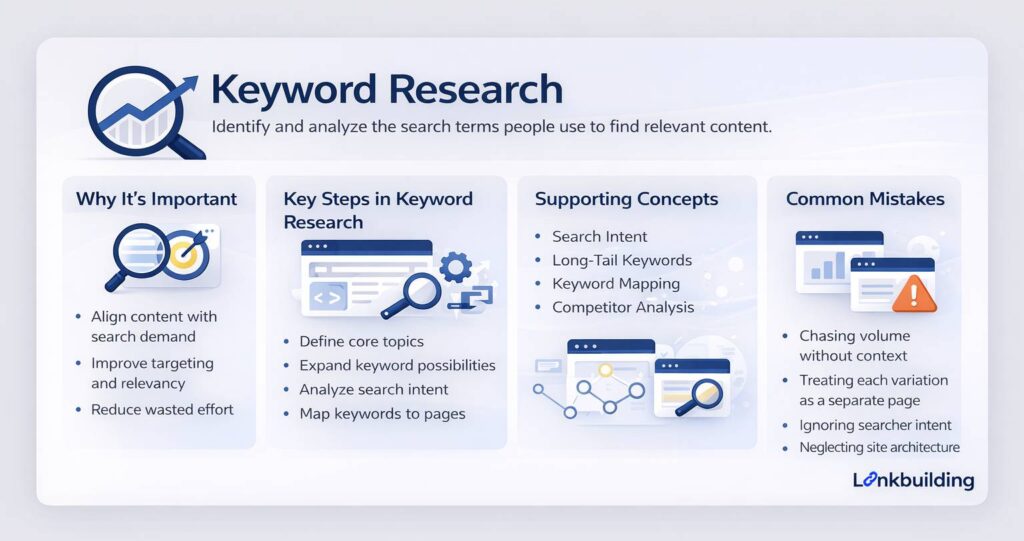

Keyword Research
Keyword Research is one of the most important disciplines in SEO because it influences what a website publishes, how pages are structured, and which topics deserve long-term investment. It is often treated as a preliminary task that happens before content creation, but that view is too narrow. In practice, Keyword Research helps shape site architecture, internal linking, content prioritization, and the overall logic of a topical authority strategy.
For business owners, marketers, and SEO professionals, the real benefit is not simply finding phrases with search volume. It is understanding how people search, what they expect from the results, and where your website has a realistic opportunity to become the best answer. That is especially important in a pillar-and-cluster model, where one broad page needs to support multiple related articles without creating overlap or confusion.
A strong Keyword Research process reduces guesswork. It helps you avoid publishing content based on assumptions, internal jargon, or isolated ideas that never had meaningful search demand in the first place. It also helps you distinguish between topics that deserve pillar-level treatment and subtopics that belong on focused cluster pages.
This guide explains what Keyword Research is, why it matters, how it works, which supporting concepts matter most, and how to apply it strategically as part of a broader SEO structure. It follows the informational pillar-page brief you provided.
What Is Keyword Research?
Keyword Research is the process of identifying the search queries, topics, and language people use in search engines, then evaluating which of those opportunities are relevant, realistic, and valuable for your website to target.
That definition sounds straightforward, but in practice, Keyword Research is not just about collecting keywords from a tool. It is about interpreting demand. A keyword is rarely just a phrase. It usually represents a question, a problem, a comparison, or a decision stage.
For example, someone searching for “Keyword Research” is not necessarily looking for the same thing as someone searching for “keyword research tools,” “how to do keyword research,” or “keyword research for local SEO.” The terms are related, but the underlying needs are different. Good Keyword Research recognises those differences and translates them into the right page types, content depth, and internal relationships.
In practical SEO terms, Keyword Research helps answer questions such as:
- What topics should this website cover?
- Which pages should be broad pillar pages and which should be cluster articles?
- Which queries can be addressed together on one page?
- Which opportunities are too competitive or too misaligned to pursue right now?
- How should content be mapped to search intent?
That is why Keyword Research sits close to search intent analysis, content strategy, site architecture, and internal linking. It is not a standalone activity. It is one of the foundations of a coherent SEO strategy.
Why Keyword Research Matters
Keyword Research matters because SEO without it becomes reactive, inconsistent, and often inefficient. Websites publish content, but the content is not always aligned with real demand or with the way people actually search.
It connects content strategy to actual search behaviour
Many businesses know their products, services, and industry extremely well. That does not automatically mean they know how their audience searches. Internal terminology is often different from the language customers use.
Keyword Research helps bridge that gap. It reveals whether users search by problem, by solution, by comparison, by location, or by specific phrasing. That insight is essential if you want content to match the market rather than only your internal perspective.
It improves targeting and page relevance
A page can be well written and still fail if it targets the wrong query or the wrong intent. Keyword Research helps define what a page is meant to rank for and what type of information the user expects.
That improves relevance. Instead of publishing a generic article about SEO, you can create a focused page about Keyword Research, then support it with separate pages on search intent, long-tail keywords, keyword clustering, or competitor analysis. Each page serves a clear role instead of competing with the others.
It supports topical authority
Topical authority is not built by publishing unrelated articles around a loose theme. It is built by covering a subject in a structured way, where the main topic is supported by clear subtopics and internal links reflect those relationships.
Keyword Research makes that possible. It helps you identify the parent topic, related subtopics, and semantic variations that belong together. For a site building authority in SEO, a pillar page on Keyword Research might naturally connect to cluster content around:
- long-tail keywords
- keyword search volume
- keyword difficulty
- competitor keyword analysis
- keyword mapping
- search intent analysis
- free keyword tools
- keyword research with Google
That is more valuable than publishing disconnected pages that happen to mention similar phrases.
It reduces wasted production effort
One of the least discussed benefits of Keyword Research is efficiency. Content production is expensive in time, budget, and organisational attention. Publishing pages that never had realistic demand, or that target queries your site cannot compete for, creates waste.
Research does not eliminate uncertainty, but it improves decision quality. It helps you decide where to invest, what to postpone, and which topics may need a narrower or more strategic angle.
How Keyword Research Works
Keyword Research works best as a structured process rather than a one-time export from a tool. The mechanics vary by site, but the logic is usually the same: define topic areas, expand keyword possibilities, analyse intent, assess opportunity, and map keywords to the right pages.
Start with topics before keywords
A common mistake is to begin with a keyword database and collect hundreds of phrases before establishing the core topic strategy. That creates volume, but not direction.
A stronger approach starts with subject areas that matter to the site’s audience and business goals. These are usually the broad categories the site wants to be known for. In an SEO content strategy, those might include Keyword Research, on-page SEO, technical SEO, internal linking, content optimisation, and link building.
Once you define the topics, you can expand each one into search terms, questions, modifiers, and subtopics. That keeps research aligned with site architecture instead of turning it into a disconnected list.
Expand into related terms and variations
After defining the core topic, the next step is to identify the ways users search around it. That usually includes:
- primary terms
- close variations
- question-based queries
- long-tail keywords
- semantically related phrases
- problem-led searches
- comparison and tool-based variations where relevant
For Keyword Research, this may include terms around process, tools, intent, clustering, competitor analysis, search volume, and prioritisation. The goal is not to target every variation separately. It is to understand the language and breadth of the topic.
Analyse the search intent behind the query
Intent analysis is one of the most important parts of Keyword Research. Without it, the research remains superficial.
You need to understand what kind of result users expect when they search a specific term. Search engines are already signalling this through the current results. If the first page is dominated by comprehensive guides, then an informational page is likely the right format. If it is dominated by product pages, category pages, or tool landing pages, that points to a different intent.
For a term like “Keyword Research,” the intent is clearly informational and broad. That supports a pillar page rather than a short definition page or a commercial landing page.
Intent analysis also helps separate similar-looking terms that deserve different treatments. “Keyword Research” and “best keyword research tools” sit in the same thematic space, but they do not deserve the same type of page.
Evaluate opportunity and difficulty
Once intent is clear, evaluate whether the keyword is worth pursuing and how difficult it may be to rank.
Search volume can be useful, but it should not dominate the decision. Broad terms often look attractive in tools, but they may be highly competitive or too ambiguous. Lower-volume terms can be more valuable if they are more specific, better aligned, or easier to win.
A realistic evaluation usually includes:
Relevance
Does the topic fit your expertise and your site’s purpose? A keyword may have strong demand, but if it sits outside your real authority, it may attract weak traffic and create a fragmented strategy.
Competition
Look at the pages already ranking. Are they strong brands, detailed resources, or thin pages that could realistically be improved upon? Manual review often tells you more than a difficulty score alone.
Business value
Not every informational page converts directly, but it may still support traffic quality, trust, and internal linking to deeper pages. Keyword Research helps identify pages that contribute strategically even when they are not directly commercial.
Fit within the existing structure
Do you already have related content? If yes, should you update it, consolidate it, or create a supporting cluster article rather than another overlapping page? Good research prevents duplication as much as it identifies new ideas.
Group keywords into logical clusters
Modern SEO does not require a separate page for every keyword variation. In many cases, multiple related phrases can and should be addressed together on one page.
Keyword clustering helps identify which terms belong together based on similar intent and overlapping search results. This is important for avoiding cannibalisation and building deeper pages instead of thinner, fragmented ones.
For a pillar page on Keyword Research, the main term and closely related informational variations can usually live together. More specific subtopics, such as competitor analysis or long-tail keyword strategy, may deserve separate cluster pages that link back to the pillar.
Map keywords to pages
Research becomes useful only when it is translated into page decisions. Keyword mapping is where the strategy becomes operational.
A good keyword map clarifies:
- which page owns the main topic
- which pages support it
- which terms belong on each page
- how internal links should connect them
- where content gaps still exist
For a website using a pillar-and-cluster structure, this step is essential. It prevents overlap and creates stronger thematic relationships across the site.
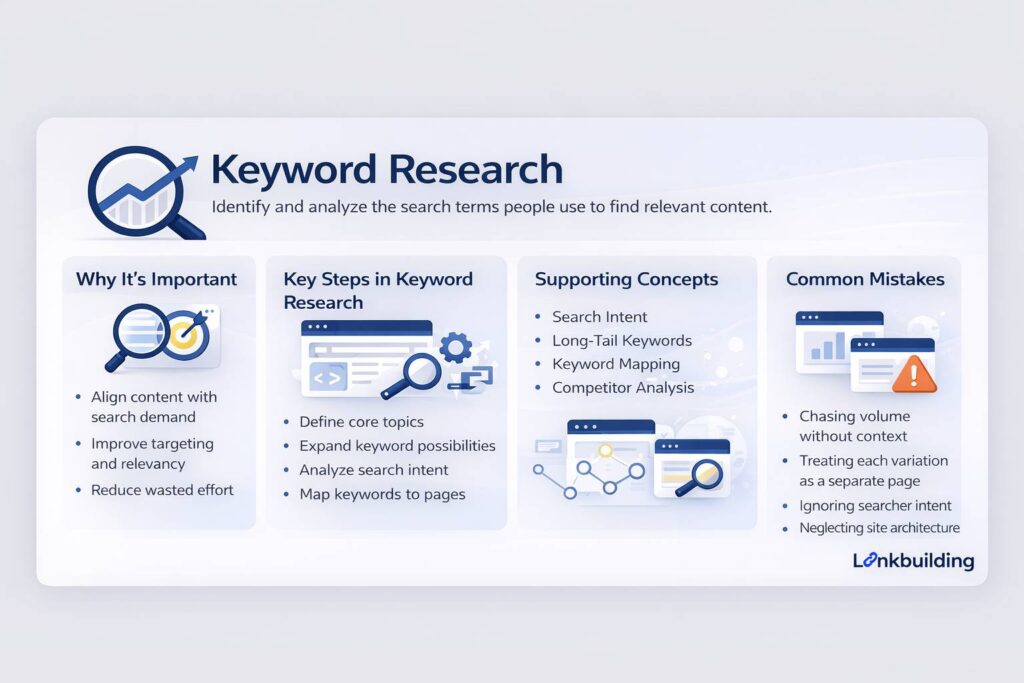
Important Subtopics Within Keyword Research
A strong pillar page should frame the topic broadly enough to support the cluster, while still giving readers meaningful depth. Keyword Research relies on several supporting concepts that deserve attention.
Search intent
Search intent is central to Keyword Research because it explains why a query exists. Two phrases may look similar, but if the user expectations differ, they should not be treated as interchangeable.
Informational intent is especially important for content-led SEO strategies. If a user wants to learn, then the page needs to educate. If the user wants to compare tools or evaluate a service, the format changes.
This is one reason Keyword Research should never be reduced to volume metrics. A lower-volume query with a clear and aligned intent may be more valuable than a broader term with mixed results.
Long-tail keywords
Long-tail keywords are more specific queries, usually with clearer intent and lower competition than broad head terms. They are often strong opportunities for cluster content.
They matter because they allow websites to target narrower needs more precisely. A broad term may be useful for a pillar page, but long-tail terms often belong on focused supporting articles that answer one problem well.
For example, a broad guide to Keyword Research can naturally link to a more specific article about long-tail keyword strategy or keyword research with Google.
Keyword clustering
Keyword clustering is the practice of grouping related keywords that can be targeted on a single page. It helps reduce duplication and makes content more comprehensive.
This is especially important in topical SEO. Without clustering, teams often create multiple pages that compete for the same search intent. That weakens the site structure and makes internal linking less clear.
Clustering supports better editorial decisions because it forces you to think in terms of page roles rather than just phrase counts.
Keyword mapping
Keyword mapping translates research into site architecture. It decides where the keyword belongs and how it relates to surrounding pages.
This matters because SEO performance is shaped not only by page quality, but by how clearly the site communicates structure. A good map ensures that the pillar page covers the broad topic, while cluster pages handle narrower subtopics in a way that strengthens the whole section of the site.
Competitor analysis
Competitor keyword analysis helps you understand the existing landscape, but it should be used strategically. The purpose is not to copy what others publish. It is to identify gaps, patterns, and realistic opportunities.
You may find that competitors rank because they cover a topic thoroughly, because they have stronger authority, or because the current results are weaker than expected. Each scenario leads to different strategic choices.
Competitor analysis is most useful when combined with intent analysis and editorial judgment. Data alone does not tell you whether you can create something meaningfully better.
Common Keyword Research Mistakes
Keyword Research often underperforms because it is treated as mechanical rather than strategic.
Chasing volume without context
High-volume terms look appealing, but they are not always the best targets. Some are too broad, too competitive, or too loosely aligned with business goals.
A page that ranks for a more specific, intent-aligned query can often deliver better outcomes than a page targeting a broad term that attracts the wrong visitors.
Treating each variation as a separate page
This is one of the most common causes of weak content architecture. Closely related terms often belong together on one strong page. Splitting them into multiple URLs can create thin content and internal competition.
Ignoring the actual search results
Keyword tools provide useful inputs, but the live search results reveal what search engines currently reward. Ignoring that evidence can lead to content that looks optimised on paper but does not match the reality of the SERP.
Using metrics without judgment
Difficulty scores, trend indicators, and volume estimates are helpful, but they are not strategy. They cannot tell you whether the topic fits your expertise, whether the ranking pages are actually strong, or whether the opportunity supports the wider site structure.
Disconnecting research from internal linking and site architecture
Keyword Research is most effective when it informs how pages are related. If research is done in isolation from architecture, the site may end up with content, but not with structure. That limits topical authority and weakens the user journey.
Practical Guidance for Applying Keyword Research Well
A strong Keyword Research process is not about collecting the most data. It is about improving the quality of decisions.
Start by defining the core topics your site should own. Then examine how users search within those topics, which intents appear in the results, and which pages should serve as pillars versus supporting clusters.
In practice, a useful workflow often looks like this:
- Define the core topic area and its strategic relevance.
- Build out related keyword possibilities and question variations.
- Review live search results to understand intent and content expectations.
- Group related terms into clusters based on overlapping meaning and SERPs.
- Decide which cluster belongs on a pillar page and which deserve separate supporting pages.
- Map target keywords to existing or planned URLs.
- Build internal links that reflect the topic hierarchy.
- Revisit the research as rankings, competitors, and site authority evolve.
This process works particularly well in a pillar-and-cluster model. A broad Keyword Research page can introduce the framework, while supporting articles go deeper into related subtopics such as search intent, keyword search volume, competitor analysis, or long-tail keywords. Those relationships strengthen topical coverage and make internal linking more natural.
It is also worth recognising that not every keyword deserves immediate action. Some opportunities are better saved for later, when the site has more authority or when the surrounding content cluster is stronger. Prioritisation is part of good research.
Timing and Expectations
Keyword Research can create clarity quickly, but the SEO outcomes it supports usually take longer.
For an established site, better research can sometimes lead to relatively fast gains if it helps improve targeting, consolidate overlapping pages, or refresh underperforming content. For newer sites, the value may be more foundational at first. It shapes better decisions, but traffic growth still depends on execution, authority building, and time.
It is also important to keep expectations realistic. Research identifies opportunity. It does not guarantee rankings on its own. A keyword can be well chosen and still underperform if the page is weak, the internal linking is poor, or the site lacks the trust signals needed to compete.
That is why Keyword Research should be viewed as part of a broader SEO system rather than an isolated tactic.
Conclusion
Keyword Research is more than a list of terms to include in content. It is the process that helps a website understand demand, interpret intent, and build pages around topics that matter.
When done well, it supports smarter topic selection, clearer page roles, stronger site architecture, and more purposeful internal linking. It helps a website move away from random content production and toward a structure that builds topical authority over time.
For a site using a pillar-and-cluster model, Keyword Research is especially important because it determines how the main topic is framed and how supporting articles are organised around it. That structure gives the site a better chance to rank, attract relevant traffic, and become a credible resource within its subject area.
In that sense, Keyword Research is not just the beginning of SEO. It is one of the disciplines that makes the rest of the strategy coherent.