

What Is Content Optimization? A Clear SEO Explanation
Content optimization is a core part of effective SEO, but it is often explained too narrowly. Many people treat it as a simple editing task: add keywords, improve headings, and publish. In reality, it is a broader process that helps content become more useful, more relevant, and more competitive in search.
That matters because publishing content alone does not create results. A page can be live, indexed, and still underperform if it does not match search intent, cover the topic clearly, or fit into the site’s broader structure. For websites building topical authority through a cluster model, that becomes even more important.
This article explains what content optimization is, why it matters, how it works, and what businesses should focus on when applying it.
What Is Content Optimization?
Content optimization is the process of improving content so it performs better for both users and search engines.
In practical terms, that means refining a page so it is more relevant to the target query, easier to understand, better aligned with search intent, and more useful than competing pages. It also means making sure the page supports the wider SEO strategy instead of existing in isolation.
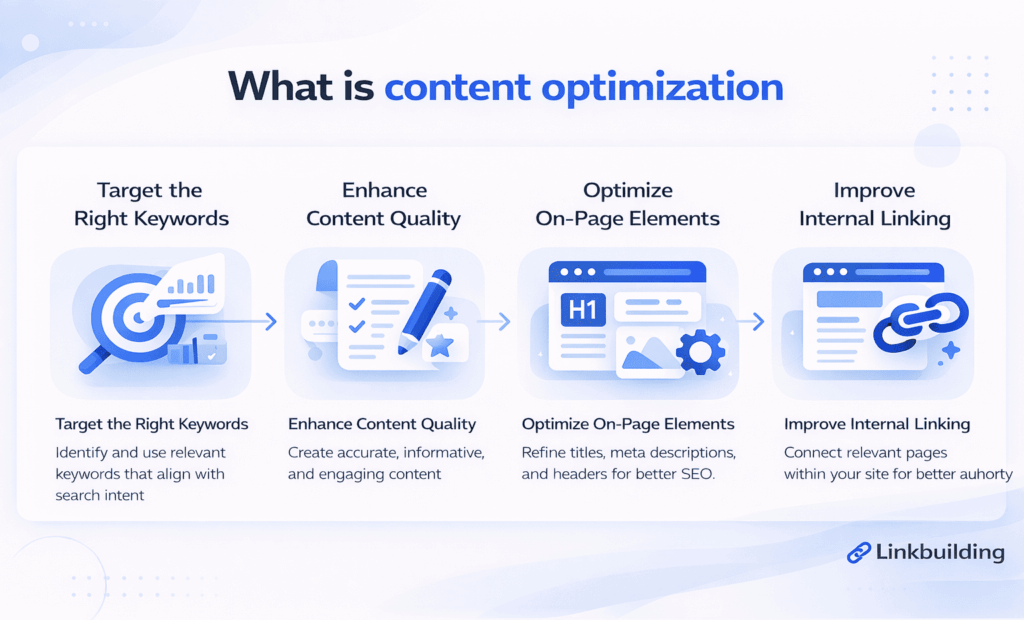
Content optimization can include improving:
- topic focus
- keyword targeting
- search intent alignment
- headings and structure
- clarity and readability
- internal links
- metadata
- depth and completeness
So when someone asks, “What is content optimization?”, the best answer is not just “adding keywords.” It is the strategic improvement of content so it ranks better, serves readers better, and contributes more effectively to the website.
Why Content Optimization Matters
Content optimization matters because search engines do not reward content just for existing. Pages perform when they are relevant, helpful, and clearly aligned with what the searcher wants.
It improves search relevance
A page needs to address the topic in the right way, not just mention it. If someone searches for a definition, they expect a clear explanation with practical context. If the page is vague, overly broad, or written for a different intent, it is less likely to perform well.
It supports stronger rankings
Better optimization helps search engines understand what a page is about and why it deserves visibility. Stronger structure, clearer topical focus, and better intent alignment can all improve a page’s ability to compete.
It helps build topical authority
On a site using a pillar-and-cluster model, every page should play a defined role. This cluster page answers a specific question. Other related pages might go deeper into search intent, on-page SEO, internal linking, content audits, or updating old content. Together, those pages build a clearer topic network.
It improves user experience
Optimized content is easier to read and easier to trust. It answers the main question quickly, then expands where needed. That improves usability, which is usually good for SEO as well.
How Content Optimization Works
Content optimization works best when it is approached as a process, not a quick checklist.
Start with the page’s purpose
Before changing anything, define the role of the page. Is it informational, commercial, or transactional? Is it a pillar page or a cluster page? What exact query is it trying to satisfy?
For this page, the role is clear: it is an informational cluster page answering the question “What is content optimization?”
Match the page to search intent
Search intent should shape the content before any detailed editing begins. A page targeting an informational query should explain clearly, stay focused, and avoid drifting into a sales pitch or an unrelated SEO overview.
If the page misses intent, other improvements will have limited impact.
Improve structure and clarity
A well-optimized page is easy to scan and easy to follow. That usually means a clear H1, logical H2 sections, concise paragraphs, and language that is direct without being simplistic.
Good structure supports both readers and search engines.
Strengthen the content itself
Optimization often means improving what the page says, not just how it is formatted. That might include removing irrelevant sections, clarifying weak explanations, adding missing context, or tightening the overall focus.
The goal is not to make every page longer. The goal is to make it more useful.
Refine on-page elements
Once the content is strategically sound, supporting SEO elements can be improved. That includes title tags, meta descriptions, headings, and internal links. These help reinforce the page’s relevance, but they work best when the underlying content is already strong.
Important Subtopics Within Content Optimization
Content optimization connects to several related SEO concepts.
Search intent
Search intent is one of the most important parts of optimization. A page can use the right keyword and still fail if it does not meet the reason behind the search.
Content quality
Optimization is closely tied to quality. Thin or generic pages are difficult to optimize because the foundation is weak. Strong content gives clear answers, reflects real understanding, and covers the topic with enough depth to satisfy the reader.
Internal linking
Content should be connected to relevant supporting pages. In a cluster structure, internal links help users move through the topic and help search engines understand the relationship between pages.
On-page SEO
On-page SEO is part of content optimization, but not all of it. It covers elements like headings, metadata, and keyword placement. Content optimization goes further by addressing usefulness, completeness, and strategic fit.
Common Mistakes
Many pages are “optimized” in ways that do not actually improve performance.
Treating optimization as keyword insertion
Adding the target phrase repeatedly is not a strategy. It often makes the writing worse without improving relevance in any meaningful way.
Optimizing before defining the topic
If the page’s purpose is unclear, edits to headings or metadata will not solve the real problem. Topic clarity comes first.
Covering too much
A focused cluster page should answer one main question well. It should not try to become a complete guide to SEO. Over-expansion usually weakens relevance.
Ignoring site structure
Pages perform better when they fit into a clear architecture. Overlapping pages, weak internal links, and unclear content roles can reduce the impact of optimization.
Practical Guidance
A useful way to approach content optimization is to ask a few direct questions:
- What exact keyword or query is this page targeting?
- What does the user expect from this page?
- Is the content too broad, too shallow, or off-topic?
- Does the structure make the answer easy to understand?
- Are there relevant internal links to related pages?
From there, improve the page in the right order. Start with intent and topic alignment. Then improve clarity, structure, and depth. After that, refine internal links and on-page SEO details.
For many websites, improving existing content is more efficient than constantly publishing new articles. A page that already has some relevance can often perform much better with the right strategic updates.
Timing and Expectations
Content optimization can improve rankings and traffic, but results are rarely immediate. Some updates show impact within a few weeks, especially when the page already has authority and the changes fix a clear mismatch. More competitive topics may take longer.
It is also important to measure the right outcomes. Updating a page is not the goal. Better visibility, stronger engagement, and more qualified traffic are the real indicators of success.
Optimization should be treated as an ongoing process, not a one-time task.
Conclusion
So, what is content optimization?
It is the process of improving content so it becomes more relevant, more useful, better structured, and more capable of performing well in search. It sits at the intersection of content quality, search intent, on-page SEO, and site architecture.
That is why content optimization matters in any serious SEO strategy. It does not just make content look more polished. It makes content more effective.
For a website building topical authority through a cluster model, that is exactly the point. Each page should have a clear role, answer a clear query, and support the broader topic structure. Content optimization is what helps make that happen.