

How to Use Keywords in Content Without Over-Optimizing
Keywords still matter in SEO, but the way they should be used has changed. Many pages underperform because they either ignore keyword targeting altogether or rely on outdated tactics such as repetition, awkward exact matches, and forced placement. Neither approach works well over time.
To use keywords in content effectively, you need to balance relevance with readability. The page should make its topic clear to search engines, but it should also feel natural, useful, and well written for the reader. That is especially important on sites using a pillar-and-cluster model, where each page needs a defined role within the broader topic structure.
This article explains how to use keywords in content properly, why it matters, how the process works, and what common mistakes to avoid.
What Does It Mean to Use Keywords in Content?
To use keywords in content means placing the target query and related phrases in a page in a way that clearly communicates topical relevance without making the writing sound unnatural.
In practical terms, this includes using the primary keyword in important places such as the title, H1, introduction, and relevant body sections. It also includes supporting that main term with semantically related phrases, subtopics, and language that reflects how people actually search and how the topic is discussed.
This is not the same as keyword stuffing.
Using keywords well does not mean repeating the same phrase over and over. It means building a page around a topic, then using the target terms where they belong. A strong page should signal relevance clearly, but it should still read like expert content rather than a search-engine checklist.
Why It Matters for SEO
Search engines need signals to understand what a page is about. Keywords are part of those signals, even if modern SEO relies on far more than exact-match phrasing.
It helps define topical relevance
A page needs to make its subject clear. If the target phrase never appears in important parts of the content, the page may be harder to interpret. Strategic keyword use helps confirm the page’s topic and intent.
It supports search intent alignment
Keywords are not just about wording. They are tied to intent. If the keyword suggests an informational query, the content should explain the topic clearly. If the keyword suggests a comparison or decision-making need, the page structure and language should reflect that.
It helps pages compete more precisely
A page may cover a useful topic, but if it does not use the language searchers expect, it can struggle to compete. Good keyword usage helps connect expert content with real search demand.
It supports cluster structure
On a pillar-and-cluster site, each page should target a distinct topic or query. Using keywords properly helps differentiate cluster pages and reduce overlap between them.
How to Use Keywords in Content Properly
The best way to use keywords in content is to begin with topic clarity and intent, not placement rules alone.
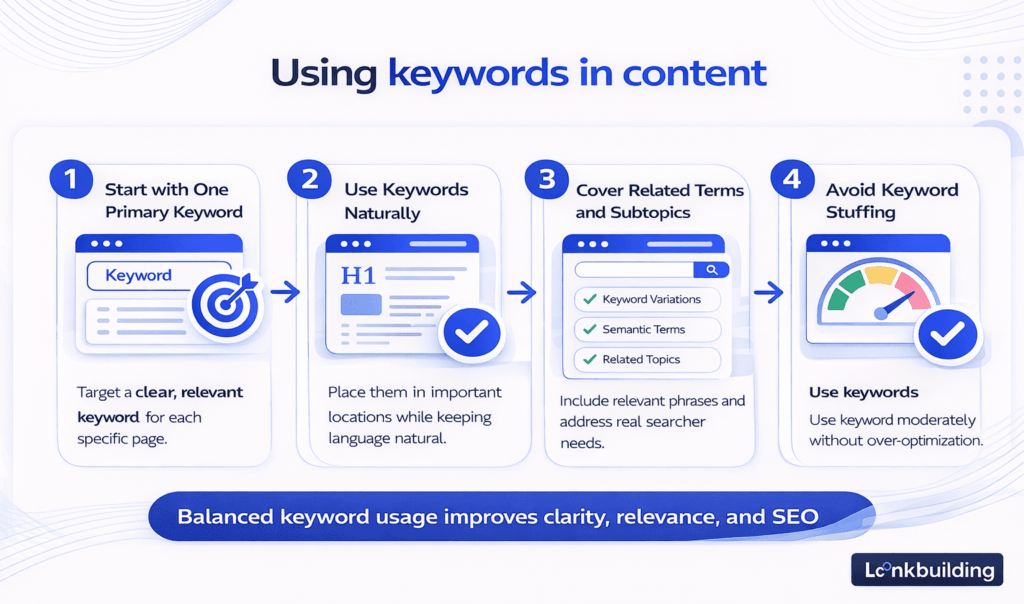
Start with one primary keyword
Every page should have one main target. That target should shape the core focus of the content.
For this page, the primary keyword is use keywords in content. That means the article should explain the concept directly and practically. It should not drift into a broad guide on all of SEO writing.
A clear primary keyword helps keep the page focused.
Use the keyword in critical locations
Some placements matter more than others. In most cases, the primary keyword or a close variation should appear in:
- the title
- the H1
- the introduction
- at least one or two relevant subheadings where natural
- the main body copy
- the title tag and meta description
These placements help establish relevance early and clearly.
Write around the topic, not just the phrase
A strong page will rarely rely on one term alone. It will also include supporting language such as related concepts, synonyms, subtopics, and intent-aligned phrasing.
For example, a page about how to use keywords in content may also naturally include phrases related to keyword placement, search intent, on-page SEO, topic relevance, natural language, content optimization, and semantic variation.
This creates stronger topical coverage without making the page repetitive.
Keep the language natural
Natural writing is one of the best safeguards against over-optimization.
If a phrase sounds awkward in a sentence, forcing it in usually weakens the content. It is often better to use a close variation or rewrite the sentence more naturally than to preserve an exact match at all costs.
Match the keyword to the page’s role
Keyword use should reflect the purpose of the page.
A pillar page may use broader topic language and connect many related ideas. A cluster page should usually be narrower and more direct. That distinction helps prevent overlap and keeps the site structure cleaner.
Important Subtopics Within Keyword Usage
To use keywords in content well, it helps to understand the related elements that shape good on-page optimization.
Search intent
Search intent should guide keyword usage. The same keyword can mean different things depending on what searchers expect from the query.
If the user wants a clear explanation, the content should not bury the answer or shift into a sales-oriented structure. Keyword targeting only works when it is matched with the right intent.
Semantic relevance
Modern SEO is not built on exact-match repetition alone. Search engines understand related terms and broader context much better than before.
That means a page should include relevant supporting language, not just the main keyword. Semantic breadth strengthens relevance and improves the natural flow of the writing.
Headings and structure
Keywords work better when the page structure is strong. Headings should reflect real subtopics and guide the reader logically through the page. A weak structure can limit the impact of otherwise solid keyword targeting.
Internal linking context
The language used in internal links also contributes to relevance. A page targeting keyword usage can naturally link to related articles on search intent, content optimization, on-page SEO, and internal linking strategy. These contextual links reinforce the topic cluster.
Common Mistakes
Many SEO pages use keywords in ways that either weaken the writing or fail to improve relevance meaningfully.
Repeating the exact phrase too often
This is the most obvious mistake. Repetition makes the content sound forced and often reduces trust. It also makes the writing less effective for real readers.
Using keywords without intent alignment
A page can include the target phrase in all the right places and still fail if it does not answer the real query properly. Keywords do not replace substance.
Forcing keywords into headings
Headings should clarify the structure of the page. If they are written only to include a phrase, they often become awkward and less useful.
Ignoring related language
A page that relies only on one exact keyword often feels narrow and unnatural. Good keyword usage includes variation and supporting context.
Treating density as the strategy
There is no useful reason to chase a fixed keyword density. The right level is the one that makes the topic clear without harming readability.
Practical Guidance
If you want to use keywords in content effectively, start by reviewing the page as a reader and as an SEO strategist.
Ask:
- Does the page target one clear keyword?
- Is the search intent correct?
- Does the keyword appear in the most important places?
- Does the writing still sound natural?
- Are related terms and subtopics included?
- Does the page feel focused, or does it drift across too many topics?
Then improve the content in the right order. First, confirm the page’s purpose and target query. Second, strengthen structure and topical focus. Third, refine keyword placement in headings, introductions, and body copy. Finally, review metadata and internal links.
This order matters because keyword placement works best when the page already has a clear direction.
For content teams, it is also worth building briefs around intent and topic coverage, not just target phrases. That usually leads to better pages and more consistent keyword usage across a cluster.
Timing and Expectations
Better keyword usage can improve a page’s clarity and competitiveness, but results are not always immediate.
If the page already has some topical relevance, improving keyword alignment may support rankings relatively quickly. In more competitive spaces, stronger results may depend on other factors as well, including content depth, internal linking, authority, and overall site quality.
The main point is to stay realistic. Good keyword usage improves the page’s ability to compete, but it works best as part of a broader content optimization strategy.
Conclusion
To use keywords in content properly, you need to think beyond repetition. The goal is not to fit the phrase into as many places as possible. The goal is to make the topic clear, align with search intent, and support the reader with content that feels natural and useful.
That is what effective keyword use looks like in modern SEO.
For websites building topical authority, this matters even more. Each page should target a distinct query, fit cleanly into the cluster, and signal relevance without sounding over-optimized. When done well, keyword usage strengthens the page, the topic structure, and the site’s long-term SEO performance.