

How to Optimize Internal Links for Better SEO and Site Structure
Internal linking is one of the most overlooked parts of SEO. Many websites publish strong content, target relevant keywords, and still underperform because their pages are poorly connected. Important articles sit too deep in the site, supporting pages do not reinforce the main topic properly, and users are left without a clear path to related content.
That is why it matters to optimize internal links deliberately rather than treating them as a minor editing step.
For websites using a pillar-and-cluster model, internal linking is not optional. It is the mechanism that turns individual pages into a connected topic system. It helps search engines understand page relationships, supports topical authority, and guides users from broader informational content to more specific supporting resources.
This article explains what it means to optimize internal links, why it matters for SEO, how to do it properly, and what mistakes to avoid.
What Does It Mean to Optimize Internal Links?
To optimize internal links means improving the way pages on your website link to each other so the structure is clearer, more useful, and more strategically aligned with SEO goals.
In practical terms, that includes deciding which pages should receive the most internal link support, where links should be placed, how anchor text should be written, and how the overall linking structure supports both search intent and site architecture.
This is not just about adding more links.
A page with too many weak or irrelevant internal links is not well optimized. Strong internal linking is selective. The links should help users move naturally through the topic and help search engines understand which pages matter most within the site.
When you optimize internal links properly, you improve discoverability, topical clarity, and the strength of your content relationships.
Why It Matters for SEO
Internal links help search engines crawl pages, interpret page hierarchy, and understand how topics relate across the site. They also help users continue their journey rather than reaching a dead end after reading one page.
It strengthens topical authority
In a cluster model, internal links are what connect the pillar page to its supporting cluster pages. Without those links, the structure exists only in theory.
For example, a broader page on content optimization should naturally link to supporting articles about content audits, search intent, on-page SEO, rewriting content, content structure SEO, and improving internal links. Those cluster pages should also link back to the pillar page and, where relevant, to each other.
This reinforces topic relationships in a way that search engines can understand more clearly.
It helps important pages receive more support
Not every page on a site has equal value. Some pages are core assets that deserve stronger internal prominence because they target important queries, drive conversions, or anchor a topic cluster.
Internal linking helps direct more attention and contextual support toward those pages.
It improves crawl efficiency and discoverability
Pages that are isolated or buried deep in the site structure are harder to discover and reinforce. Internal links make it easier for search engines to find content and understand how it fits into the website.
This is especially useful for newer cluster pages that need clearer integration into the existing structure.
It improves user navigation
Good internal linking is also a usability improvement. It helps readers move from a general topic to more specific guidance without having to search the site manually.
That creates a better experience and often supports stronger engagement as well.
How to Optimize Internal Links
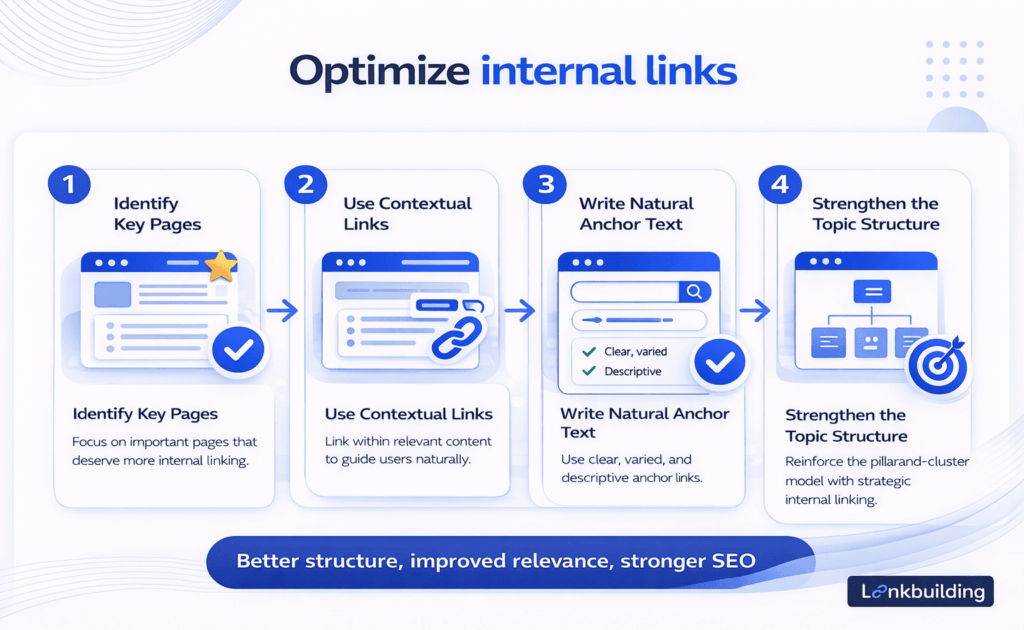
The best way to optimize internal links is to start with structure, not anchor text.
Identify your key pages first
Before adding or adjusting links, define which pages matter most.
These may include pillar pages, high-value cluster pages, commercial landing pages, or content that already performs well and deserves more support. Internal linking becomes more effective when it is built around priorities instead of being added randomly as content is published.
Map relationships between pages
Once the important pages are clear, review how they connect.
Ask which pages belong together in the same topic area, which pages should link back to the pillar page, and where contextual links between cluster pages would help users and reinforce the structure. This is where internal linking becomes strategic rather than incidental.
A cluster page should not link to every related article just because they are vaguely connected. It should link where the connection is relevant in context.
Use contextual links inside the body content
The strongest internal links are usually placed within the main body copy, where they support the reader naturally.
Contextual links tend to carry more meaning because they are surrounded by relevant content. A link placed inside a paragraph about search intent, for example, gives clearer topical context than a generic sitewide block of links placed at the bottom of the page.
Write anchor text naturally
Anchor text matters, but it should not be forced.
A good internal anchor should make it clear what the user will find if they click. Sometimes that will be a partial keyword match. Sometimes it will be a broader descriptive phrase. Exact match anchor text can be useful, but it should be used sparingly and only when it feels natural.
Good anchor text is specific, readable, and honest about the destination.
Support the pillar-and-cluster model consistently
If your site uses topical clusters, internal linking should reflect that clearly.
A pillar page should link to supporting cluster articles. Cluster pages should usually link back to the pillar page where relevant. Supporting pages can also link to nearby cluster content when it helps the reader continue deeper into the topic.
This consistency is what makes the architecture work.
Important Subtopics Within Internal Link Optimization
To optimize internal links well, it helps to understand the supporting concepts that shape a good structure.
Anchor text strategy
Anchor text should support clarity, not manipulation. Overusing exact-match phrases makes content sound unnatural and can weaken trust. The better approach is to vary anchors naturally while keeping them relevant to the destination page.
Link relevance
Relevance matters more than volume. A few well-placed internal links that genuinely support the topic are more valuable than a large number of generic links scattered across the page.
Each link should earn its place.
Content hierarchy
Internal linking should reflect page importance. Core pages should receive more contextual support from relevant surrounding content. Weaker or lower-priority pages should not dominate the internal structure just because they happen to be older or more numerous.
Orphan pages and weak integration
Some pages remain technically published but are barely connected to the rest of the site. These orphaned or weakly integrated pages often struggle because they are not properly supported by the structure. Optimizing internal links often begins by identifying and fixing that problem.
Common Mistakes
Many websites add internal links, but they do not truly optimize internal links in a strategic way.
Adding links without a clear structure
A random collection of links is not a linking strategy. Without a clear sense of hierarchy and topic relationships, internal links often become inconsistent and ineffective.
Overusing exact-match anchors
Using the exact target keyword repeatedly can make the page feel forced and repetitive. It is usually better to mix partial-match, descriptive, and semantic anchors based on the surrounding sentence.
Linking for SEO instead of for the reader
Internal links should support the user journey first. If the link feels unnatural in the sentence or does not help the reader understand the topic better, it is probably not a strong link.
Ignoring older content
Many teams add internal links only when publishing new pages. That leaves older articles disconnected. Some of the best internal linking gains come from going back into existing content and strengthening connections across the cluster.
Linking too broadly
More links do not always mean better results. When a page links to too many loosely related destinations, the structure becomes noisy and less useful. Focus matters.
Practical Guidance
If you want to optimize internal links properly, begin with a manageable review of one topic cluster rather than the whole site.
Start by identifying the pillar page and the key cluster pages around it. Then review:
- which pages already link to the pillar
- which cluster pages are missing useful contextual links
- where anchor text feels weak or overly repetitive
- whether older articles should link to newer supporting content
- whether any important pages are underlinked
Then improve the structure gradually.
A good working approach is to strengthen internal links in three layers. First, make sure the pillar page links to the right supporting content. Second, make sure cluster pages link back to the pillar where useful. Third, add relevant cross-links between supporting pages when they genuinely deepen the topic.
That creates a cleaner, more understandable system than simply adding links wherever possible.
Timing and Expectations
When you optimize internal links, some benefits can appear relatively quickly, especially if important pages were previously underlinked or poorly integrated. Search engines may begin interpreting the structure more clearly once the relationships between pages are reinforced.
Still, internal linking is not a standalone fix for every SEO problem. If a page has weak content, poor search intent alignment, or little topical relevance, better linking alone will not make it perform strongly.
Internal link optimization works best as part of a broader content and site architecture strategy.
Conclusion
To optimize internal links well, you need to think beyond link quantity. The goal is to create a structure that is clear, relevant, and useful for both search engines and users.
That means linking important pages deliberately, using natural anchor text, reinforcing the pillar-and-cluster model, and making sure related content is connected in ways that actually help the reader.
For websites building topical authority, this matters more than it first appears. Internal links are what turn separate articles into a coherent topic system. Done properly, they strengthen relevance, improve discoverability, and help your best content perform with more consistency over time.