
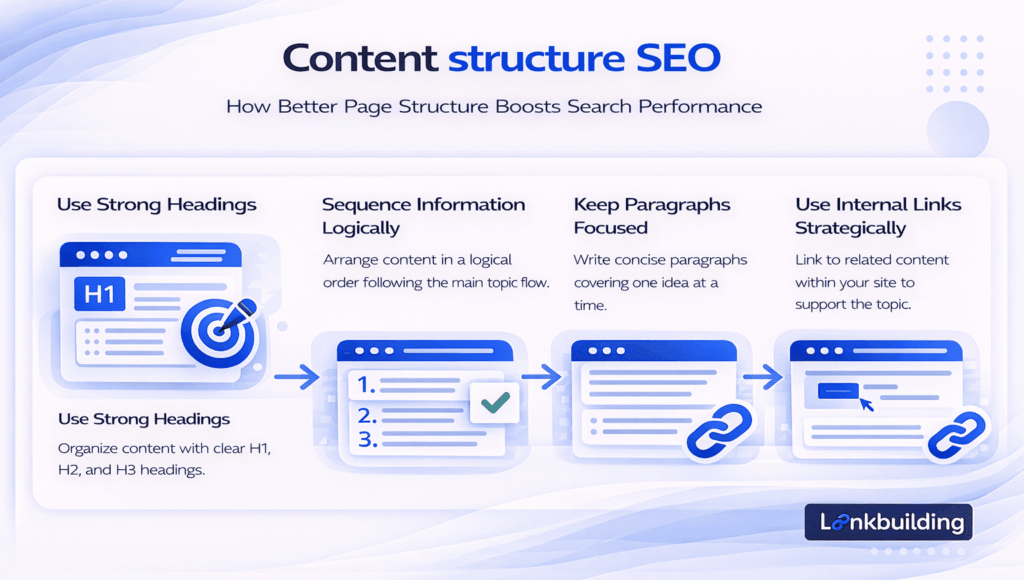

How Better Page Structure Improves Search Performance
Content quality matters in SEO, but content quality alone is not enough. A page can contain useful information and still underperform if the structure is weak. When sections are disorganized, headings are unclear, ideas are buried, or the page does not guide the reader logically, both usability and search performance suffer.
That is why content structure SEO matters.
Good structure helps search engines understand what a page is about, how the information is organized, and which topics matter most. It also helps readers scan quickly, find answers faster, and move through the content without friction. For websites building topical authority through a pillar-and-cluster model, structure becomes even more important because each page needs a clear role within the wider content system.
This article explains what content structure SEO means, why it matters, how it works, and how to apply it in a practical way.
What Is Content Structure SEO?
Content structure SEO is the practice of organizing content in a way that improves clarity, relevance, crawlability, and user experience.
In practical terms, it means structuring a page so the topic is easy to understand from the start, the sections follow a logical order, the headings reflect real subtopics, and the content supports the search intent behind the query. It is not just about formatting. It is about shaping information so both readers and search engines can interpret it efficiently.
A well-structured page usually includes:
- a clear H1 aligned with the main topic
- logical H2 sections covering the core subtopics
- H3 subsections only where they help clarity
- an introduction that frames the topic properly
- paragraphs grouped around one idea at a time
- internal links placed where they genuinely support the reader
- a clear progression from explanation to application
Content structure SEO is not about making a page look tidy for its own sake. It is about improving how the page communicates its value.
Why Content Structure SEO Matters
Poor structure weakens otherwise strong content. A page may target the right keyword and still fail because the content is difficult to scan, inconsistent in focus, or poorly sequenced.
It helps search engines interpret the page
Search engines rely on page signals to understand topic relevance. Headings, section order, internal context, and content hierarchy all help clarify what the page covers and which ideas are central.
If the structure is vague or chaotic, that understanding becomes weaker. The page may still be indexed, but it becomes harder to interpret with confidence.
It improves readability and engagement
Most readers do not consume web content from top to bottom in one pass. They scan first. They look for headings, key phrases, and signs that the page will answer their question quickly.
A well-structured page supports that behavior. It reduces friction and helps users decide that the content is worth reading.
It strengthens search intent alignment
Structure is one of the clearest ways to show that a page matches search intent. If someone wants a practical explanation, the page should not bury the answer under long, indirect sections. If the query suggests a step-by-step need, the content should be organized in a sequence that reflects that need.
It supports topical authority
In a pillar-and-cluster model, structure helps differentiate pages within the topic. A pillar page should be broad and navigational. A cluster page should be narrower and more direct. Good structure makes that distinction clearer and helps related pages support one another without excessive overlap.
How Content Structure SEO Works
Content structure SEO works by improving the hierarchy and flow of a page so the content is easier to interpret and more effective in serving its purpose.
Start with the page’s main intent
Before deciding on headings or layout, define the page’s role.
Is the page answering a specific question? Is it a broader overview? Is it meant to support commercial investigation or purely informational intent? Structure should reflect the dominant goal of the page, not just the topic itself.
For this page, the role is informational. The user wants to understand content structure SEO, why it matters, and how to approach it correctly.
Build a logical hierarchy
A strong page hierarchy starts with the primary topic and then moves into supporting subtopics in a sensible order.
The H1 should define the main focus. H2s should break the topic into meaningful sections. H3s should only be used where an H2 contains multiple distinct ideas that need separation.
Hierarchy matters because it shows which ideas are foundational and which are supporting details.
Sequence the information properly
Even when the right headings are present, poor sequence can still weaken the page.
Good sequencing means placing information in the order the reader is most likely to need it. In most informational SEO content, that often means:
- define the concept
- explain why it matters
- show how it works
- address supporting concepts
- clarify common mistakes
- offer practical guidance
That order is not rigid, but it works because it mirrors how understanding usually develops.
Keep each section focused
A common structural problem is that sections try to do too much at once. They begin on one subtopic, drift into another, and lose clarity.
Strong content structure SEO depends on discipline. Each section should have a clear purpose. Each paragraph should support that purpose. When a page keeps changing direction, relevance becomes weaker.
Important Subtopics Within Content Structure SEO
Content structure SEO connects to several related areas of on-page optimization.
Headings and semantic hierarchy
Headings do more than break up the page visually. They signal topic relationships and help define the hierarchy of information.
That means headings should describe the section accurately, use natural language, and reflect real subtopics rather than stuffed keyword variations.
Paragraph design and readability
Structure is not limited to headings. Paragraph length, sentence flow, and grouping of ideas also affect how the page performs.
Short to medium paragraphs usually work best for web content because they reduce visual density and make scanning easier. Long walls of text often create friction, even when the writing itself is strong.
Internal linking context
Internal links are part of structure, not just navigation. A well-structured page links to related content at the point where that content becomes relevant.
For example, a page on content structure SEO might naturally reference related articles about search intent, content optimization, on-page SEO, or internal linking strategy. Those connections help readers and reinforce the topical relationship between pages.
Content depth and balance
A well-structured page should feel complete without becoming bloated. That requires balance.
Some sections deserve more space than others. Some supporting points only need a short explanation. Good structure reflects the importance of the idea, not a rigid template where every section gets the same length.
Common Mistakes
Many pages have enough information to rank but are held back by structural weaknesses.
Using headings as decoration
Some pages include headings simply to break up text, not to reflect real topic hierarchy. That creates a page that looks organized on the surface but lacks semantic clarity underneath.
Covering too many ideas in one page
A cluster page should stay focused. If the page tries to explain every connected SEO concept in depth, it can lose topical clarity and overlap too heavily with nearby content.
Burying the main answer
One of the most common issues in content structure SEO is delaying the answer for too long. Readers should understand quickly that the page addresses their query directly.
Creating sections with no clear purpose
Every major section should justify its place. If a heading leads to generic filler or loosely related content, it weakens the overall page.
Practical Guidance
A useful way to improve structure is to review the page as if you were scanning it for the first time.
Ask:
- Does the H1 clearly reflect the topic?
- Do the H2s cover the real subtopics in a logical order?
- Can a reader understand the page flow just by reading the headings?
- Does each section stay focused on one purpose?
- Are there any sections that belong on a different page?
- Are internal links placed where they support the topic naturally?
In many cases, improving structure does not require rewriting the entire article. Often the gains come from reordering sections, tightening headings, breaking up dense paragraphs, and clarifying the progression of ideas.
For teams producing content at scale, structure should be part of the brief from the start. It is easier to build a clear page than to repair a confused one later.
Timing and Expectations
Changes to content structure can improve usability immediately, but SEO impact may take time.
If the page already has topical relevance and authority, structural improvements can help search engines interpret it more clearly and may support better performance over time. If the page also has problems with intent, depth, or internal linking, structure alone will not solve everything.
That is why content structure SEO should be treated as one part of a broader optimization process. It helps strong content perform better, but it cannot compensate for a weak topic strategy or poor content quality.
Conclusion
Content structure SEO is about organizing information so it is easier to understand, easier to crawl, and easier to trust.
That makes it one of the most practical ways to improve content performance. Strong structure helps readers find answers faster, helps search engines interpret the page more confidently, and helps websites maintain clearer topic relationships across a cluster model.
For businesses investing in SEO, this matters more than it may seem at first. A well-structured page does not just feel more polished. It is more likely to satisfy search intent, support internal linking, and contribute to long-term topical authority.
That is the real value of content structure SEO. It turns content from a collection of ideas into a page that actually works.