

Content Optimization Tools: What They Do and How to Use Them Strategically
Content optimization has become more demanding than simply publishing a well-written article and adding a keyword to the title. Strong content now depends on search intent, structure, topical coverage, internal linking, on-page elements, and ongoing refinement. That is why content optimization tools have become part of many SEO workflows.
Used well, these tools can improve efficiency, highlight gaps, and support better decision-making. Used poorly, they can create formulaic content, encourage over-optimization, and distract teams from the real goal, which is publishing pages that are genuinely useful and strategically aligned.
For websites building topical authority through a pillar-and-cluster model, that distinction matters. Tools should support editorial judgment, not replace it. This cluster page explains what content optimization tools are, why they matter, how they work, and how to use them in a practical, responsible way.
What Are Content Optimization Tools?
Content optimization tools are software platforms or features that help improve content for search visibility, relevance, readability, structure, and performance.
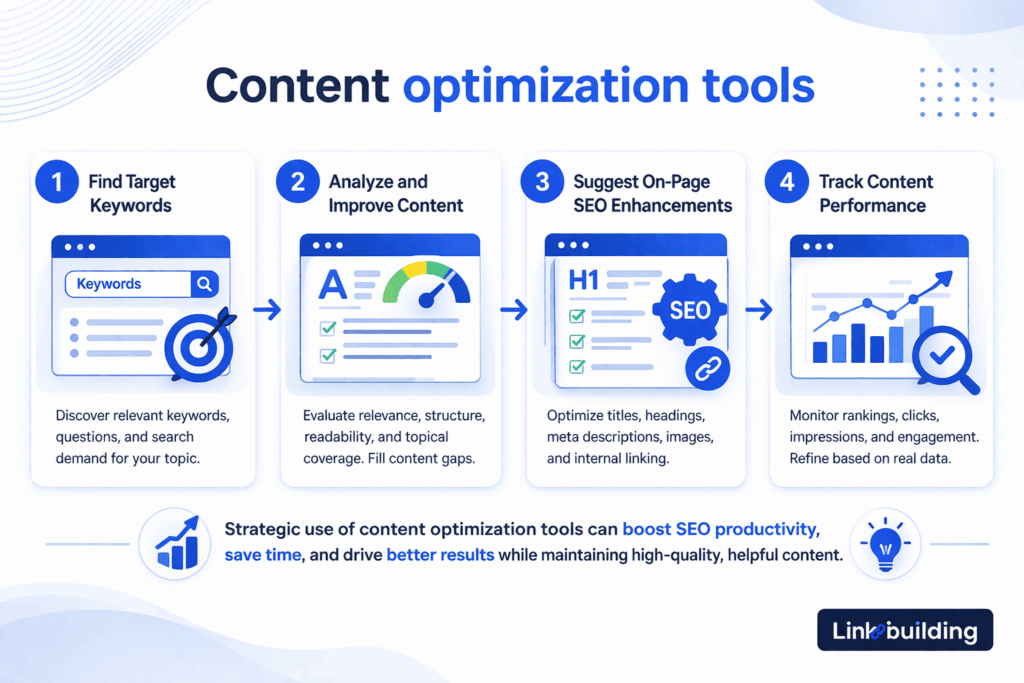
In practical terms, these tools assist with tasks such as:
- analyzing keyword relevance
- evaluating topical coverage
- identifying search intent gaps
- improving on-page SEO elements
- reviewing readability and structure
- suggesting internal links
- tracking performance after publication
Some tools are built specifically for SEO content optimization. Others are broader writing, analytics, or site-audit platforms that contribute to the same workflow.
The important point is that content optimization tools do not optimize content by themselves. They surface information, patterns, and recommendations. The actual optimization still depends on strategic judgment. A tool can tell you that a topic is missing from a draft. It cannot decide whether that topic actually belongs on the page or whether adding it would weaken focus.
Why Content Optimization Tools Matter
As content operations grow, it becomes harder to maintain quality and consistency through manual review alone. That is where content optimization tools can be useful.
They help identify gaps faster
Without tooling, it is easy to miss missing subtopics, weak internal links, thin sections, or pages that no longer match the current search landscape. Tools can speed up detection and give teams a more structured review process.
They improve workflow efficiency
Optimization is not only about writing. It also involves auditing, updating, linking, formatting, and measuring. Tools can reduce manual work and make those processes more repeatable.
They support better consistency across clusters
In a pillar-and-cluster model, content needs to stay aligned. A pillar page should be broad and navigational. A cluster page should remain focused. Content optimization tools can help teams maintain that structure by surfacing overlap, weak topic coverage, or missed linking opportunities.
They make performance review more practical
Good content work is iterative. Some pages need updates, some need rewrites, and some need stronger internal support. Tools can help teams see which pages deserve attention and where the opportunity is.
How Content Optimization Tools Work
Content optimization tools work by analyzing content against a set of signals, benchmarks, or performance indicators. The exact approach depends on the tool, but most fall into a few common categories.
Content scoring and topical analysis
Many optimization tools review a draft against ranking content for the target topic and highlight commonly covered subtopics, language patterns, and structural elements.
This can be useful, but it should be treated carefully. The goal is not to imitate search results mechanically. The goal is to understand the competitive baseline and decide which elements genuinely improve the page.
On-page SEO review
Some tools focus on page-level optimization. They help review titles, headings, metadata, keyword placement, image usage, and structural clarity.
These features are useful when they support a clear content strategy. They are less useful when they encourage checklists without context.
Readability and writing support
Writing tools often help with clarity, sentence complexity, repetition, and readability. These features can improve user experience, especially for pages that are dense or unclear.
Still, readability suggestions should be weighed against audience expectations. Professional readers do not need every topic reduced to overly simple phrasing.
Performance monitoring
Analytics and SEO platforms also function as content optimization tools when they help evaluate rankings, impressions, clicks, engagement, and page-level performance.
This matters because optimization should not stop at publication. Strong teams revisit content based on real outcomes, not just pre-publish recommendations.
Important Types of Content Optimization Tools
Not every tool serves the same purpose. It is usually better to think in categories than in brand names alone.
Keyword and topic research tools
These tools help identify target queries, supporting subtopics, search demand, and related language. They are useful early in the process when defining what a page should cover and how it fits into the cluster.
Content briefing and scoring tools
These are often used during drafting and editing. They can help writers understand topic expectations, structural gaps, and relevance signals. Their value depends heavily on whether the team uses them as guidance rather than as rigid rules.
On-page SEO tools
These tools review structural elements such as titles, headings, internal links, metadata, and page-level completeness. They are especially useful for auditing existing content and identifying missed fundamentals.
Site audit and internal linking tools
For larger sites, technical and structural tools can help find orphan pages, weak internal connections, duplicate themes, and pages that are poorly integrated into the topic architecture.
Analytics and performance tools
These tools help determine whether the page is actually working. They make it easier to identify content that should be refreshed, consolidated, rewritten, or further supported.
Common Mistakes When Using Content Optimization Tools
The problem is rarely the tool itself. The problem is how it gets used.
Treating tool recommendations as rules
A recommendation is not automatically a best practice. If a tool suggests adding more keywords, more headings, or more subtopics, those additions should still be judged against search intent and page focus.
Writing for the tool instead of the reader
This is one of the most common failures in SEO content production. Teams chase scores, density, or checklists and end up with content that feels mechanical. That may satisfy the interface, but it does not always satisfy the searcher.
Trying to cover everything
Some optimization tools encourage broad topic expansion. That can be useful on pillar pages, but harmful on cluster pages. A focused cluster page should not become bloated just because a tool suggests every related subtopic.
Ignoring site architecture
A page is not a standalone asset. Good optimization has to reflect the site structure. If tools are used without considering the broader pillar-and-cluster system, content may become repetitive or misaligned.
Overlooking human review
Strong SEO content still requires editorial judgment. Tools can support process, but they cannot replace experience, nuance, or business understanding.
Practical Guidance for Using Content Optimization Tools Well
The best way to use content optimization tools is to place them inside a broader content process rather than letting them define the process.
Start with strategy. Define the page’s role, target keyword, search intent, and position within the cluster. Then use tools to support that direction.
A practical workflow often looks like this:
- use research tools to understand the topic and query
- build a brief around intent and page purpose
- use optimization tools to review structure and topical completeness
- refine on-page elements and internal links
- publish and monitor performance
- revisit the page based on real data
This order matters because it keeps the strategy primary and the tooling secondary.
It is also worth separating tool use by page type. A pillar page may benefit from broader topic coverage analysis. A cluster page may benefit more from tighter relevance checks, internal linking support, and structural review.
Timing and Expectations
Content optimization tools can make teams faster and more consistent, but they do not create instant SEO wins.
Some improvements can have quick benefits, especially when tools help identify clear weaknesses in existing content. For example, fixing weak internal links, improving metadata, or clarifying structure may help relatively quickly. Broader gains from improved topical coverage or content refreshes may take longer.
It is also important to be realistic about what tools can and cannot do. They can improve workflows and support better decisions, but they do not guarantee rankings. Search performance still depends on competition, authority, intent alignment, content quality, and site structure.
Conclusion
Content optimization tools are useful when they help teams make better content decisions, not when they become the decision-maker.
At their best, they help identify gaps, improve workflow efficiency, support site structure, and make content refinement more practical. At their worst, they encourage generic writing, over-optimization, and content built around software prompts instead of user needs.
For websites building topical authority, that difference is critical. Tools should strengthen the pillar-and-cluster system, support clearer content roles, and help improve performance over time. But the real advantage still comes from strategy, editorial judgment, and a strong understanding of what the page needs to achieve.
That is how content optimization tools should be used: as support for better SEO thinking, not as a substitute for it.