

How to Build a Smarter SEO Improvement Process
Content rarely performs at its full potential the moment it is published. Some pages rank but attract the wrong audience. Others bring traffic without conversions. Some are useful but poorly structured, underlinked, or out of date. That is why strong SEO results usually depend less on single-page fixes and more on having a clear content optimization strategy.
A content optimization strategy gives structure to improvement. Instead of making random edits across the site, it helps you decide what to optimize, why it matters, what role each page plays, and how those changes support broader SEO goals. For websites built on a pillar-and-cluster model, this is especially important. Every page should not only perform individually, but also strengthen the wider topic system.
This article explains what a content optimization strategy is, why it matters, how it works, what supporting concepts shape it, and how to approach it in a practical way.
What Is a Content Optimization Strategy?
A content optimization strategy is a structured plan for improving existing and new content so it performs better in search and supports business goals more effectively.
In practical terms, that means deciding how to improve pages based on search intent, topic relevance, structure, internal linking, on-page SEO, and performance data. It is not just a list of edits. It is the framework behind those edits.
A good strategy answers questions such as:
- which pages matter most
- what each page is supposed to do
- where current content is underperforming
- which improvements should be prioritized
- how pages fit into the broader site architecture
This is what separates optimization from isolated tweaking. Updating a title tag or rewriting an intro may help, but those actions only become strategic when they are tied to a clear objective.
Why It Matters
Many websites publish regularly but still struggle to build consistent organic growth. The problem is often not a lack of effort. It is a lack of prioritization and structure.
It turns content into a system
Without a strategy, content often becomes fragmented. Pages overlap, topics are covered unevenly, and internal links develop randomly. A content optimization strategy helps turn the site into a more coherent topic network.
That matters in a cluster model because the strength of the whole structure depends on how well the pages support one another.
It improves resource allocation
Most teams do not have unlimited time to optimize everything. A strategy helps focus effort on pages with the greatest opportunity, whether that means improving rankings, reducing cannibalization, increasing conversions, or strengthening a topic cluster.
It supports better SEO outcomes
Search visibility improves when pages are clearer, more relevant, better structured, and better connected internally. A content optimization strategy helps address those areas consistently rather than leaving them to chance.
It connects SEO with business goals
Traffic alone is not the point. A strong optimization strategy looks at whether content supports leads, trust, authority, product understanding, or other meaningful business outcomes.
How a Content Optimization Strategy Works
A content optimization strategy works best when it starts with page purpose and site structure rather than isolated page edits.
Define the role of each page
Before changing anything, clarify what each page is meant to do.
Is it a pillar page that introduces a broad topic and links outward? Is it a focused cluster page targeting one informational query? Is it a more commercial page intended to move the user toward action?
Without that clarity, optimization often becomes inconsistent. Pages drift into overlapping topics, compete with each other, or miss the intent they should be serving.
Prioritize based on opportunity
Not every page deserves the same level of attention.
A practical strategy usually prioritizes pages that already show promise, such as those with impressions but weak clicks, pages ranking just outside strong visibility positions, pages with clear intent mismatches, or commercially valuable pages that underperform.
This prevents teams from spending too much time polishing low-impact content while higher-value opportunities are ignored.
Diagnose the real problem
Optimization should solve a defined issue.
A page may underperform because the search intent is wrong. Another may need stronger structure. Another may have good content but weak internal support. Another may need a rewrite because the topic has shifted or the page overlaps with another article.
The strategy becomes stronger when it identifies the real cause rather than assuming every page needs the same type of update.
Apply changes in a logical order
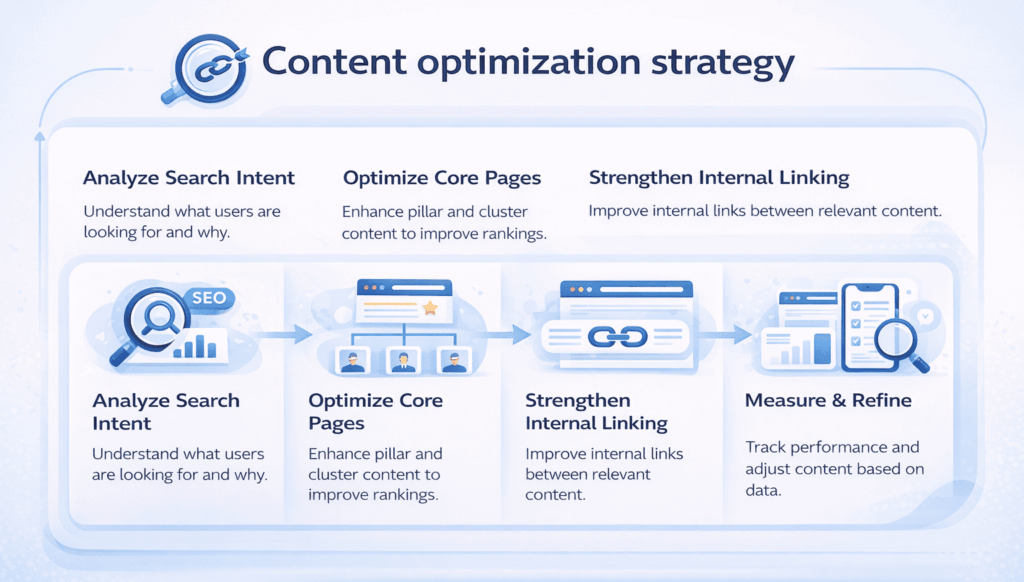
In most cases, content optimization is most effective when done in layers:
- confirm page role and target query
- fix intent mismatches
- improve structure and topical coverage
- refine on-page SEO elements
- strengthen internal links
- review conversion path where relevant
- monitor results and adjust
This sequence matters because small surface changes rarely solve deeper alignment problems.
Important Subtopics Within a Content Optimization Strategy
A good strategy depends on several related concepts working together.
Search intent
Search intent should shape the page before anything else. A well-written page can still fail if it answers the wrong version of the query.
If the user wants a practical explanation, the content should not read like a broad opinion piece. If the query suggests commercial investigation, the page may need clearer evaluation or next-step guidance.
Intent is one of the core filters in any optimization strategy.
Content hierarchy and site architecture
A content optimization strategy should reflect the site’s structure. On a pillar-and-cluster site, that means knowing how pages relate to one another.
The pillar page should provide broad coverage and connect to supporting content. Cluster pages should stay more focused and distinct. Optimization helps maintain that structure as the site grows.
Internal linking
Internal linking is not an afterthought. It is one of the main ways the strategy becomes visible on the site.
Pages should link in ways that reinforce topical relationships and help users continue naturally into related content. Weak internal linking often limits the value of otherwise strong pages.
Content quality and depth
Optimization is not just about metadata or formatting. It also depends on whether the page genuinely deserves to perform.
That means the content should be accurate, clear, sufficiently detailed for the intent, and written with real strategic understanding rather than thin summaries.
Performance review and content auditing
A content optimization strategy should include ongoing evaluation. Pages age, search results shift, and topic competition changes over time. Regular content audits help identify where further updates, consolidation, or pruning may be needed.
Common Mistakes
Many websites attempt optimization without a real strategy behind it. The same issues come up repeatedly.
Treating all pages the same
A pillar page and a cluster page should not be optimized the same way. Neither should an informational article and a commercial landing page. Strategy requires different standards for different page roles.
Focusing on keywords before intent
Keyword placement matters, but it is not the starting point. If the page is built around the wrong user need, keyword refinements will not solve the real issue.
Optimizing randomly
One of the biggest weaknesses in SEO programs is reactive editing. Teams change whatever looks weak without a framework for priority or consistency. That usually produces uneven results.
Ignoring overlap inside the cluster
As content libraries expand, pages can start competing with each other. A good strategy watches for this and keeps page roles distinct.
Measuring too narrowly
If success is judged only by ranking for one keyword, the strategy may miss broader improvements in traffic quality, assisted conversions, user flow, or topic authority.
Practical Guidance
A useful content optimization strategy does not have to begin with a full site overhaul. It can start with one topic cluster.
Review the pillar page and the supporting cluster articles around it. Identify which pages are central, which ones are outdated, which ones are underlinked, and which ones may be too thin or too broad. Then decide what kind of improvements would strengthen the cluster as a whole.
A practical review usually includes questions like these:
- What is this page supposed to do?
- Does it match the current search intent?
- Is the structure clear and useful?
- Does it support the right topic cluster?
- Is it stronger or weaker than related pages on the site?
- Does it need better internal links?
- Is it contributing to the business goal attached to that topic?
This process helps turn scattered updates into a genuine optimization plan.
It is also worth documenting standards. Clear guidance on page type, heading structure, internal linking, search intent, and update priority can make a content team far more consistent over time.
Timing and Expectations
A content optimization strategy can improve results, but the timeline depends on what is being changed and how strong the underlying site already is.
Some improvements can show impact relatively quickly, especially when the pages already have authority and the strategy corrects obvious issues such as weak internal linking, poor intent alignment, or shallow structure. Broader gains may take longer, particularly when the topic cluster itself needs to mature.
It is also important to remember that strategy is not the same as immediate output. A content optimization strategy improves how decisions are made. The actual SEO results come from applying it consistently over time.
Conclusion
A content optimization strategy is what makes SEO improvement scalable, focused, and consistent.
Instead of treating optimization as a series of disconnected edits, it gives structure to how pages are evaluated, prioritized, improved, and connected within the wider site architecture. That is especially valuable on websites using a pillar-and-cluster model, where the strength of the system depends on how well each page supports the whole.
Done well, a content optimization strategy improves more than rankings. It improves clarity, topic focus, internal structure, and the business value of the content itself.
That is the real goal. Not just better pages in isolation, but a stronger content system that can perform more reliably over time.