
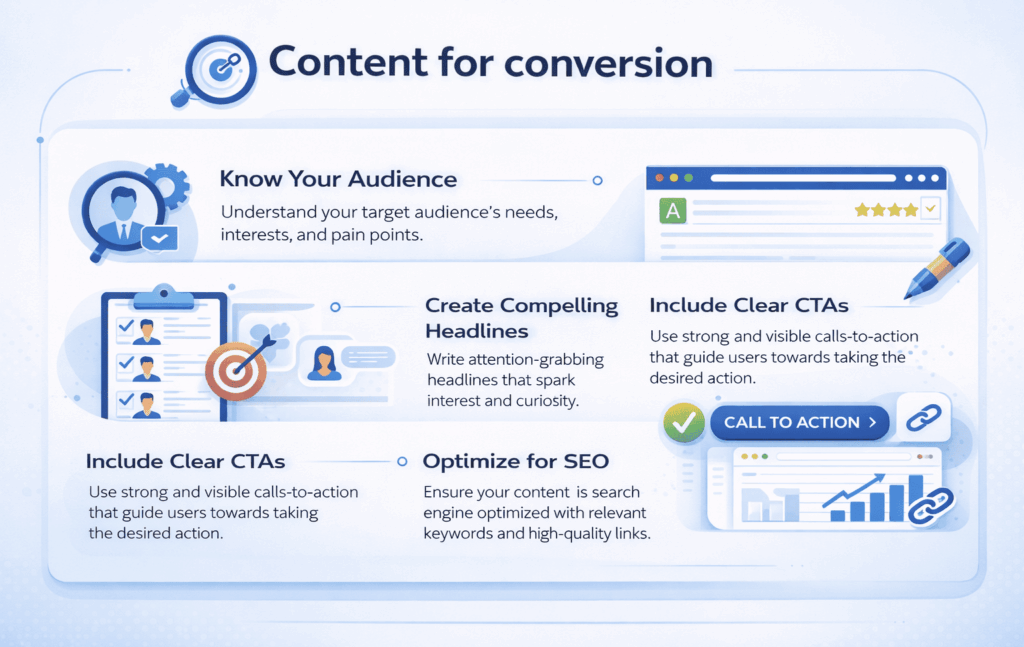

How to Create Content That Drives Action
A lot of content attracts traffic but does very little after the click. It may rank, get impressions, and even bring in qualified visitors, yet still fail to generate leads, sign-ups, demos, or sales conversations. That gap is usually not a traffic problem alone. It is often a conversion content problem.
Conversion content sits at the point where SEO, messaging, user intent, and business goals meet. It is not just content with a call to action added at the end. It is content designed to help the right visitor move one step closer to a meaningful decision.
For websites built on a pillar-and-cluster model, this matters more than many teams realize. Informational pages build visibility and topical authority, but not every page should stop at education. Some pages need to bridge the gap between attention and action. That is where conversion content becomes strategically important.
This article explains what conversion content is, why it matters, how it works, and how to create it without making the page feel sales-heavy or thin.
What Is Conversion Content?
Conversion content is content created to move a user toward a defined action.
That action might be a lead form submission, demo request, newsletter sign-up, consultation booking, product trial, or purchase. In some cases, the action is smaller, such as clicking deeper into a service page or downloading a resource. The specific goal depends on the business model and the role of the page.
In practical terms, conversion content is not simply promotional content. It still needs to be useful, relevant, and aligned with user intent. The difference is that it is built with a clearer commercial outcome in mind.
A strong conversion-focused page usually does three things at once:
- it answers the visitor’s question or concern
- it builds confidence and reduces friction
- it guides the reader toward the next logical step
That is why conversion content should not be confused with aggressive sales copy. Done well, it feels helpful and strategically persuasive, not pushy.
Why Conversion Content Matters
Many SEO strategies focus heavily on traffic growth, but traffic alone does not create business value. If content never helps users move closer to action, the site can become informative without becoming effective.
It connects SEO to business outcomes
SEO often succeeds at attracting visitors early in the decision process. Conversion content helps ensure that relevant traffic has a path forward.
Without that layer, the site may generate awareness but fail to turn interest into measurable business results.
It supports the middle and bottom of the funnel
Not every visitor is ready to convert immediately, but some are further along than broad informational content assumes. They may want proof, reassurance, practical specifics, or help evaluating options.
Conversion content serves those visitors better than purely educational pages.
It reduces wasted traffic
A page that brings in qualified visitors but gives them no clear next step often underperforms commercially. Conversion content reduces that waste by aligning the page more closely with user needs and business intent.
It strengthens content clusters
In a pillar-and-cluster structure, conversion content can play an important supporting role. Informational cluster pages build topic authority, while more commercially aligned pages help channel users toward action at the right point in the journey.
How Conversion Content Works
Conversion content works by matching the visitor’s level of intent and removing friction between interest and action.
Start with the user’s stage of awareness
A page only converts well when it speaks to the reader’s actual position in the journey.
Someone at the top of the funnel may need education and clarity before they are ready for any offer. Someone comparing options may need specificity, trust signals, and clearer differentiation. Someone close to action may need reassurance, proof, and a simple path to respond.
That means conversion content is not a single format. It changes depending on the query, the page type, and the likely user mindset.
Align the page with a clear goal
Every conversion page should have one primary action in mind.
If a page tries to push too many outcomes at once, it often weakens all of them. A service page might aim for consultation requests. A comparison page might aim for demo bookings. A case study might aim for contact clicks or related service-page visits.
A clear goal helps the structure, message, and calls to action stay consistent.
Build trust before asking for action
One of the biggest mistakes in conversion content is trying to convert before the page has earned trust.
Most visitors need a reason to believe the offer is relevant, credible, and worth their time. That is why strong conversion content includes useful explanation, proof, clarity, and a sense of practical realism before the CTA becomes central.
Reduce friction in the decision path
Conversion content should make the next step feel natural, not abrupt.
That can mean:
- explaining the problem clearly
- showing why the solution matters
- addressing common concerns
- clarifying what happens next
- making the action easy to understand
The best conversion pages do not just persuade. They reduce uncertainty.
Important Subtopics Within Conversion Content
Conversion content becomes much stronger when it is supported by a few related disciplines.
Search intent alignment
A page should match both SEO intent and business intent. If the query is informational, the page cannot behave like a hard sales page without creating friction. If the query has commercial investigation intent, the page should do more than educate.
Understanding that difference is essential.
Messaging and positioning
Even when traffic is relevant, weak positioning can reduce conversions. The page needs to make the value clear, explain why the offer matters, and differentiate the business in a credible way.
Calls to action
A CTA should fit the page. A high-commitment CTA on a low-intent informational page often performs poorly. A weak CTA on a commercially strong page leaves opportunity on the table.
Good calls to action feel like the logical next step, not an interruption.
Trust signals
Trust is a central part of conversion content. Depending on the page, that may come from examples, process clarity, testimonials, case studies, credentials, or realistic explanations of what the user can expect.
Common Mistakes
A lot of content misses its conversion potential because the strategy is too shallow or too aggressive.
Treating every page like a sales page
Not every page should convert in the same way. A cluster article targeting informational intent should not read like a product pitch. That usually harms both rankings and user trust.
Adding a CTA without changing the page strategy
A call to action alone does not create conversion content. If the page does not support the decision, the CTA is just decoration.
Ignoring search intent
Some pages fail because they try to force business goals onto a query that does not support them. Conversion content still has to satisfy the original reason the visitor arrived.
Being vague about the next step
Visitors are less likely to act when the page is unclear about what happens after the click or form fill. Ambiguity creates friction.
Overwriting the page with persuasion
Pages can become less effective when they are overloaded with claims, urgency, or generic selling language. Strong conversion content is persuasive because it is relevant and grounded, not because it sounds louder.
Practical Guidance
If you want to create better conversion content, start by identifying where it belongs in the cluster.
Not every page needs the same commercial weight. Some pages are meant to educate. Some should bridge the gap between education and action. Some should support direct conversion. That role should be clear before the page is written or revised.
Then review the page around a few practical questions:
- What is the visitor likely trying to solve here?
- How close are they to making a decision?
- What doubts or objections might they have?
- What action makes sense from this page?
- Does the page earn trust before asking for that action?
From there, improve the page in layers. First, strengthen intent alignment. Second, improve messaging and structure. Third, make the next step clearer. Fourth, add or refine trust signals and calls to action.
This usually produces better results than trying to “increase conversions” by only changing button copy or CTA placement.
Timing and Expectations
Conversion content can improve business performance, but results depend on more than the page alone.
Some improvements show quickly, especially when the page already attracts relevant traffic and the main issue is weak messaging or poor CTA alignment. In other cases, gains take longer because the content first needs stronger rankings, better intent alignment, or more trust-building support across the site.
It is also important to measure the right outcomes. A page may improve click-through to service pages before it improves direct lead volume. A cluster page may assist conversions rather than generate them directly. Those patterns still matter.
Conversion content should be judged in context, not only by last-click conversions.
Conclusion
Conversion content is the part of a content strategy that turns relevance into action.
It helps connect SEO traffic with real business outcomes by creating pages that do more than inform. They guide, reassure, clarify, and move the right visitor toward the right next step.
For websites building topical authority, that makes conversion content especially valuable. Informational pages build reach and trust. Conversion-focused pages help capture the value of that attention without undermining the quality of the content system.
Done well, conversion content does not feel like a sales detour. It feels like the natural next step for a visitor who is ready to move forward.