
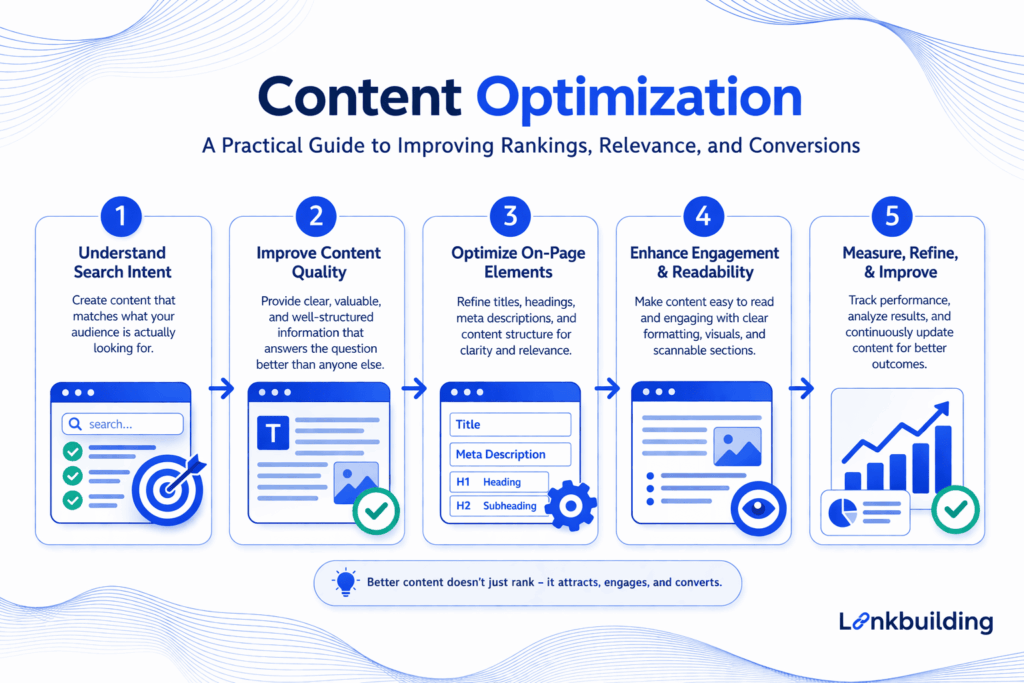

A Practical Guide to Improving Rankings, Relevance, and Conversions
Content optimization is one of the most misunderstood parts of SEO. Many websites publish regularly, target relevant keywords, and still struggle to earn consistent rankings or meaningful business results. The problem is rarely content volume alone. More often, it is a quality, structure, and relevance issue.
Strong content does not perform because it exists. It performs because it matches search intent, answers the right questions, fits into a clear site architecture, and signals topical authority over time. That is where content optimization becomes essential.
For businesses investing in organic growth, content optimization is not just about tweaking headings or adding keywords to a page. It is the process of improving existing and new content so it better satisfies users, aligns with search demand, supports internal linking, and contributes to measurable SEO outcomes.
This pillar page explains what content optimization is, why it matters, how it works in practice, and how to approach it strategically. It is designed to give you a broad foundation while also supporting deeper cluster articles on related topics such as keyword mapping, search intent, internal linking, content audits, on-page SEO, and topical authority.
What Is Content Optimization?
Content optimization is the process of improving a page so it performs better for both users and search engines.
In practical terms, that means refining content so it is more relevant to the target query, easier to understand, better structured, better aligned with search intent, and more useful than competing pages. It also means making sure the page fits the broader SEO strategy rather than existing as an isolated article.
A properly optimized page usually includes several elements working together:
- clear keyword targeting
- strong alignment with search intent
- logical headings and page structure
- comprehensive but focused topic coverage
- useful internal links
- clear calls to action where relevant
- solid on-page SEO fundamentals
- content depth appropriate to the query
Content optimization is not the same as keyword stuffing or surface-level editing. It is not about forcing a primary phrase into every paragraph. It is about improving the usefulness, clarity, and strategic value of a page.
On a site using a pillar-and-cluster model, content optimization also helps each page play a defined role. A pillar page should cover a topic broadly and support internal links to detailed cluster articles. A cluster page should go deeper on one subtopic without drifting into a generic overview. Optimization helps maintain that distinction.
Why Content Optimization Matters
Publishing content without optimization often leads to underperformance. Pages may be indexed, but they do not rank well, attract the wrong audience, or fail to convert.
Content optimization matters because it improves several core areas of website performance.
Better alignment with search intent
Search engines increasingly reward pages that closely match what users actually want. A page can target the right keyword and still fail if it does not satisfy the underlying intent.
For example, someone searching for content optimization is usually looking for a strategic explanation, practical guidance, and a framework they can apply. They are not looking for a thin glossary definition or a generic sales pitch. Optimizing content around that expectation increases the likelihood of stronger rankings and better engagement.
Stronger topical authority
A website does not build authority by covering topics randomly. It builds authority by covering a subject thoroughly and logically. Content optimization helps connect related pages into a coherent structure.
A strong pillar page on content optimization should naturally support related cluster content such as:
- content audit processes
- search intent analysis
- keyword research and keyword mapping
- on-page SEO best practices
- content briefs
- internal linking strategy
- content pruning and refresh workflows
- measuring content performance
This structure helps users navigate the topic and helps search engines understand the site’s expertise.
Improved rankings and organic traffic
Pages that are more relevant, better structured, and better connected internally tend to perform more consistently in search. Optimization helps improve keyword relevance, crawlability, user engagement signals, and overall content quality.
That does not mean every optimized page will immediately rank at the top. SEO is still competitive. But optimized content gives a page a far better chance than content that was published once and never refined.
Better conversion potential
Traffic alone is not the goal. For many websites, the real value comes from leads, demos, inquiries, sign-ups, or assisted conversions.
Optimized content helps by bringing in more qualified visitors and guiding them more effectively. That might mean better internal links to service pages, clearer positioning, stronger examples, or more persuasive but still realistic calls to action.
How Content Optimization Works
Content optimization is most effective when approached as a structured process rather than a one-time editing task.
Start with the page’s role
Before adjusting a page, define what it is supposed to do.
Is it a pillar page meant to cover a broad topic and link to related subtopics? Is it a cluster page targeting one specific keyword? Is it a commercial page supporting service intent? Is it an informational article intended to attract top-of-funnel traffic?
Without that clarity, optimization often becomes unfocused. Pages end up trying to rank for too many things at once.
For this topic, the page role is clear: this is a pillar page. That means it should provide a strong overview of content optimization while leaving room for dedicated supporting articles to go deeper into specific subtopics.
Clarify primary keyword and intent
Every page needs a clear main target. Here, the primary keyword is content optimization, with informational and commercial intent.
That combination matters. It means readers want to understand the topic, but many are also evaluating whether they need professional help, better processes, or more advanced SEO guidance. The content should educate first, while still showing strategic depth and business relevance.
Analyze the current SERP landscape
Before writing or revising a page, study what currently ranks. This helps identify what search engines are rewarding for that query.
Look at:
- the dominant intent behind top-ranking pages
- how broad or narrow the topic coverage is
- the types of subtopics commonly included
- the depth of explanation
- content format and structure
- commercial signals on ranking pages
This does not mean copying competitors. It means understanding the market standard and then deciding how to create something more useful, clearer, or more strategically grounded.
Improve topical coverage without losing focus
One common optimization mistake is shallow coverage. Another is over-expansion.
A good page covers the topic fully enough to satisfy intent, but it stays disciplined. A pillar page should be broad, but it still needs structure. It should introduce key related concepts and link out to deeper resources rather than trying to become an encyclopedia.
For content optimization, that means covering essential areas such as search intent, on-page elements, content quality, internal linking, measurement, and common errors. It does not mean turning the page into a general explanation of every SEO tactic.
Refine structure and readability
Even expert content fails when the page is hard to follow. Structure matters because it affects both usability and search performance.
Good optimization typically includes:
- a clear H1 that matches the topic
- H2s that reflect major subtopics
- H3s only where they improve clarity
- short to medium paragraphs
- strong topic transitions
- plain but professional language
- clear progression from concept to application
This is especially important on pillar pages, where the scope is naturally broader.
Important Subtopics Within Content Optimization
Content optimization is not a single tactic. It sits at the intersection of several related disciplines.
Search intent optimization
Search intent should shape the page before keywords are placed into headings. If the intent is wrong, other improvements only have limited value.
A page targeting an informational query should educate clearly. A page targeting a commercial investigation query should compare options, frameworks, or solutions. A transactional page should reduce friction and support decision-making.
Understanding intent is one of the most important supporting skills in content optimization.
On-page SEO
On-page SEO provides the technical and structural foundation for content performance.
This includes elements such as title tags, meta descriptions, headings, URL structure, image alt text, and internal links. But these elements only work well when they reinforce a genuinely strong page. On-page SEO cannot rescue weak, misaligned content.
Internal linking
Internal linking is often treated as an afterthought, but it plays a major role in content optimization.
A well-optimized page should link naturally to relevant supporting articles, related commercial pages, and adjacent resources. On a pillar-and-cluster site, internal linking helps distribute authority, clarify topic relationships, and improve user journeys.
A pillar page on content optimization might link to cluster pages about content audits, keyword mapping, content refresh strategy, internal linking best practices, and content briefs. Those cluster pages should also link back to the pillar page where appropriate.
Content quality and depth
Depth is not the same as length. A page becomes valuable when it answers important questions with clarity, context, and strategic understanding.
Thin content often fails because it defines a term without helping the reader act on it. Strong content explains not just what something is, but how it works, why it matters, where it fits into broader strategy, and what mistakes to avoid.
Content updating and re-optimization
Optimization is not only for new pages. In many cases, the fastest SEO gains come from improving content that already exists.
That may involve:
- updating outdated examples
- improving search intent alignment
- strengthening weak sections
- consolidating overlapping content
- refining internal links
- adding missing subtopics
- improving conversions without compromising trust
A mature SEO strategy always includes re-optimization, not just new production.
Common Mistakes in Content Optimization
Many websites invest in content but optimize it poorly. The same patterns appear repeatedly.
Focusing too much on keywords and not enough on usefulness
Keywords still matter, but they are not the strategy by themselves. Pages that mechanically repeat a target phrase often feel unnatural and perform poorly.
The better approach is to build the page around the topic, intent, and user need, then use the primary keyword naturally where it belongs.
Trying to rank one page for too many intents
A page that attempts to be informational, transactional, navigational, and comparative all at once usually becomes unfocused. Content optimization requires restraint.
Each page should have one dominant intent, even if secondary elements are present.
Writing broad content with no strategic position
Many articles explain a topic in generic terms but offer no real perspective. They say what content optimization is, but not how a serious business should approach it, what usually goes wrong, or how it fits into site architecture.
That kind of content may be technically correct, but it rarely stands out.
Ignoring internal links
Pages that are not well integrated into the rest of the site are harder for both users and search engines to interpret. Optimization should always include a review of inbound and outbound internal links.
Measuring success too early
Content rarely reaches full performance immediately. Rankings can shift, indexing can take time, and competitive queries often require authority to build. Judging a page too quickly leads to unnecessary rewrites or poor strategic decisions.
Practical Guidance for Doing Content Optimization Well
A strong content optimization workflow is systematic.
Start by reviewing your site architecture. Make sure each important topic has a logical place in the pillar-and-cluster structure. Then evaluate whether each page has a clear target keyword, clear intent, and a defined role.
Next, prioritize pages based on business value and SEO opportunity. Some pages deserve immediate attention because they already rank on page two, attract impressions without clicks, or target commercially valuable queries.
Then optimize in layers:
- fix intent mismatches first
- improve structure and clarity
- strengthen topical coverage
- refine on-page SEO elements
- improve internal linking
- review conversion paths
- monitor performance and iterate
This order matters. There is little value in polishing metadata if the page fundamentally misses the query.
For teams producing content at scale, consistency is important. Use briefs, content standards, and optimization checklists. But do not turn the process into formulaic writing. The goal is strategic consistency, not identical pages.
Timing and Expectations
Content optimization can improve performance, but it is not instant.
Small changes to already indexed pages may show results relatively quickly, especially if the page already has some authority and relevance. More competitive topics may take longer, particularly when stronger authority signals or broader site improvements are needed.
It is also important to separate indexing from ranking and ranking from business impact. A page may be crawled quickly but still need time to stabilize. It may gain traffic before it improves conversions. It may rank better only after related cluster pages and internal links are strengthened.
Realistic SEO work is iterative. Optimization improves probability and performance over time. It does not guarantee immediate outcomes.
Conclusion
Content optimization is not a cosmetic SEO task. It is a strategic discipline that improves how content serves users, supports search visibility, and contributes to business goals.
At its best, it helps a website do three things well: publish with purpose, build topical authority, and improve performance over time. That requires more than adding keywords or refreshing dates. It requires strong intent analysis, sound structure, useful depth, clear internal linking, and a realistic understanding of how SEO actually works.
For websites using a pillar-and-cluster model, content optimization is what turns content from a collection of articles into a coherent authority system. The pillar page defines the topic landscape. Cluster pages deepen specific subtopics. Internal links connect the whole structure. Optimization makes each part stronger and makes the whole system more effective.
Done well, content optimization does not make content look more optimized. It makes it more useful, more relevant, and more competitive. That is what search engines increasingly reward, and it is what serious businesses should aim for.