
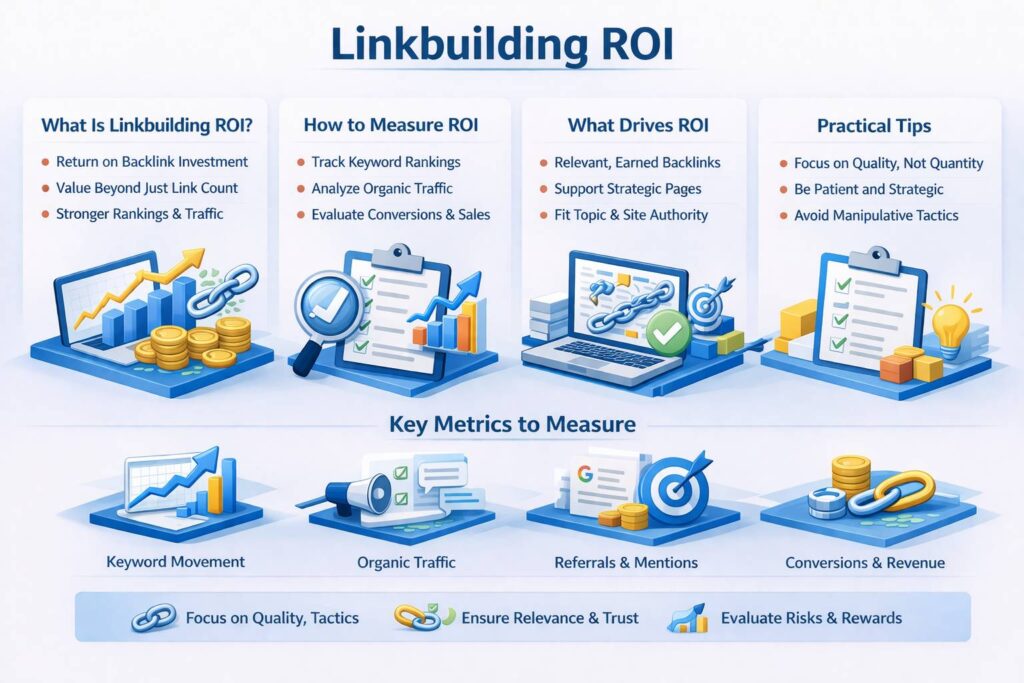

Linkbuilding ROI: How to Measure It and What Makes It Worth the Investment
Linkbuilding ROI is the return a business gets from the time, budget, and effort invested in earning backlinks. In theory, the idea sounds simple: spend money on linkbuilding, gain stronger rankings and more traffic, and generate more revenue than the campaign cost. In practice, linkbuilding ROI is more difficult to measure than many other marketing metrics because backlinks rarely create value in a straight line.
That complexity is exactly why this topic matters. Businesses often invest in linkbuilding without a clear framework for judging whether it is working. They may count links, reports, placements, or domain metrics, but still struggle to answer the real question: is this investment improving organic performance in a way that justifies the cost?
The answer depends on how linkbuilding supports the wider SEO system. Backlinks do not work in isolation. They interact with content quality, internal linking, topical relevance, technical SEO, competition, and page intent. That means linkbuilding ROI should not be measured only by the number of links acquired. It should be measured by whether those links strengthen important pages, improve visibility, attract qualified traffic, and contribute to meaningful business outcomes over time.
This article explains what linkbuilding ROI is, why it matters, how to measure it, which signals are most useful, what mistakes to avoid, and how to think about ROI realistically in a pillar-and-cluster SEO model. It follows the supplied writing and structure guidance for an informational cluster page.
What Is Linkbuilding ROI?
Linkbuilding ROI is the return on investment generated by linkbuilding activity.
At the most basic level, ROI is usually understood as:
(Return – Cost) / Cost
In SEO, however, the “return” side is rarely immediate or simple. A backlink campaign may influence rankings, organic traffic, brand visibility, referral traffic, authority signals, and revenue potential, but not all of those effects appear at the same time.
That is why linkbuilding ROI should be understood as a combination of direct and indirect outcomes, such as:
- stronger rankings for strategic pages
- more qualified organic traffic
- increased conversions from organic visits
- better visibility for priority topics
- improved authority for a wider content cluster
- referral traffic from placements
- long-term value from pages that continue earning links
In practical terms, linkbuilding ROI is not just “how much did one backlink make?” It is “did this linkbuilding investment improve the site’s performance in a way that exceeded its cost?”
Why Linkbuilding ROI Matters
Linkbuilding ROI matters because linkbuilding is resource-intensive. It takes budget, time, content, outreach, and management. Without a way to evaluate return, it becomes easy to confuse activity with progress.
It helps separate outputs from outcomes
One of the biggest problems in SEO reporting is mistaking deliverables for value. A team may acquire links, publish reports, or send outreach emails, but those are outputs. ROI depends on outcomes.
A campaign is not automatically successful because links were built. It is successful if the links contribute to stronger organic performance or meaningful commercial value.
It improves budget decisions
When a business understands linkbuilding ROI, it becomes easier to decide how much to invest, which pages deserve support, and which tactics are worth continuing.
This is especially important because some linkbuilding methods are expensive but effective, while others are cheap but strategically weak.
It supports long-term SEO thinking
SEO often underperforms when teams focus too heavily on short-term numbers. Linkbuilding ROI encourages a broader view. A strong backlink profile can support a page for months or years, and its value may spread across related pages through internal linking.
That matters in a pillar-and-cluster structure, where one well-supported page can help reinforce the wider topic architecture.
It helps avoid bad incentives
When linkbuilding is judged only by link count, teams may chase lower-quality placements to hit a target. When it is judged by ROI, quality and impact matter more than raw volume.
How Linkbuilding ROI Works
Linkbuilding ROI works by connecting backlink acquisition to measurable SEO and business outcomes.
Start with the page being supported
The first step in understanding ROI is identifying which page the links are meant to support.
A backlink to a weak or low-priority page may have limited commercial value even if the link itself looks strong. A backlink to a strategically important page can be much more valuable if that page targets meaningful queries, fits the site structure, and supports wider internal linking.
This is why linkbuilding ROI begins with page strategy, not with outreach.
Measure ranking and visibility changes
One of the clearest ways to evaluate linkbuilding ROI is to track whether supported pages improve in visibility over time.
That can include:
- ranking movement for target keywords
- visibility growth across a topic cluster
- stronger performance for high-intent pages
- improved ranking stability in competitive SERPs
This does not mean every ranking improvement comes from links alone. But if a page receives relevant backlinks and its search visibility improves meaningfully, that is an important part of the ROI picture.
Connect organic traffic to business value
Rankings matter because they can lead to traffic. Traffic matters because it can create business value.
A practical ROI model usually asks:
- Did supported pages gain more organic sessions?
- Was that traffic relevant?
- Did it contribute to leads, sales, demos, signups, or assisted conversions?
For informational pages, the value may not always be immediate revenue. Sometimes the return is in attracting qualified visitors who later convert through another page or stage in the journey.
Include referral and brand value where relevant
Some backlinks generate direct referral traffic or stronger brand exposure. That may not be the core value of every placement, but it should not be ignored.
A link from a relevant publication may contribute through:
- referral visits
- branded search growth
- trust and authority
- further earned links over time
That is why linkbuilding ROI should not be measured too narrowly.
Important Subtopics Within Linkbuilding ROI
Cost side of ROI
To measure linkbuilding ROI properly, you need a realistic view of cost. That includes more than just the price of a placement or vendor invoice.
Cost may include:
- content creation
- design work
- prospecting
- outreach
- relationship management
- tools
- internal team time
- agency fees
This matters because ROI becomes distorted when the true cost is understated.
Assisted value
Not all value from linkbuilding is direct. A backlink may help a page rank better, which then supports other pages through internal links. Or it may introduce visitors who convert later through branded search or a separate commercial page.
That assisted value is real, even when it is harder to attribute precisely.
Time lag
Linkbuilding ROI often has a delay. A link is acquired first, then crawled, then processed, then reflected through rankings over time. This makes measurement harder than channels with immediate click-to-conversion paths.
That delay is one reason expectations need to be realistic.
Page role in the site structure
A cluster page and a pillar page may produce different kinds of ROI. A cluster page might bring targeted informational traffic and support internal links to commercial pages. A pillar page may build broader topical authority and attract more backlinks over time.
So ROI should be judged relative to page purpose, not by one rigid standard.
Common Mistakes
Measuring only link quantity
A campaign that earns many weak links may look productive in a report while producing little real return. Linkbuilding ROI depends more on relevance and impact than on raw numbers.
Expecting immediate revenue from every page
Some pages contribute indirectly. Informational content may generate visibility, trust, and assisted conversions rather than immediate sales.
Ignoring the cost of execution
If content, outreach, and management time are not counted, ROI calculations become misleading.
Attributing all growth to links alone
Links matter, but they do not operate in isolation. Content quality, technical SEO, internal linking, and intent alignment also affect performance. ROI should be evaluated with that nuance in mind.
Supporting the wrong pages
A strong backlink campaign attached to a weak or misaligned page often underdelivers. Strategic page selection is a major part of ROI.
Practical Guidance for Measuring Linkbuilding ROI Well
A practical way to measure linkbuilding ROI is to work in stages.
First, identify which pages or topic clusters matter most commercially or strategically.
Second, define the cost of supporting those pages through linkbuilding. Include both direct spending and internal effort.
Third, track the outcomes that matter most for that page type. For an informational cluster page, that may include rankings, organic traffic, assisted conversions, referral traffic, and internal support for nearby pages. For a more commercial page, revenue impact may be easier to observe directly.
Fourth, evaluate performance over a realistic time frame. Linkbuilding ROI is often clearer over months than over days or weeks.
Finally, compare the campaign not just against its own link totals, but against the broader SEO value it created. Did it strengthen the page? Did it improve the cluster? Did it support the pillar? Did the traffic it helped attract have commercial relevance?
That kind of evaluation fits much better with a structured content model than simplistic “cost per link” thinking.
Timing and Expectations
Linkbuilding ROI is rarely immediate. Some links may produce visible movement faster than others, especially if they support a page that already has quality content and a realistic ranking opportunity. But in most cases, the return develops gradually.
That is because linkbuilding contributes to SEO performance over time. Pages need to be crawled, rankings need to shift, competitors may respond, and traffic patterns take time to stabilize.
It is also important to set realistic expectations about attribution. A business may not always be able to trace one backlink directly to one sale. That does not mean the investment had no return. It means linkbuilding ROI often needs to be assessed through a mix of leading and lagging indicators.
Conclusion
Linkbuilding ROI is the measure of whether the value created by backlinks exceeds the cost of earning them. The concept sounds simple, but the real assessment requires more than counting links or watching one ranking chart.
The strongest way to evaluate linkbuilding ROI is to connect backlinks to page importance, search visibility, qualified traffic, assisted business value, and the wider role the page plays inside the site’s architecture. In a pillar-and-cluster model, that matters even more because a single strong page can support other pages through internal linking and topic authority.
That is the strategic takeaway. Linkbuilding ROI is not about asking whether a link was expensive or cheap. It is about asking whether the investment helped build durable organic value. For serious SEO, that is the metric that matters most.